

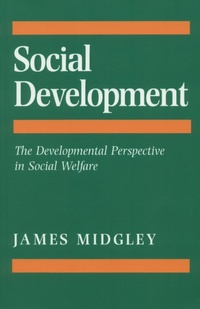
Social Development
The Developmental Perspective in Social Welfare
1st Edition
Published on 3. August 1995
208 pages
978-1-4462-3287-3 (ISBN)
Description

The social development approach seeks to integrate economic and social policies within a dynamic development process in order to achieve social welfare objectives. This first comprehensive textbook on the subject demonstrates that social development offers critically significant insights for the developed as well as the developing world.
James Midgley describes the social development approach, traces its origins in developing countries, reviews theoretical issues in the field and analyzes different strategies in social development. By adding the developmental dimension, social development is shown to transcend the dichotomy between the residualist approach, which concentrates on targeting resources to the most needy, and the institutional approach which urges extensive state involvement in welfare.
James Midgley describes the social development approach, traces its origins in developing countries, reviews theoretical issues in the field and analyzes different strategies in social development. By adding the developmental dimension, social development is shown to transcend the dichotomy between the residualist approach, which concentrates on targeting resources to the most needy, and the institutional approach which urges extensive state involvement in welfare.
Reviews / Votes
`This is an excellent and exciting book which makes a compelling case for social development. It more than succeeds in its objective of providing a comprehensive overview of the field of social development. Midgley has provided a wide-ranging and masterly synthesis of a diverse range of ideas and strategies and argued expertly for the advantages offered by social development. It is a book which deserves to be read by all who are interested in development studies, social policy and social work. It will be of value both to academics and practitioners who will find it both interesting and stimulating' - International Social Work`Midgley's new book is a timely addition to social work literature in South Africa when the role of social work in reconstruction and development is being widely discussed and debated. Midgley's message is simple and clear: there can be no social development without economic development.... Midgley provides a comprehensive discussion of theoretical debates surrounding social development.... [a] valuable addition to our social work literature' - Social Work
`Systematic and thorough.... This book can be recommended for university Development Studies teaching' - Development Policy Review
`Indeed, an ideal textbook for students of social policy, social work and public administration as the cover notes argue, but is also a considered theoretical contribution to the debate..... Midgley's practical experience [shows] and the analysis is grounded and exudes common sense.... It tries to be even-handed and is certainly comprehensive. Midgley is probably more aware of Third World approaches than many mainstream Western writers' - Third World Planning Review
`[A] very solid treatise on social development.... It is a very tight package filled with fundamental information and written very well.... Midgley... has constructed an excellent book that will serve to enhance the dialogue and debate of this important perspective. Midgley's book, in less than 200 pages and encompassing an introduction and five chapters, manages to take his reader through what I think is an impressive, comprehensive overview of the social development perspective.... All of this is followed by a very extensive reference section that in itself is an added bonus.... Midgley's book is a significant edition in the social development literature, both for what it manages to bring together in a concise volume as well as for its readability... and one that brings a vital perspective to our current times' - Social Development Issues
More details
Edition
1. Auflage
Language
English
Place of publication
London
United Kingdom
Target group
College/higher education
Product notice
Reflowable
ISBN-13
978-1-4462-3287-3 (9781446232873)
Copyright in bibliographic data and cover images is held by Nielsen Book Services Limited or by the publishers or by their respective licensors: all rights reserved.
Schweitzer Classification
Other editions
Additional editions
Book
08/1995
1st Edition
SAGE Publications Inc
€118.80
Shipment within 15-20 days
Book
08/1995
1st Edition
SAGE Publications Inc
€220.20
Shipment within 15-20 days
Person
James Midgley is the Harry and Riva Specht Professor of Public Social Services and Dean Emeritus at the University of California, Berkeley. Originally from South Africa, he studied at the University of Cape Town and the London School of Economics and held academic appointments at both universities before moving to the United States 1985 where he served as as Dean of the School of Social Work and Associate Vice Chancellor for Research at Louisiana State University. He accepted the appointment as Specht Professor and Dean of the School of Social Welfare Berkeley in 1997.
He has published widely on issues of social development, social policy, social work and international social welfare. His major books include Professional Imperialism: Social Work in the Third World. Heinemann, 1981; Social Security, Inequality and the Third World, Wiley, 1984; Comparative Social Policy and the Third World, Harvester, 1987 (with Stewart MacPherson); The Social Dimensions of Development: Social Policy and Planning in the Third World, Gower, 1989 (with Margaret Hardiman); Social Development: The Developmental Perspective in Social Welfare, Sage, 1995; Social Welfare in Global Context, Sage, 1997; Social Policy for Development, Sage, 2004 (with Anthony Hall) and Social Development: Theory and Practice, Sage, 2014.
In addition, he has edited or co-edited many books on international social welfare and social development. Among the most recent are Social Work and Social Development: Theories and Skills for Developmental Social Work, Oxford University Press, 2010 (with Amy Conley); Social Policy and Poverty in East Asia: The Role of Social Security, Routledge, 2010 (with K. L. Tang); Grassroots Social Security in Asia, Routledge, 2011 (with Mitsuhiko Hosaka); Colonialism and Welfare: Social Policy and the British Imperial Legacy. Edward Elgar, 2011 (with David Piachaud); Planning and Community Development: Case Studies. Madrid: Technical University of Madrid, GrupoGESPLAN-UPM, 2012 (with Adolfo Carzola); Social Protection, Economic Growth and Social Change: Goals, Issues and Trajectories in China, India, Brazil and Africa. Edward Elgar, 2013 (with David Piachaud); Social Protection in Southern Africa: New Opportunities for Social Development. Routledge, 2014 (with Leila Patel and Marian Ulricksen) and Social Policy and Social Change in East Asia. Lexington Books, 2014 (with James Lee and Yapeng Zhu).
He is a Fellow of the American Academy of Social Work and Social Welfare and holds Honorary Professorial appointments at the University of Johannesburg in South Africa, Nihon Fukushi University in Japan, Sun Yat-sen University in China and the Hong Kong Polytechnic University.
He has published widely on issues of social development, social policy, social work and international social welfare. His major books include Professional Imperialism: Social Work in the Third World. Heinemann, 1981; Social Security, Inequality and the Third World, Wiley, 1984; Comparative Social Policy and the Third World, Harvester, 1987 (with Stewart MacPherson); The Social Dimensions of Development: Social Policy and Planning in the Third World, Gower, 1989 (with Margaret Hardiman); Social Development: The Developmental Perspective in Social Welfare, Sage, 1995; Social Welfare in Global Context, Sage, 1997; Social Policy for Development, Sage, 2004 (with Anthony Hall) and Social Development: Theory and Practice, Sage, 2014.
In addition, he has edited or co-edited many books on international social welfare and social development. Among the most recent are Social Work and Social Development: Theories and Skills for Developmental Social Work, Oxford University Press, 2010 (with Amy Conley); Social Policy and Poverty in East Asia: The Role of Social Security, Routledge, 2010 (with K. L. Tang); Grassroots Social Security in Asia, Routledge, 2011 (with Mitsuhiko Hosaka); Colonialism and Welfare: Social Policy and the British Imperial Legacy. Edward Elgar, 2011 (with David Piachaud); Planning and Community Development: Case Studies. Madrid: Technical University of Madrid, GrupoGESPLAN-UPM, 2012 (with Adolfo Carzola); Social Protection, Economic Growth and Social Change: Goals, Issues and Trajectories in China, India, Brazil and Africa. Edward Elgar, 2013 (with David Piachaud); Social Protection in Southern Africa: New Opportunities for Social Development. Routledge, 2014 (with Leila Patel and Marian Ulricksen) and Social Policy and Social Change in East Asia. Lexington Books, 2014 (with James Lee and Yapeng Zhu).
He is a Fellow of the American Academy of Social Work and Social Welfare and holds Honorary Professorial appointments at the University of Johannesburg in South Africa, Nihon Fukushi University in Japan, Sun Yat-sen University in China and the Hong Kong Polytechnic University.
Content
Introduction
A Definition of Social Development
The Historical Context
Theoretical Debates
Strategies for Social Development
Achieving Social Development
The Institutional Perspective
A Definition of Social Development
The Historical Context
Theoretical Debates
Strategies for Social Development
Achieving Social Development
The Institutional Perspective
