

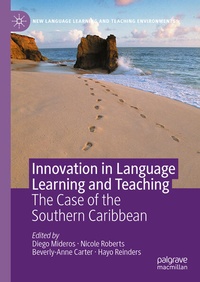
Innovation in Language Learning and Teaching
Description

This book presents a unique perspective from an underrepresented region in the Global South. The volume features four different countries in the region: Barbados, Guyana, St. Lucia, and Trinidad and Tobago, as well as Martinique, an island located just north of St. Lucia which is an overseas region of France. It documents innovations in learning and teaching Spanish, French, and Chinese in the case of the English-speaking countries, and English as a foreign language (EFL) in the case of Martinique. The chapters cover different aspects of language education in the Caribbean and will be of particular interest to those involved in managing change in language education that attempts to mediate between global trends and local needs.
Reviews / Votes
"The innovations and experiences presented provide valuable and detailed first-hand perspectives, guidance, and analysis . . this book will be a crucial resource for teachers and scholars in all areas of language pedagogy and practice, including the teaching and learning of specialised languages, translator and interpreter training etc. . those considering embarking on research in the domain, will find this volume a fount of inspiration for further innovative work on language learning and teaching across the Caribbean and elsewhere." (Antony Hoyte-West, English Studies at NBU, Vol. 9 (2), 2023)More details
Other editions
Additional editions
Persons
Diego Mideros is a lecturer in Spanish at The University of the West Indies, Trinidad and Tobago. He coordinates the non-specialist Spanish language courses at the university's Centre for Language Learning. His interests are learner autonomy, out-of-class learning, identity in language learning, and qualitative approaches to L2 research.
Nicole Roberts is a senior lecturer in Spanish and the Acting Director, Centre for Language Learning, The University of the West Indies, Trinidad and Tobago. She has published on social and socio-cultural factors which impact reading comprehension and writing in Spanish as well as the importance of study abroad on FL acquisition.
Beverly-Anne Carter is a retired Professor of Applied Languages and Director (2005-2022) of the Centre for Language Learning, St. Augustine Campus of The University of the West Indies, Trinidad and Tobago. She has published in the areas of learner autonomy in language learning, foreign language pedagogy and methodology, and language policy and planning.
Hayo Reinders (www.innovationinteaching.org) is TESOL Professor and Director of Research at Anaheim University, USA, and Professor of Applied Linguistics at KMUTT in Thailand. He is founder of the Global Institute for Teacher Leadership and editor of Innovation in Language Learning and Teaching. His interests are in out-of-class learning, technology, and language teacher leadership.
