

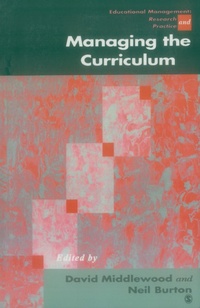
Managing the Curriculum
1st Edition
Published on 28. April 2001
224 pages
978-1-4462-3219-4 (ISBN)
Description

`Each chapter in the book is firmly rooted in research and is well referenced as one would expect of such a book. It will be of particular use to people with an academic interest in this aspect of school management but will also be thought-provoking for those who are involved in the development of the curriculum within their institution' - escalate
This book explores many of the new aspects of the core business of schools and colleges, that is, the curriculum. Keeping the focus clearly on learning and teaching, the contributors explore the practical issues for managers at institutional level, within the context of their need to understand and analyze key educational values and principles. Part One presents overviews of theories and models of curriculum, while Part Two examines how these are applied through planning, monitoring and evaluating. Part Three explores in detail the various managerial roles within schools and colleges from leaders to those responsible for cross-curriculum work and special educational needs. The fourth part discusses the importance of effectively managing resources for the curriculum - the environment, support staff and finance.
Contributors use empirical research evidence to analyze current curriculum trends whilst proposing various new models which are likely to emerge in the 21st century.
This book explores many of the new aspects of the core business of schools and colleges, that is, the curriculum. Keeping the focus clearly on learning and teaching, the contributors explore the practical issues for managers at institutional level, within the context of their need to understand and analyze key educational values and principles. Part One presents overviews of theories and models of curriculum, while Part Two examines how these are applied through planning, monitoring and evaluating. Part Three explores in detail the various managerial roles within schools and colleges from leaders to those responsible for cross-curriculum work and special educational needs. The fourth part discusses the importance of effectively managing resources for the curriculum - the environment, support staff and finance.
Contributors use empirical research evidence to analyze current curriculum trends whilst proposing various new models which are likely to emerge in the 21st century.
Reviews / Votes
`Each chapter in the book is firmly rooted in research and is well referenced as one would expect of such a book. It will be of particular use to people with an academic interest in this aspect of school management but will also be thought provoking for those who are involved in the development of the curriculum within their institution' - escalate "Gwen Doty has written a practical, usable, and timely book on a subject that can have tremendous impact on student achievement. Well worth the reading!" -- Donna Walker Tileston "Timely and very relevant to classroom teachers and those training to be in the field." -- Anita Perry, Title I TeacherMore details
Series
Edition
First Edition
Language
English
Place of publication
London
United Kingdom
Target group
College/higher education
Product notice
Reflowable
ISBN-13
978-1-4462-3219-4 (9781446232194)
Copyright in bibliographic data and cover images is held by Nielsen Book Services Limited or by the publishers or by their respective licensors: all rights reserved.
Schweitzer Classification
Other editions
Additional editions
David Middlewood | Neil Burton
Managing the Curriculum
Book
06/2001
1st Edition
SAGE Publications Inc
€85.30
Shipment within 15-20 days
David Middlewood | Neil Burton
Managing the Curriculum
Book
05/2001
1st Edition
SAGE Publications Inc
€270.83
Article exhausted; check different version
Persons
David Middlewood is currently a part-time Research Fellow at the Centre for Educational Studies in the University of Warwick, having previously worked at the University of Lincoln and the University of Leicester where he was Deputy Director of the Centre for Educational Leadership and Management. Prior to working in Higher Education, David taught in schools for many years, culminating in the principalship of a comprehensive secondary school for nine years, where awards were won for creative arts and equal opportunities. He has taught and researched extensively in the UK and also in various countries in Europe and Africa, being a visiting professor in New Zealand and in South Africa. David has written and edited more than twenty books, many on people leadership and management, strategic leadership, appraisal, practitioner research and some recent research includes work on high performing teams, support staff and student voice. He was co-editor of two professional journals for both primary and secondary school leaders for over six years. He recently co-authored a book on the leadership of groups of schools and his current work (with Ian Abbott) concerns leadership of learning for disadvantaged pupils.
Neil Burton is Partnership Manager and Associate Tutor of education masters courses with the University of Leicester, having worked in teacher education for several universities for the past 20 years. He is a member of the editorial board of Education 3-13 and is a recent past Chair of the Association for the Study of Primary Education. In addition to working with several school-based initial teacher training providers, he also teaches children (6-18 years-old) in schools on a regular basis for the joy of it.
Neil Burton is Partnership Manager and Associate Tutor of education masters courses with the University of Leicester, having worked in teacher education for several universities for the past 20 years. He is a member of the editorial board of Education 3-13 and is a recent past Chair of the Association for the Study of Primary Education. In addition to working with several school-based initial teacher training providers, he also teaches children (6-18 years-old) in schools on a regular basis for the joy of it.
Content
PART ONE: STRATEGIC MANAGEMENT OF THE CURRICULUM
Framing Teaching and Learning in the 21st Century - Jacky Lumby
Models of Curriculum Organization - Neil Burton and David Middlewood, with Roy Blatchford
The Management Consequences of Different Models of Teaching and Learning - Peter Silcock and Mark Brundrett
PART TWO: OPERATIONAL MANAGEMENT OF THE CURRICULUM
Managing the Planning of Learning and Teaching - Neil Burton
Managing Monitoring of the Curriculum - Brian Hardie
Curriculum Evaluation - Margaret Preedy
Measuring What We Value
PART THREE: ROLES AND RESPONSIBILITIES IN CURRICULUM MANAGEMENT
Leadership of the Curriculum - David Middlewood
Setting the Vision
The Subject Leader - Christine Wise and Hugh Busher
Cross-Curriculum Co-Ordination - Les Bell
Meeting Individual Needs within an Inclusive Curriculum - Daniela Sommefeldt
FART FOUR: RESOURCING THE CURRICULUM
Managing the Learning Environment - Ann R J Briggs
Managing Curriculum Support Staff for Effective Learning - David Middlewood and Richard Parker
The Managment Resources for Learning - Ann R J Briggs and Neil Burton
Framing Teaching and Learning in the 21st Century - Jacky Lumby
Models of Curriculum Organization - Neil Burton and David Middlewood, with Roy Blatchford
The Management Consequences of Different Models of Teaching and Learning - Peter Silcock and Mark Brundrett
PART TWO: OPERATIONAL MANAGEMENT OF THE CURRICULUM
Managing the Planning of Learning and Teaching - Neil Burton
Managing Monitoring of the Curriculum - Brian Hardie
Curriculum Evaluation - Margaret Preedy
Measuring What We Value
PART THREE: ROLES AND RESPONSIBILITIES IN CURRICULUM MANAGEMENT
Leadership of the Curriculum - David Middlewood
Setting the Vision
The Subject Leader - Christine Wise and Hugh Busher
Cross-Curriculum Co-Ordination - Les Bell
Meeting Individual Needs within an Inclusive Curriculum - Daniela Sommefeldt
FART FOUR: RESOURCING THE CURRICULUM
Managing the Learning Environment - Ann R J Briggs
Managing Curriculum Support Staff for Effective Learning - David Middlewood and Richard Parker
The Managment Resources for Learning - Ann R J Briggs and Neil Burton
