

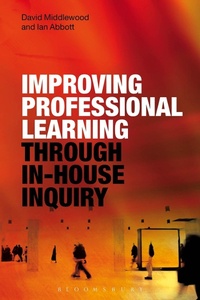
Improving Professional Learning through In-house Inquiry
1st Edition
Published on 19. November 2015
176 pages
978-1-4725-7084-0 (ISBN)
Description

Improving Professional Learning through In-House Inquiry shows how to identify the Continuous Professional Development (CPD) needs of an individual or team and then to meet those needs through carrying out specific inquiry within the organisation.
Middlewood and Abbott demonstrate how the most effective professional learning occurs when the the needs of an organisation are identified at all levels and provide clear support for following this approach. The authors also show that effective student involvement is key because it clearly links CPD with the ultimate aim: to meet students' learning needs. Examples of how this has been achieved successfully in schools and colleges are drawn on throughout, showcasing a variety of settings in various countries. Four extended case studies from different types of educational institutions are provided to illustrate learning journeys.
Middlewood and Abbott demonstrate how the most effective professional learning occurs when the the needs of an organisation are identified at all levels and provide clear support for following this approach. The authors also show that effective student involvement is key because it clearly links CPD with the ultimate aim: to meet students' learning needs. Examples of how this has been achieved successfully in schools and colleges are drawn on throughout, showcasing a variety of settings in various countries. Four extended case studies from different types of educational institutions are provided to illustrate learning journeys.
More details
Edition
1. Auflage
Language
English
Place of publication
London
United Kingdom
Publishing group
Bloomsbury Publishing PLC
Target group
Professional and scholarly
College/higher education
ISBN-13
978-1-4725-7084-0 (9781472570840)
Copyright in bibliographic data and cover images is held by Nielsen Book Services Limited or by the publishers or by their respective licensors: all rights reserved.
Schweitzer Classification
Other editions
Additional editions
David Middlewood | Ian Abbott
Improving Professional Learning through In-house Inquiry
Book
11/2015
Bloomsbury Academic
€54.65
Shipment within 15-20 days
Persons
David Middlewood is Research Fellow at the Centre for Educational Studies, University of Warwick, UK. He has published 17 books spanning people leadership and management (with Tony Bush), practitioner research and creating a learning school.
Ian Abbott is Associate Professor and Director of the Centre for Educational Studies at the University of Warwick, UK. He has worked extensively with schools and colleges and has wide experience of teacher education and CPD.
Ian Abbott is Associate Professor and Director of the Centre for Educational Studies at the University of Warwick, UK. He has worked extensively with schools and colleges and has wide experience of teacher education and CPD.
Content
About the authors
Contributors
List of figures
Glossary of terms used
Preface
Part I: Principles
1. Effectiveness in Professional Learning and CPD
2. The School/College as a Research-based Community
3. Involving Learners in Research and Professional Learning
4. Improving Professional Learning at Whole School Level
5. Collaborative and Team Approaches to Professional Learning
6. Improving Professional Learning at Individual Classroom Level
Part II: Practice
7. The Secondary School as Research Community, Richard Parker (University of Northampton, UK)
8. The Primary School with CPD at its Heart, Susan Robinson (University of Warwick, UK, and National College, UK)
9. The Post-Compulsory College: Investigating for Teaching and Learning, Derek Warren and Cathy Francis-Wright (North Warwickshire & Hinckley College, UK)
10. The Abu Dhabi Schools and Researching Staff Needs in a Centralised System, Ayman Hefnawi, Auruna Rajah and Uwem Umana with Philip Whitehead and David Middlewood (Abu Dhabi Education Council, United Arab Emirates, and University of Warwick, UK)
Part III: Overview
11. Conclusions and Reflections
Bibliography
Index
Contributors
List of figures
Glossary of terms used
Preface
Part I: Principles
1. Effectiveness in Professional Learning and CPD
2. The School/College as a Research-based Community
3. Involving Learners in Research and Professional Learning
4. Improving Professional Learning at Whole School Level
5. Collaborative and Team Approaches to Professional Learning
6. Improving Professional Learning at Individual Classroom Level
Part II: Practice
7. The Secondary School as Research Community, Richard Parker (University of Northampton, UK)
8. The Primary School with CPD at its Heart, Susan Robinson (University of Warwick, UK, and National College, UK)
9. The Post-Compulsory College: Investigating for Teaching and Learning, Derek Warren and Cathy Francis-Wright (North Warwickshire & Hinckley College, UK)
10. The Abu Dhabi Schools and Researching Staff Needs in a Centralised System, Ayman Hefnawi, Auruna Rajah and Uwem Umana with Philip Whitehead and David Middlewood (Abu Dhabi Education Council, United Arab Emirates, and University of Warwick, UK)
Part III: Overview
11. Conclusions and Reflections
Bibliography
Index
