

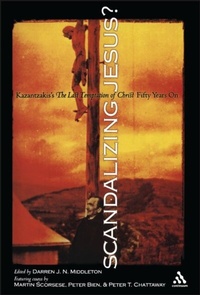
Scandalizing Jesus?
Kazantzakis'S the Last Temptation of Christ Fifty Years on
1st Edition
Published on 3. November 2005
288 pages
978-1-84714-421-8 (ISBN)
Description

2005 marks the fiftieth anniversary of Nikos Kazantzakis' The Last Temptation of Christ. Since Kazantzakis ranks as one of the twentieth century's most important European writers, and given that this particular work of his has garnered so much publicity, this collection of essays re-assesses the novel, though not forgetting the movie, in light of one half century's worth of criticism and reception history.
Clergy and laity alike have denounced this novel. When it first appeared, the Greek Orthodox Church condemned it, the Vatican placed it on its Index of Forbidden Texts, and conservative-evangelicals around the world protested its allegedly blasphemous portrayal of a human, struggling Messiah who "succumbs" to the devil's final snare while on the Cross: the temptation to happiness. Assuredly, the sentiments surrounding this novel, at least in the first thirty years or so, were very strong.
When Martin Scorcese decided in the early 1980s to adapt the novel for the silver screen, even stronger feelings were expressed. Even today his works are seldom studied in Greece, largely because the Greek government is unable or unwilling to anthologize his material for the national curriculum. After fifty years, however, the time seems right to re-examine the novel, the man, and the film, locating Kazantzakis and his work within an important debate about the relationship between religion and art (literary and cinematic).
Until now a book-length assessment of Kazantzakis' novel, and the film it inspired, has not appeared. No such volume is planned to commemorate the fiftieth anniversary of the novel's publication. For those who work in Kazantzakis studies, a focused anthology like this one is missing from library collections.
The volume contains original essays by Martin Scorcese, the film critic Peter Chattaway, and Kazantzakis' translator, Peter A. Bien.
Clergy and laity alike have denounced this novel. When it first appeared, the Greek Orthodox Church condemned it, the Vatican placed it on its Index of Forbidden Texts, and conservative-evangelicals around the world protested its allegedly blasphemous portrayal of a human, struggling Messiah who "succumbs" to the devil's final snare while on the Cross: the temptation to happiness. Assuredly, the sentiments surrounding this novel, at least in the first thirty years or so, were very strong.
When Martin Scorcese decided in the early 1980s to adapt the novel for the silver screen, even stronger feelings were expressed. Even today his works are seldom studied in Greece, largely because the Greek government is unable or unwilling to anthologize his material for the national curriculum. After fifty years, however, the time seems right to re-examine the novel, the man, and the film, locating Kazantzakis and his work within an important debate about the relationship between religion and art (literary and cinematic).
Until now a book-length assessment of Kazantzakis' novel, and the film it inspired, has not appeared. No such volume is planned to commemorate the fiftieth anniversary of the novel's publication. For those who work in Kazantzakis studies, a focused anthology like this one is missing from library collections.
The volume contains original essays by Martin Scorcese, the film critic Peter Chattaway, and Kazantzakis' translator, Peter A. Bien.
More details
Edition
1. Auflage
Language
English
Place of publication
London
United Kingdom
Publishing group
Bloomsbury Publishing PLC
Target group
Professional and scholarly
ISBN-13
978-1-84714-421-8 (9781847144218)
Copyright in bibliographic data and cover images is held by Nielsen Book Services Limited or by the publishers or by their respective licensors: all rights reserved.
Schweitzer Classification
Other editions
Additional editions
Darren J. N. Middleton
Scandalizing Jesus?
Kazantzakis's The Last Temptation of Christ Fifty Years On
Book
12/2005
Continuum International Publishing Group Ltd.
€60.00
Shipment within 15-20 days
Content
Acknowledgements vii
Note on Titles ix
Contents x
Foreword
Don Cupitt xiii
Introduction: Literary Lord, Screen Savior
Darren J. N. Middleton 1
PART I: LITERARY LORD
1: Renan's Vie de Jésus as a Primary Source for The Last Temptation
Peter A. Bien 13
2: The Novel, the Four Gospels, and the Continuing Historical Quest
W. Barnes Tatum 43
3:Pontius Pilate: Modern Man in Search of a Soul
Lewis Owens 70
4:Kazantzakis, Chalcedonian Orthodoxy, and Monophysitism
Daniel A. Dombrowski 91
5:Reading Kazantzakis Through Gregory of Nyssa: Some Common
Anthropological Themes
Pamela J. Francis 115
6:The Unreality of Repressed Desires in The Last Temptation
Vrasidas Karalis 133
7:The Temptation That Never Was: Kazantzakis and Borges
Roderick Beaton 152
8:"This Clay Bird is the Soul of Man":
A Platonic Reading of Kazantzakis's The Last Temptation
C. D. Gounelas 171
9:In-the-Name-of-the-Father: The Semiotic Threat Over the Symbolic Logos
Charitini Christodolou 195
10:An Unholy Trinity: Women in Pre-Easter Patriarchy
Jen Harrison 216
11:Distant Flutter of a Butterfly: The Indian Response to The Last Temptation
Mini Chandran 230
PART II: SCREEN SAVIOR
12:Satan and the Curious: Texas Evangelicals Read The Last Temptation of Christ
Darren J. N. Middleton and Elizabeth H. Flowers 247
13:Battling the Flesh: Sexuality and Spirituality in The Last Temptation of Christ
Peter T. Chattaway 262
14:Martin Scorsese's The Last Temptation of Christ: A Critical Reassessment
of Its Sources, Its Theological Problems, and Its Impact on the Public
Lloyd C. Baugh, S. J. 287
15:Teaching the Temptation: Seminarians Viewing The Last Temptation of Christ
Melody D. Knowles and Allison Whitney 324
16:The Dual Substance of Cinema: What Kazantzakis's Christ Can Teach
Us About Sound/Image Relationship in Film
Randolph Jordan342
17:Identity and Ethnicity in Peter Gabriel's Soundtrack for The Last
Temptation of Christ
Eftychia Papanikolaou365
18:On Reappreciating Kazantzakis
Martin Scorsese386
Webliography
Austin S. Lingerfelt389
Bibliography399
Contributors
Index
Note on Titles ix
Contents x
Foreword
Don Cupitt xiii
Introduction: Literary Lord, Screen Savior
Darren J. N. Middleton 1
PART I: LITERARY LORD
1: Renan's Vie de Jésus as a Primary Source for The Last Temptation
Peter A. Bien 13
2: The Novel, the Four Gospels, and the Continuing Historical Quest
W. Barnes Tatum 43
3:Pontius Pilate: Modern Man in Search of a Soul
Lewis Owens 70
4:Kazantzakis, Chalcedonian Orthodoxy, and Monophysitism
Daniel A. Dombrowski 91
5:Reading Kazantzakis Through Gregory of Nyssa: Some Common
Anthropological Themes
Pamela J. Francis 115
6:The Unreality of Repressed Desires in The Last Temptation
Vrasidas Karalis 133
7:The Temptation That Never Was: Kazantzakis and Borges
Roderick Beaton 152
8:"This Clay Bird is the Soul of Man":
A Platonic Reading of Kazantzakis's The Last Temptation
C. D. Gounelas 171
9:In-the-Name-of-the-Father: The Semiotic Threat Over the Symbolic Logos
Charitini Christodolou 195
10:An Unholy Trinity: Women in Pre-Easter Patriarchy
Jen Harrison 216
11:Distant Flutter of a Butterfly: The Indian Response to The Last Temptation
Mini Chandran 230
PART II: SCREEN SAVIOR
12:Satan and the Curious: Texas Evangelicals Read The Last Temptation of Christ
Darren J. N. Middleton and Elizabeth H. Flowers 247
13:Battling the Flesh: Sexuality and Spirituality in The Last Temptation of Christ
Peter T. Chattaway 262
14:Martin Scorsese's The Last Temptation of Christ: A Critical Reassessment
of Its Sources, Its Theological Problems, and Its Impact on the Public
Lloyd C. Baugh, S. J. 287
15:Teaching the Temptation: Seminarians Viewing The Last Temptation of Christ
Melody D. Knowles and Allison Whitney 324
16:The Dual Substance of Cinema: What Kazantzakis's Christ Can Teach
Us About Sound/Image Relationship in Film
Randolph Jordan342
17:Identity and Ethnicity in Peter Gabriel's Soundtrack for The Last
Temptation of Christ
Eftychia Papanikolaou365
18:On Reappreciating Kazantzakis
Martin Scorsese386
Webliography
Austin S. Lingerfelt389
Bibliography399
Contributors
Index
