

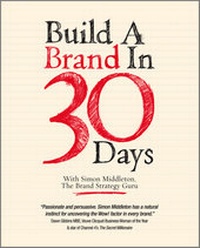
Build a Brand in 30 Days
With Simon Middleton, The Brand Strategy Guru
Published on 1. November 2010
358 pages
978-0-85708-034-9 (ISBN)
Description

You don't need a marketing degree or intensive training to build anattention-grabbing brand; you just need this book - and 30 days.
Simon Middleton shows you how to create, manage and communicateyour brand profoundly and effectively, in just 30 days, byfollowing 30 clear exercises. How you work through the book is upto you, the result will be the same: an authentic, compelling, andhighly distinctive brand that will attract and engage customers andfans. You will learn how to:
* Establish your brand values and positioning
* Get the all-important name right
* Bring your brand to life
* Turn your customers into your advocates
* Manage your PR and use your marketing budget wisely
* Inspire your staff to live the brand too
* Deal with problems when something goes wrong
Branding isn't about funky logos and expensive advertising. Yourbrand is what your company means to the world. Getting that meaningright is the most important thing you can do in business.
'Passionate and persuasive, Simon Middleton has a naturalinstinct for uncovering the Wow! factor in every brand.' DawnGibbins MBE, Veuve Clicquot Business Woman of the Year and Star ofChannel 4's The Secret Millionaire
Simon Middleton shows you how to create, manage and communicateyour brand profoundly and effectively, in just 30 days, byfollowing 30 clear exercises. How you work through the book is upto you, the result will be the same: an authentic, compelling, andhighly distinctive brand that will attract and engage customers andfans. You will learn how to:
* Establish your brand values and positioning
* Get the all-important name right
* Bring your brand to life
* Turn your customers into your advocates
* Manage your PR and use your marketing budget wisely
* Inspire your staff to live the brand too
* Deal with problems when something goes wrong
Branding isn't about funky logos and expensive advertising. Yourbrand is what your company means to the world. Getting that meaningright is the most important thing you can do in business.
'Passionate and persuasive, Simon Middleton has a naturalinstinct for uncovering the Wow! factor in every brand.' DawnGibbins MBE, Veuve Clicquot Business Woman of the Year and Star ofChannel 4's The Secret Millionaire
More details
Other editions
Additional editions
Book
04/2010
1st Edition
Capstone Publishing Ltd
€28.50
Shipment within 3-4 weeks
Person
Simon Middleton, The Brand Strategy Guru, is a leading specialist brand consultant. His work has included brand strategy and campaigns for companies like Deloitte, Barclays, British Airways, Norwich Union, Denplan, pharmaceutical giant Merial, and Britain's best known sandwich chain, Pret A Manger. He has also advised numerous charities on their specific brand strategy, including St John Ambulance, the Anthony Nolan Trust and Comic Relief.
Simon presents master classes and keynotes all over the world and is a regular commentator on all things 'brand' for the BBC, Sky News and Five News among others. His TV series The Brand Effect is the first in-depth look at brands and branding on British television.
Content
Introduction.
DAY 1 What your brand is and what your brand isn't.
DAY 2 Your brand benchmark test.
DAY 3 Finding your authentic purpose.
DAY 4 Ambition and desire: what do you actually want fromthis?
DAY 5 From personal ambitions to rational intent: brandstrategy
REAL BRAND STORY: bpha.
DAY 6 Talent: recognizing it and developing it.
DAY 7 Establishing your brand values.
REAL BRAND STORY: Adnams.
DAY 8 Putting your brand in context: finding out what'sout there.
DAY 9 and 10 Use your imagination.
REAL BRAND STORY: BeWILDerwood.
DAY 11 Who don't you want to sell to?
DAY 12 Exploring your brand through the six-leggedspider.
DAY 13 Refining your unique brand essence.
DAY 14 Understanding brand 'positioning'.
REAL BRAND STORY: Bray's Cottage Pork Pies.
DAY 15 Creating the narrative.
THE EXPERT VIEW: Tracy Kenny, Aviva.
DAY 16 Your brand name: how to get it right and how toavoid pitfalls.
REAL BRAND STORY: Voluntary Norfolk.
DAY 17 Creating the internal brand positioningstatement.
DAY 18 Shaping the external brand positioning line.
REAL BRAND STORY: Anthony Nolan.
DAY 19 Nurturing your greatest resource: you.
DAY 20 Do-it-yourself media relations.
THE EXPERT VIEW: Gordon Maw, MAW Communications.
REAL BRAND STORY: Jess Morgan.
DAY 21 How not to waste your advertising budget.
THE EXPERT VIEW: Chris Murphy, Chairman, balloon dog.
DAY 22 Making your brand come alive online.
THE EXPERT VIEW: Mark Cook, Marketing Director, Further SearchMarketing.
THE EXPERT VIEW: Stephanie Diamond, President, Digital MediaWorks, Inc.
THE EXPERT VIEW: Fiona Ryder, Chief Executive Offi cer,StreamExchange.
DAY 23 A brilliant brand at every touch-point.
REAL BRAND STORY: Mr. Site.
DAY 24 Design matters.
THE EXPERT VIEW: Scott Poulson, founder of Special DesignStudio.
DAY 25 Your personal brand behaviour.
DAY 26 How to get your staff to live your brand.
THE EXPERT VIEW: Caroline Rust, owner of WorkShopsWork.
DAY 27 Why cheaper isn't always better.
DAY 28 What to do when your brand gets things wrong.
DAY 29 Brand extension: opportunities and dangers.
REAL BRAND STORY: What makes Pret special?
DAY 30 Next steps.
MY REAL BRAND STORY: Hemsby & Newport.
References and further reading.
Real Brand Story and Expert View Contributors.
Brand Strategy Guru Speaking and Consultancy.
DAY 1 What your brand is and what your brand isn't.
DAY 2 Your brand benchmark test.
DAY 3 Finding your authentic purpose.
DAY 4 Ambition and desire: what do you actually want fromthis?
DAY 5 From personal ambitions to rational intent: brandstrategy
REAL BRAND STORY: bpha.
DAY 6 Talent: recognizing it and developing it.
DAY 7 Establishing your brand values.
REAL BRAND STORY: Adnams.
DAY 8 Putting your brand in context: finding out what'sout there.
DAY 9 and 10 Use your imagination.
REAL BRAND STORY: BeWILDerwood.
DAY 11 Who don't you want to sell to?
DAY 12 Exploring your brand through the six-leggedspider.
DAY 13 Refining your unique brand essence.
DAY 14 Understanding brand 'positioning'.
REAL BRAND STORY: Bray's Cottage Pork Pies.
DAY 15 Creating the narrative.
THE EXPERT VIEW: Tracy Kenny, Aviva.
DAY 16 Your brand name: how to get it right and how toavoid pitfalls.
REAL BRAND STORY: Voluntary Norfolk.
DAY 17 Creating the internal brand positioningstatement.
DAY 18 Shaping the external brand positioning line.
REAL BRAND STORY: Anthony Nolan.
DAY 19 Nurturing your greatest resource: you.
DAY 20 Do-it-yourself media relations.
THE EXPERT VIEW: Gordon Maw, MAW Communications.
REAL BRAND STORY: Jess Morgan.
DAY 21 How not to waste your advertising budget.
THE EXPERT VIEW: Chris Murphy, Chairman, balloon dog.
DAY 22 Making your brand come alive online.
THE EXPERT VIEW: Mark Cook, Marketing Director, Further SearchMarketing.
THE EXPERT VIEW: Stephanie Diamond, President, Digital MediaWorks, Inc.
THE EXPERT VIEW: Fiona Ryder, Chief Executive Offi cer,StreamExchange.
DAY 23 A brilliant brand at every touch-point.
REAL BRAND STORY: Mr. Site.
DAY 24 Design matters.
THE EXPERT VIEW: Scott Poulson, founder of Special DesignStudio.
DAY 25 Your personal brand behaviour.
DAY 26 How to get your staff to live your brand.
THE EXPERT VIEW: Caroline Rust, owner of WorkShopsWork.
DAY 27 Why cheaper isn't always better.
DAY 28 What to do when your brand gets things wrong.
DAY 29 Brand extension: opportunities and dangers.
REAL BRAND STORY: What makes Pret special?
DAY 30 Next steps.
MY REAL BRAND STORY: Hemsby & Newport.
References and further reading.
Real Brand Story and Expert View Contributors.
Brand Strategy Guru Speaking and Consultancy.
Day 1 WHAT YOUR BRAND IS AND WHAT YOUR BRAND ISN'T There are lots of misconceptions about brand and branding and what these terms actually mean. For some people these terms are veiled in a kind of arcane mystery, as though 'brand' was exclusively the province of specially qualified executives in huge and complex companies. For others the words 'brand' and 'branding' are inseparable from other specific aspects of marketing, such as advertising, logos, and slogans. Yet others think of branding as a dark, mysterious and probably evil art, practised by the hidden persuaders of capitalism.
But brand isn't really about any of these things. Brand isn't a subset of advertising (it's actually much more important than that). Brand isn't your logo. And it shouldn't be complex or mysterious.
Brand is serious and important to your business: but it's also very simple in its essence. Brand is about meaning. In short, your brand is the sum total of all the meanings that all your possible audiences carry around about you in their heads and in their hearts.
In other words, your brand is everything that your customers and prospective customers think, feel, say, hear, read, watch, imagine, suspect and even hope about your product, service or organization.
Take the British store John Lewis. Ask any group of people in the southern half of the UK what John Lewis 'means' (and I know because I've asked numerous workshop audiences over several years) and you will discover that most people share a fairly small number of 'meanings' for John Lewis.
Regardless of background, level of affluence, and whether they shop in John Lewis or not, the following meanings are always mentioned within the first minute or two of starting this exercise: quality, service, value, partnership, middle class.
This is not to say that these are the only words used. Of course not, but no matter how often I repeat the exercise these five meanings are the dominant ones: in fact they are the 'headline' meanings under which almost every other idea about John Lewis can be put.
Some people will say "John Lewis staff are always polite", which of course falls under Service. Others will remember the store's longstanding slogan "Never knowingly undersold", which reflects the brand meaning of Value.
Interestingly, most people are familiar with the fact that John Lewis is a partnership organization: in other words that each of its staff 'own' a little bit of the business. Materially this doesn't matter to us, the shopper. But philosophically, somehow it does. I think it's because we feel somewhere deep inside that if this store is in partnership with its employees then that indicates a value system which will in one way or another translate into a better relationship with us. We become a kind of partner of John Lewis too, just by shopping there: which is not the feeling one gets in most stores.
Not all the meanings that groups throw up in this exercise are positive. 'Middle class' is descriptive and neutral in and of itself, but is actually loaded with value judgements, most - though not all - on the negative side.
The negatives for John Lewis under the Middle Class headline include descriptions like: boring, stuffy, old fashioned, a bit posh. Some people go on to say "it's not for me" and "it's not really a family store", and "it's expensive".
But alongside these interpretations, John Lewis is also seen as aspirational and appealing, even to those people who call it stuffy, boring and posh.
The point overall is that John Lewis as a brand has a definable meaning which is almost all positive (quality, service, value) and that even its few negative meanings actually have a positive aspect. After all, even 'boring' is a reassurance that things will be just as you expect, every time. John Lewis is therefore much more than a name or a logo, or a number of big stores with certain stock. John Lewis 'means' something.
One more example. Draw the Nike logo (which, curiously, everyone seems to know is called the 'swoosh') on a piece of paper and people instantly respond with a whole new set of meanings. Nike headline meanings usually amount to the following: achievement, sport, design/technology, fashion, quality, expense, high-profile sponsorship figures (exemplified by Tiger Woods), hip-hop culture, child labour/sweatshops.
Nike has somewhat more complex meanings than John Lewis for two reasons. First, it's an international brand with a massive advertising and sponsorship spend. Second, it works across cultures to many different audiences.
Once again, you'll see on the list one brand meaning which is obviously not a desirable one for Nike. The interesting thing about 'child labour' as a brand meaning is that it is historic rather than current; however, it is a very powerful meaning, and one that Nike will have to live with for decades to come regardless of their actual labour practices.
Nike is a fascinating case of brand meaning. One might say that Nike is a brand and nothing else. The fact that Nike can be simultaneously so successful and yet so insubstantial as an organization is the most powerful evidence in retailing of the power of brand as meaning. And the fact that it is so multi-faceted as a brand (even though it markets a fairly narrow range of goods) demonstrates that brand is not a static thing but an ever-changing and dynamic one.
Why does this matter? Why does brand meaning matter so very much to Nike, to John Lewis, to any other brand you can name? And why should it matter to you?
Well, the answer is that without 'brand' John Lewis would be just a department store, and Nike would be, well, not much really. It is brand that gives these two businesses a personality and presence in the world. It is brand that enables us to understand them, and allows them to communicate with and sell to us.
Brand is a kind of shorthand. A way for a business or a product to introduce itself to people (customers and potential customers). But brand is also a kind of tool for those customers to use when making buying decisions.
When we choose a pair of trainers or decide which department store to shop in, we don't make the choice rationally, at least not completely rationally. That would be impossible, because the world is too complex. And even an apparently simple decision like which department store to visit when, say, looking for a new fridge, is fraught with difficulty.
Do we really have time to compare every single feature and benefit of every make and model of fridge in every different store? Let alone to cross reference that information with prices, guarantees, special offers, delivery charges and so on. And what is our ideal fridge decision anyway? How do we know when we've made the best rational choice?
The fact is that we don't have time or head-space, or even the information processing capacity to make these decisions rationally. So instead we use a system of signs and meanings that have come to be known as 'brand'.
If we've registered John Lewis in our internal system as a brand that we trust to give us quality, service and value, then we don't have to make anywhere near as many difficult decisions. Plus, of course, we remember the John Lewis promise of being 'never knowingly undersold', which overcomes our anxieties about them being expensive.
Funny thing about this slogan, too. When John Lewis say it, we believe it, because they are a trusted brand. It wouldn't be difficult to name a dozen retailers from whom we wouldn't trust that statement.
There's one more crucial element to remember from the beginning about brand: it's not about size. It is perfectly possible to be a brand with just a few dozen loyal customers. You can be a local chip shop and be a great brand. It's not the absolute numbers of people who know about you that make you a brand, but the relative coherence of what they think, feel and believe about you.
If you have 100 customers who share a set of meanings about your business then you've got a strong brand. If you've got 10,000 customers who don't have a shared set of meanings then you have a weak or non-existent brand.
"So what," you might say, "I've got 10,000 customers. . . so who needs a brand?"
Good question, but the answer is simple. Ten thousand people might buy from you this week or this month, but if you haven't engaged them as a brand (given them some meaning), then there's no particular reason for them to buy from you again. They might do. But they might just go somewhere else.
But if you have a strong brand, a strong set of meanings, then your 100 customers will come back, again and again. Because your brand helps them to make their buying decisions easier. And not only will they come back, but they'll tell others about you too.
Brand gives you stability, growth potential, loyalty and longevity.
Consider the alternative....
But brand isn't really about any of these things. Brand isn't a subset of advertising (it's actually much more important than that). Brand isn't your logo. And it shouldn't be complex or mysterious.
Brand is serious and important to your business: but it's also very simple in its essence. Brand is about meaning. In short, your brand is the sum total of all the meanings that all your possible audiences carry around about you in their heads and in their hearts.
In other words, your brand is everything that your customers and prospective customers think, feel, say, hear, read, watch, imagine, suspect and even hope about your product, service or organization.
Take the British store John Lewis. Ask any group of people in the southern half of the UK what John Lewis 'means' (and I know because I've asked numerous workshop audiences over several years) and you will discover that most people share a fairly small number of 'meanings' for John Lewis.
Regardless of background, level of affluence, and whether they shop in John Lewis or not, the following meanings are always mentioned within the first minute or two of starting this exercise: quality, service, value, partnership, middle class.
This is not to say that these are the only words used. Of course not, but no matter how often I repeat the exercise these five meanings are the dominant ones: in fact they are the 'headline' meanings under which almost every other idea about John Lewis can be put.
Some people will say "John Lewis staff are always polite", which of course falls under Service. Others will remember the store's longstanding slogan "Never knowingly undersold", which reflects the brand meaning of Value.
Interestingly, most people are familiar with the fact that John Lewis is a partnership organization: in other words that each of its staff 'own' a little bit of the business. Materially this doesn't matter to us, the shopper. But philosophically, somehow it does. I think it's because we feel somewhere deep inside that if this store is in partnership with its employees then that indicates a value system which will in one way or another translate into a better relationship with us. We become a kind of partner of John Lewis too, just by shopping there: which is not the feeling one gets in most stores.
Not all the meanings that groups throw up in this exercise are positive. 'Middle class' is descriptive and neutral in and of itself, but is actually loaded with value judgements, most - though not all - on the negative side.
The negatives for John Lewis under the Middle Class headline include descriptions like: boring, stuffy, old fashioned, a bit posh. Some people go on to say "it's not for me" and "it's not really a family store", and "it's expensive".
But alongside these interpretations, John Lewis is also seen as aspirational and appealing, even to those people who call it stuffy, boring and posh.
The point overall is that John Lewis as a brand has a definable meaning which is almost all positive (quality, service, value) and that even its few negative meanings actually have a positive aspect. After all, even 'boring' is a reassurance that things will be just as you expect, every time. John Lewis is therefore much more than a name or a logo, or a number of big stores with certain stock. John Lewis 'means' something.
One more example. Draw the Nike logo (which, curiously, everyone seems to know is called the 'swoosh') on a piece of paper and people instantly respond with a whole new set of meanings. Nike headline meanings usually amount to the following: achievement, sport, design/technology, fashion, quality, expense, high-profile sponsorship figures (exemplified by Tiger Woods), hip-hop culture, child labour/sweatshops.
Nike has somewhat more complex meanings than John Lewis for two reasons. First, it's an international brand with a massive advertising and sponsorship spend. Second, it works across cultures to many different audiences.
Once again, you'll see on the list one brand meaning which is obviously not a desirable one for Nike. The interesting thing about 'child labour' as a brand meaning is that it is historic rather than current; however, it is a very powerful meaning, and one that Nike will have to live with for decades to come regardless of their actual labour practices.
Nike is a fascinating case of brand meaning. One might say that Nike is a brand and nothing else. The fact that Nike can be simultaneously so successful and yet so insubstantial as an organization is the most powerful evidence in retailing of the power of brand as meaning. And the fact that it is so multi-faceted as a brand (even though it markets a fairly narrow range of goods) demonstrates that brand is not a static thing but an ever-changing and dynamic one.
Why does this matter? Why does brand meaning matter so very much to Nike, to John Lewis, to any other brand you can name? And why should it matter to you?
Well, the answer is that without 'brand' John Lewis would be just a department store, and Nike would be, well, not much really. It is brand that gives these two businesses a personality and presence in the world. It is brand that enables us to understand them, and allows them to communicate with and sell to us.
Brand is a kind of shorthand. A way for a business or a product to introduce itself to people (customers and potential customers). But brand is also a kind of tool for those customers to use when making buying decisions.
When we choose a pair of trainers or decide which department store to shop in, we don't make the choice rationally, at least not completely rationally. That would be impossible, because the world is too complex. And even an apparently simple decision like which department store to visit when, say, looking for a new fridge, is fraught with difficulty.
Do we really have time to compare every single feature and benefit of every make and model of fridge in every different store? Let alone to cross reference that information with prices, guarantees, special offers, delivery charges and so on. And what is our ideal fridge decision anyway? How do we know when we've made the best rational choice?
The fact is that we don't have time or head-space, or even the information processing capacity to make these decisions rationally. So instead we use a system of signs and meanings that have come to be known as 'brand'.
If we've registered John Lewis in our internal system as a brand that we trust to give us quality, service and value, then we don't have to make anywhere near as many difficult decisions. Plus, of course, we remember the John Lewis promise of being 'never knowingly undersold', which overcomes our anxieties about them being expensive.
Funny thing about this slogan, too. When John Lewis say it, we believe it, because they are a trusted brand. It wouldn't be difficult to name a dozen retailers from whom we wouldn't trust that statement.
There's one more crucial element to remember from the beginning about brand: it's not about size. It is perfectly possible to be a brand with just a few dozen loyal customers. You can be a local chip shop and be a great brand. It's not the absolute numbers of people who know about you that make you a brand, but the relative coherence of what they think, feel and believe about you.
If you have 100 customers who share a set of meanings about your business then you've got a strong brand. If you've got 10,000 customers who don't have a shared set of meanings then you have a weak or non-existent brand.
"So what," you might say, "I've got 10,000 customers. . . so who needs a brand?"
Good question, but the answer is simple. Ten thousand people might buy from you this week or this month, but if you haven't engaged them as a brand (given them some meaning), then there's no particular reason for them to buy from you again. They might do. But they might just go somewhere else.
But if you have a strong brand, a strong set of meanings, then your 100 customers will come back, again and again. Because your brand helps them to make their buying decisions easier. And not only will they come back, but they'll tell others about you too.
Brand gives you stability, growth potential, loyalty and longevity.
Consider the alternative....
