

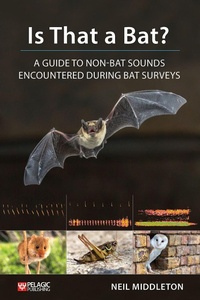
Is That a Bat?
A Guide to Non-Bat Sounds Encountered During Bat Surveys
Published on 13. January 2020
288 pages
978-1-78427-198-5 (ISBN)
Description

Bat detector surveys are carried out by ecological consultants, researchers, conservationists and hobbyists. Understanding and categorising non-bat sounds in surveys offers the potential of knock-on benefits for informing development projects (e.g. other important records discovered within a site), as well as the possibility of associated conservation benefits. In recent years the number of people carrying out these surveys and recording calls with bat detectors has grown considerably. These surveys often generate vast amounts of audio recordings, resulting in the heavy workload associated with completing the sound analysis and reporting process.
Those carrying out analysis can be distracted, intrigued or delayed owing to the occurrence of recordings that are unfamiliar and not identifiable to them. These recordings can relate to 'difficult to ID' bat species, but also, often, sounds not related to bats. This can be especially true when noise triggers such as insects, small mammals or birds look like bat-related noise. Therefore, only knowing what bats sound like is not enough. It is extremely useful to know what other sources of noise look and sound like within the same soundscape. This resource will help bat workers, in whatever environment they are in, to be more confident in recognising, categorising and dismissing other sounds. The book includes a substantial downloadable sound library (.wav format) that readers can listen to by ear or process through sound analysis software.
Is That a Bat? also caters for sounds that are also heard by ear alone, in the field, during the hours of darkness. These scenarios often have bat surveyors intrigued or confused as to what they are listening to. Occasionally, knowing what these sounds are could be important, or at the very least, of interest.
The first chapter caters for the subject overall, including suggestions from the author as to why the subject matter is of value. It also discusses bat-related calls (including social calls) with a view to offering comparisons against the other sources of sound discussed in separate chapters. Continuing through the book, there are chapters covering the following: small mammals; amphibians; insects; birds; electrical/mechanical noise; and other noise/nuisances. Within each chapter there are sub-sections about bat detector recorded sound, sound by ear, as well as advice on techniques and methods to reduce or increase the likelihood of recording other sounds. The book concludes with associated appendices, including a 'Problem Solving Key' to help those encountering an unfamiliar sound to narrow it down to the likely source.
With technology advancing at pace, the technical ability of the analyst is of huge importance. With a wider perspective and more knowledge, those responsible for interpreting field encounters can be more confident when making decisions about sources of sound. Apart from that, 'knowing stuff' makes the job far more interesting and gives the bat worker a greater appreciation of the natural world within which they are working.
Those carrying out analysis can be distracted, intrigued or delayed owing to the occurrence of recordings that are unfamiliar and not identifiable to them. These recordings can relate to 'difficult to ID' bat species, but also, often, sounds not related to bats. This can be especially true when noise triggers such as insects, small mammals or birds look like bat-related noise. Therefore, only knowing what bats sound like is not enough. It is extremely useful to know what other sources of noise look and sound like within the same soundscape. This resource will help bat workers, in whatever environment they are in, to be more confident in recognising, categorising and dismissing other sounds. The book includes a substantial downloadable sound library (.wav format) that readers can listen to by ear or process through sound analysis software.
Is That a Bat? also caters for sounds that are also heard by ear alone, in the field, during the hours of darkness. These scenarios often have bat surveyors intrigued or confused as to what they are listening to. Occasionally, knowing what these sounds are could be important, or at the very least, of interest.
The first chapter caters for the subject overall, including suggestions from the author as to why the subject matter is of value. It also discusses bat-related calls (including social calls) with a view to offering comparisons against the other sources of sound discussed in separate chapters. Continuing through the book, there are chapters covering the following: small mammals; amphibians; insects; birds; electrical/mechanical noise; and other noise/nuisances. Within each chapter there are sub-sections about bat detector recorded sound, sound by ear, as well as advice on techniques and methods to reduce or increase the likelihood of recording other sounds. The book concludes with associated appendices, including a 'Problem Solving Key' to help those encountering an unfamiliar sound to narrow it down to the likely source.
With technology advancing at pace, the technical ability of the analyst is of huge importance. With a wider perspective and more knowledge, those responsible for interpreting field encounters can be more confident when making decisions about sources of sound. Apart from that, 'knowing stuff' makes the job far more interesting and gives the bat worker a greater appreciation of the natural world within which they are working.
Reviews / Votes
In fact it is an invaluable read and reference for anyone identifying bats through sound analysis at any level, from beginners to the more experienced. .... This book succeeds brilliantly in encouraging appreciation of the rich and varied world of sound around us. These sounds can sometimes confound our attempts to accurately identify bat species from their calls but at the same time they greatly increase our scope for evaluating and enjoying the biodiversity around us (very timely in the context of current multi-taxa monitoring initiatives). It also makes an important contribution to helping raise standards in the acoustic identification of bats. -- Philip Briggs, Bat Conservation Trust .. this is the book highlight for me this year. -- Stuart Newson * BTO News * Very readable book... I expect to use it regularly as a source of reference. I recommend it not just to those members interested in bats and ultrasonics, but to the growing number of us doing nocmig, or using an Audiomoth or other long-term monitoring device. -- Simon Elliott * Wildlife Sound * ... a nice overview of problems a non-expert in bat echolocation research might encounter during a nightly excursion, or when analysing their recordings. -- Martin K. Obrist * Bioacoustics * Without a doubt, anyone who intends to record bats in their natural environment, would do well with a copy of this book. -- Al Milano * batdetecting.blogspot.com *More details
Series
Language
English
Place of publication
Exeter
United Kingdom
Target group
Professional and scholarly
Product notice
Reflowable
Illustrations
6 farbige Abbildungen, 257 Schaubilder, 36 s/w Tabellen
36 Tables, black and white; 257 Figures; 6 Illustrations, color
ISBN-13
978-1-78427-198-5 (9781784271985)
Copyright in bibliographic data and cover images is held by Nielsen Book Services Limited or by the publishers or by their respective licensors: all rights reserved.
Schweitzer Classification
Other editions
Additional editions
Book
01/2020
Pelagic Publishing
€48.50
Shipment within 10-15 days
Person
Neil Middleton is the owner of BatAbility Courses & Tuition, a training organisation that delivers bat-related skills development to customers from throughout the UK and beyond. He has a constant appetite for self-development, as well as seeking to develop those around him, and to this end he has designed and delivered in excess of 200 training events covering a wide range of business and ecology-related subjects. Neil has had a strong interest in the natural world since childhood, particularly in relation to birds and mammals. He has studied bats for over 25 years, with a particular focus on their acoustic behaviour (echolocation and social calls). In 2014 he was the lead author of an important and well-received book about bat social calls, entitled Social Calls of the Bats of Britain and Ireland. Two years later he wrote The Effective Ecologist, which tackles the challenges facing ecologists, at all levels, as they endeavour to perform at the highest level within their working environment.
Content
Preface
Acknowledgements
Preamble: Before We Get Started
Downloading Files from the Sound Library
1. Well, What On Earth Could It Be?
2. Terrestrial Mammals
3. Birds
4. Amphibians
5. Insects
6. Electronic & Mechanical
7. Weather, People & Other Nuisances
References
Appendix I Supporting Figures
Appendix II Problem Solving
Appendix III Useful Additional Resources
Appendix IV Test Yourself
Appendix V Glossary
Index
Acknowledgements
Preamble: Before We Get Started
Downloading Files from the Sound Library
1. Well, What On Earth Could It Be?
2. Terrestrial Mammals
3. Birds
4. Amphibians
5. Insects
6. Electronic & Mechanical
7. Weather, People & Other Nuisances
References
Appendix I Supporting Figures
Appendix II Problem Solving
Appendix III Useful Additional Resources
Appendix IV Test Yourself
Appendix V Glossary
Index
