

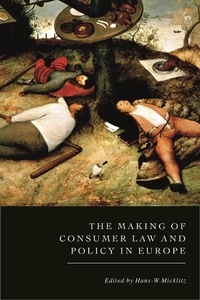
The Making of Consumer Law and Policy in Europe
1st Edition
Published on 4. November 2021
432 pages
978-1-5099-4485-9 (ISBN)
Description

This book analyses the founding years of consumer law and consumer policy in Europe. It combines two dimensions: the making of national consumer law and the making of European consumer law, and how both are intertwined.
The chapters on Germany, Italy, the Nordic countries and the United Kingdom serve to explain the economic and the political background which led to different legal and policy approaches in the then old Member States from the 1960s onwards. The chapter on Poland adds a different layer, the one of a former socialist country with its own consumer law and how joining the EU affected consumer law at the national level. The making of European consumer law started in the 1970s rather cautiously, but gradually the European Commission took an ever stronger position in promoting not only European consumer law but also in supporting the building of the European Consumer Organisation (BEUC), the umbrella organisation of the national consumer bodies.
The book unites the early protagonists who were involved in the making of consumer law in Europe: Guido Alpa, Ludwig Krämer, Ewa Letowska, Hans-W Micklitz, Klaus Tonner, Iain Ramsay, and Thomas Wilhelmsson, supported by the younger generation Aneta Wiewiórowska Domagalska, Mateusz Grochowski, and Koen Docter, who reconstructs the history of BEUC. Niklas Olsen and Thomas Roethe analyse the construction of this policy field from a historical and sociological perspective.
This book offers a unique opportunity to understand a legal and political field, that of consumer law and policy, which plays a fundamental role in our contemporary societies.
The chapters on Germany, Italy, the Nordic countries and the United Kingdom serve to explain the economic and the political background which led to different legal and policy approaches in the then old Member States from the 1960s onwards. The chapter on Poland adds a different layer, the one of a former socialist country with its own consumer law and how joining the EU affected consumer law at the national level. The making of European consumer law started in the 1970s rather cautiously, but gradually the European Commission took an ever stronger position in promoting not only European consumer law but also in supporting the building of the European Consumer Organisation (BEUC), the umbrella organisation of the national consumer bodies.
The book unites the early protagonists who were involved in the making of consumer law in Europe: Guido Alpa, Ludwig Krämer, Ewa Letowska, Hans-W Micklitz, Klaus Tonner, Iain Ramsay, and Thomas Wilhelmsson, supported by the younger generation Aneta Wiewiórowska Domagalska, Mateusz Grochowski, and Koen Docter, who reconstructs the history of BEUC. Niklas Olsen and Thomas Roethe analyse the construction of this policy field from a historical and sociological perspective.
This book offers a unique opportunity to understand a legal and political field, that of consumer law and policy, which plays a fundamental role in our contemporary societies.
More details
Edition
1. Auflage
Language
English
Place of publication
London
United Kingdom
Publishing group
Bloomsbury Publishing PLC
Target group
College/higher education
ISBN-13
978-1-5099-4485-9 (9781509944859)
Copyright in bibliographic data and cover images is held by Nielsen Book Services Limited or by the publishers or by their respective licensors: all rights reserved.
Schweitzer Classification
Other editions
Additional editions
Hans-W. Micklitz
The Making of Consumer Law and Policy in Europe
Book
06/2023
Hart Publishing
€75.79
Shipment within 15-20 days
Hans-W. Micklitz
The Making of Consumer Law and Policy in Europe
Book
12/2021
Hart Publishing
€148.80
Shipment within 15-20 days
Person
Hans-W Micklitz is Professor of Economic Law at the European University Institute, Florence, Italy.
Content
1. Cross (?) Fertilisation
Ewa Letowska (Polish Academy of Sciences, Poland)
PART I - THE MAKING OF CONSUMER LAW IN THE EU
2. The Origins of Consumer Law and Policy at EU Level
Ludwig Krämer (European Commission, Belgium (retired))
3. The Early Years of the European Consumer Organisation BEUC, 1962-1985
Koen Docter (European University Institute, Italy)
4. The Intellectual Community of Consumer Law and Policy in the EU
Hans-W Micklitz (European University Institute, Italy)
PART II - THE MAKING OF NATIONAL CONSUMER LAW AND POLICY AND ITS INTERACTION WITH THE EU
5. German Consumer Law: Own Initiatives in the 1970s and Transposition of EU Directives since the 1980s
Klaus Tonner (University of Rostock, Germany)
6. The Making of Consumer Law and Policy in Italy
Guido Alpa (La Sapienza University of Rome, Italy)
7. The Emergence of Nordic Consumer Law and a Nordic Consumer Law Community and Its Impact on Nordic Legal Unity
Thomas Wilhelmsson (University of Helsinki, Finland)
8. Consumer Law in Poland: Or There and Back Again
Aneta Wiewiórowska Domagalska (University of Osnabrück, Germany) and Mateusz Grochowski (Max Planck Institute for Comparative and International Private Law, Germany)
9. Ordoliberalism and Opportunism? The Making of Consumer Law in the UK
Iain Ramsay (University of Kent, UK)
PART III - POST WAR HISTORY AND THE SOCIOLOGY OF CONSUMPTION
10. Consumer Imaginaries, Political Visions and the Ordering of Modern Society
Niklas Olsen (University of Copenhagen, Denmark)
11. The Making of Consumer Law - A Sociological Critique
Thomas Roethe (European University Institute, Italy)
12. Looking Back to Look Forward: Spring 2021
Hans-W Micklitz (European University Institute, Italy) and Thomas Wilhelmsson (University of Helsinki, Finland)
Ewa Letowska (Polish Academy of Sciences, Poland)
PART I - THE MAKING OF CONSUMER LAW IN THE EU
2. The Origins of Consumer Law and Policy at EU Level
Ludwig Krämer (European Commission, Belgium (retired))
3. The Early Years of the European Consumer Organisation BEUC, 1962-1985
Koen Docter (European University Institute, Italy)
4. The Intellectual Community of Consumer Law and Policy in the EU
Hans-W Micklitz (European University Institute, Italy)
PART II - THE MAKING OF NATIONAL CONSUMER LAW AND POLICY AND ITS INTERACTION WITH THE EU
5. German Consumer Law: Own Initiatives in the 1970s and Transposition of EU Directives since the 1980s
Klaus Tonner (University of Rostock, Germany)
6. The Making of Consumer Law and Policy in Italy
Guido Alpa (La Sapienza University of Rome, Italy)
7. The Emergence of Nordic Consumer Law and a Nordic Consumer Law Community and Its Impact on Nordic Legal Unity
Thomas Wilhelmsson (University of Helsinki, Finland)
8. Consumer Law in Poland: Or There and Back Again
Aneta Wiewiórowska Domagalska (University of Osnabrück, Germany) and Mateusz Grochowski (Max Planck Institute for Comparative and International Private Law, Germany)
9. Ordoliberalism and Opportunism? The Making of Consumer Law in the UK
Iain Ramsay (University of Kent, UK)
PART III - POST WAR HISTORY AND THE SOCIOLOGY OF CONSUMPTION
10. Consumer Imaginaries, Political Visions and the Ordering of Modern Society
Niklas Olsen (University of Copenhagen, Denmark)
11. The Making of Consumer Law - A Sociological Critique
Thomas Roethe (European University Institute, Italy)
12. Looking Back to Look Forward: Spring 2021
Hans-W Micklitz (European University Institute, Italy) and Thomas Wilhelmsson (University of Helsinki, Finland)
