

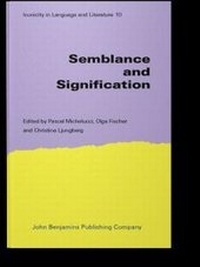
Semblance and Signification
1st Edition
Published on 23. November 2011
XII, 427 pages
978-90-272-8482-2 (ISBN)
Description

The articles assembled in Semblance and Signification explore linguistic and literary structures from a range of theoretical perspectives with a view to understanding the extent, prevalence, productivity, and limitations of iconically grounded forms of semiosis. With the complementary examination of large theoretical issues, extensive corpus analysis in several modern languages such as Italian, Japanese Sign Language, and English, and applied close studies across a range of artistic media, this volume brings a fresh understanding of the cognitive underpinnings of iconicity. If primary and secondary modelling systems are rarely studied in tandem, it is clear from this volume that their fruitful juxtaposition yields striking insight into the cognitive concerns that pervade current semiotic research.
More details
Other editions
Additional editions
Pascal Michelucci | Olga Fischer | Christina Ljungberg
Semblance and Signification
Book
11/2011
John Benjamins Publishing Co
€111.30
Shipment within 10-15 days
Persons
Content
- Semblance and Signification
- Editorial page
- Title page
- LCC data
- Table of contents
- Preface and acknowledgements
- Introduction
- References
- Part I. Word forms, word formation, and meaning
- Toward a phonosemantic definition of iconic words
- 1. Introduction
- 2. Japanese phonosemantics
- 3. Morphophonological condition of iconic words
- 4. Experiment 1: The morphophonological condition as a non-sufficient condition
- 4.1 Method and prediction
- 4.2 Results and discussion
- 5. Experiment 2: Referential condition of iconic words
- 5.1 Method and prediction
- 5.2 Results and discussion
- 6. Conclusion
- References
- Iconic thinking and the contact-induced transfer of linguistic material
- 1. Introduction
- 2. Sign language morphology and word-formation processes
- 3. Transfer of linguistic material
- 3.1 Form
- 3.2 Meaning
- 3.3 Form-meaning units
- 3.4 Syntactic relations
- 4. The transfer of meaning and syntactic relations
- 5. Conclusion
- Note
- Acknowledgement
- References
- Ezra Pound among the Mawu
- 1. Introduction
- 2. Ideophones
- 2.1 The Mawu people and their language
- 2.2 Ideophones in Siwu
- 3. Iconicity: Relations between form and meaning in ideophones
- 3.1 A cautionary tale
- 3.2 Imagic iconicity
- 3.3 Diagrammatic iconicity
- 3.3.1 Gestalt iconicity
- 3.3.2 Relative iconicity
- 4. Beyond lexical iconicity
- 5. Concluding remarks
- References
- Cognitive iconic grounding of reduplication in language
- 1. Introduction
- 5.1 Evidence for cognitive connections between transparent and opaque reduplication from sign language
- 5.2 Evidence for cognitive connections between transparent and opaque reduplication from the use of the ge-prefix in Germanic languages
- 5.3 Why transparency may be lost: grammaticalization and lexicalization
- 6. Concluding remarks
- Acknowledgements
- References
- Imagic iconicity in the Chinese language
- 1. Introduction
- 2. A historical-theoretical overview
- 2.1 The Pre-Qin period
- 2.2 The Han period
- 2.3 The Song period
- 2.4 The Qing period
- 2.5 From 1949 to the present
- 3. Imagic iconicity
- 3.1 Picto-phonetic iconicity
- 3.1.1 Onomatopoeic iconicity
- 3.1.2 Phonaesthetic iconicity
- 3.2 Pictographic iconicity
- 3.3 Picto-phonetic-graphic iconicity
- 4. Concluding remarks
- References
- Words in the mirror
- 1. Theoretical and methodological aspects
- 1.1 Echo-mirror neurons and arbitrariness
- 1.2 An ancient question
- 1.3 Two notions of arbitrariness
- 1.4 Two notions of iconicity
- 1.5 Working hypothesis
- 1.6 Methodological remarks
- 2. Descriptive aspects
- 2.1 Vowel monophonemes
- 2.1.1 Opposition axes
- 2.1.1.1 Aperture. The [degree of aperture] of the phonemes tends to distinguish the {grammatical category} of the lexemes:
- 2.1.1.2 Place. The [place of articulation] of the phonemes tends to distinguish the {morphological variation} of the lexemes inside each category:
- 2.1.1.3 Accent. The [accent] distinguishes the {verbs}:
- 2.1.1.4 Centrality. The phonological [central] position of /a/ (with respect to [front] and [back] vowels) is reflected by the semantic central positions of ha (with respect to è and ho) and a (with respect to e and o):
- 2.1.2 Opposition directions
- 2.1.2.1 Aperture. The [degree of aperture] tends to distinguish the {grammatical categories} in accordance to the level of topological-relational complexity. The more [open (F1 acute)] degree characterizes the {more-relational} grammatical categories, suc
- 2.1.2.2 Place. The [place of articulation] tends to distinguish the {morphological variation} in accordance with a 'positive' or 'negative' spatial polarity. The place [front (F2 acute)] connotes the spatially {positive} side of each pair (plurality of i,
- 2.1.2.3 Accent. The [accent] distinguishes two complementary aspects of the aperture as power to contain. The [stressed] accent connotes ha /'a/ 'has' as an active {containing}, while the [unstressed] accent connotes a /a/ 'at, to' as a passive {contain
- 2.1.2.4 Centrality. The [central open] position of the phoneme /a/ corresponds to the central position of the notion of a {structured spatiality} as the power to contain or be contained (ha: a 'has : at'), which is the base of any set-element or structure
- 2.2 System of persons
- 2.2.1 Subsystems differentiation
- 2.2.2 Subtypes differentiation
- 2.2.2.1 Verbal persons asymmetry. In the phonology of verbs like avere, the first person {P1} /-?/ is distinguished primarily from the third person {P3} /-a/, which is then distinguished, secondarily, from the second person {P2} /-ai/ by adding a phonem
- 2.2.2.2 Pronominal persons asymmetry. In the phonology of pronouns, only the first person distinguishes, by the initial phoneme, the singular subject (/'io/), the plural subject (/'noi/), the singular object (/mi, me, 'me/) and the plural object (/vi, ve
- 2.2.3 Persons differentiation
- 2.3 System of adverbs
- 2.3.1 Types differentiation
- 2.3.2 Categories differentiation
- 2.3.3 Semantic values differentiation
- 2.3.3.1 General place (qui, qua, lì, là, via). The velar plosive consonant /k-/, having a more [closed] and [back] articulation inside the locutor's mouth, distinguishes the place qui, qua {near to the locutor}
- the alveolar lateral approximant /l-/,
- 2.3.3.2 Vertical place (su, giù). The phono-articulatory opposition between /s-/ [open, front, acute] and /3-/ [closed, back, grave] can be regarded as an imagic diagram of the logical-semantic opposition between {up} and {down}, because in the common sen
- 2.3.3.3 Vectorial place (ci, ce, vi, ve, ne). The phono-articulatory opposition between /v/ (or /v-/) [front, acute
- single place of articulation] and /n-/ [back, grave
- double place of articulation] can be regarded as an imagic diagram of the logical-sem
- 2.3.3.4 Time (poi, già, mai). The phono-articulatory opposition between /p-/ [front, acute] and /3-/ [back, grave], can be regarded as an imagic diagram of the logical-semantic opposition between {future} and {past}, because in the walking experience futu
- 2.3.3.5 Quantity (più, men, un po'). The phono-articulatory opposition between /p-/ [front acute] and /m-/ [back grave], can be interpreted as an imagic diagram of the logical-semantic opposition between {more} and {less}, in accordance with previou
- 2.3.3.6 Manner (ben, mal). The phono-articulatory opposition between /p-/ [front, acute
- single place] and /m-/ [back, grave
- double place] to signify the logical-semantic opposition between {well} and {badly} is another special case of the general diagr
- 2.3.3.7 Holophrastic (sì, no). The phono-articulatory opposition between both /s-, -i/ [front, acute
- single place] and /n-, -o/ [back, grave
- double place], to signify the logical-semantic opposition between {affirmative} and {negative} is another specia
- 2.3.3.8 Negation (non). The phono-articulatory value /non/ can be considered an imagic diagram of the semantic value {negation}, as opposed to its absence, because it involves some of the most [back grave] elements of the Italian phonological system.
- 3. Conclusion
- References
- Part II. General theoretical approaches
- Un mélange genevois
- 1. Symbols, signs, and iconicity
- 2. Discourses on iconicity
- 2.1 Iconicity divided between linguistic and iconic signs
- 2.2 Iconicity construed as cognitive type by Groupe µ
- 2.3 Iconicity redefined as nuclear content and pragmatic law by Eco
- 2.4 Meaning as effects of tangible laws
- 3. Exploring Saussurean ideas
- 3.1 Transferring the notion of langue into visual images
- 3.2 The actual functioning of arbitrariness
- 3.3 The network of differences, games, and increase of relations
- 4. The search for 'symbolic logic'
- References
- How to put art and brain together
- References
- Image, diagram, and metaphor
- 1. Introduction
- 2. Classification of hypoicons
- 3. The Basis of Resemblance or Similarity
- 4. A Topical Reinterpretation of Metaphorical Significance
- 5. Conclusion
- References
- Part III. Narrative grammatical structures
- The farmers sowed seeds and hopes
- 1. Introduction
- 2. Salience, animacy and abstractness, and their effect on word order in literal expressions
- 2.1 Salience
- 2.2 Animacy
- 2.3 Abstractness
- 3. Salience and word order in the zeugma: Pilot studies
- 3.1 Distribution in poetic language
- 3.2 Salience: Recall and interpretation tasks
- 4. Salience, abstractness and animacy
- 4.1 Experiments 1-3: The effect of salience and abstractness on word order: Recall, interpretation and preference
- 4.1.1 Experiment 1: Recall
- 4.1.2 Experiment 2: Interpretation
- 4.1.3 Experiment 3: Preference
- 4.2 Experiments 4-6: The effects of salience and animacy on word order in three tasks: Recall, interpretation and preference
- 4.2.1 Experiment 4: Recall
- 4.2.2 Experiment 5: Interpretation
- 4.2.3 Experiment 6: Preference
- 5. Conclusion
- References
- Non-iconic chronology in English narrative texts
- 1. The problem
- 2. Corpus and method
- 3. General features of non-iconic chronology in English narrative texts
- 3.1 Main findings
- 3.2 Discussion
- 4. Incidence of non-iconic chronology
- 4.1 Method
- 4.2 Results
- 4.3 Discussion
- 5. Typical structures for non-iconic chronology
- 5.1 Results
- 5.2 Discussion.
- 6. Summary and outlook
- Narrative texts quoted
- References
- A burning world of war
- 1. Introduction
- 2. The burning-log metaphor - the major icon of the novel
- 2.1 Twin-poles, no escape
- 2.2 The burning-log metaphor and other major characters
- 3. A burning world of war
- 3.1 Universal war
- 3.1.1 Being instead of fighting
- 3.1.2 Iconicity in landscape description
- 3.2 War between 'Us' and 'Them'?
- 4. Conclusion
- References
- Part IV. Cognitive poetics
- Aesthetic qualities as structural resemblance
- 1. Introduction: Emotional qualities and onomatopoeia
- 2. Convergent and divergent styles
- 3. Perceptual forces (large scale)
- 4. Perceptual forces (minute scale)
- 5. Materials and structures
- Observations on Larsen's criticism of the click experiment
- References
- Audio processors
- Mental space mapping in classical Chinese poetry
- 1. Introduction
- 2. Classical Chinese poetry and its American mediators
- 3. Equivalence: A structural feature or a cognitive category?
- 4. Sample analyses of space in Ancient Style poetry
- References
- Iconicity in conceptual blending
- 1. Introduction: The aims of this study
- 2. William Morris (1834-96) and News from Nowhere (1890)
- 2.1 Time, place, and politics: The Thames, Kelmscott, Iceland, Nowhere
- 2.2 News from Nowhere: structure and themes
- 3. Conceptual integration: Story, projection, mental spaces, blending, and material anchors
- 3.1 Story - projection - parable
- 3.2 Mental spaces and blending
- 3.3 Compression in the blended space
- 3.4 Conceptual anchors and material anchors
- 4. News from Nowhere: A blending analysis
- 4.1 The hyper-blend of Nowhere
- 4.1.1 Emergent structure in the hyper-blend
- 4.1.2 Variability in blending
- 4.2 Textual analysis: Conceptual and material anchors for aspects of Nowhere
- 4.2.1 The River Thames
- 4.2.2 Nineteenth-century coins: Decompressing the culturally established money blend
- 4.2.3 Trafalgar Square
- 4.2.4 An old house amongst new folk: Kelmscott Manor and Ellen
- 5. Conclusion
- References
- Part V. Acoustic and visual iconicity
- Thematized iconicity and iconic devices in the modern novel
- 1. Introduction: A lacuna in recent studies of iconicity in fiction
- 2. Dysfunctional acoustic semiosis: David Lodge's Deaf Sentence
- 3. Text thematizing image and image illuminating text: Two-way traffic in Umberto Eco's The Mysterious Flame of Queen Loana
- 4. Yambo's treasure trove
- 5. Concluding thoughts
- References
- Iconicity and intermediality in Charles Simic's Dime-Store Alchemy
- 1. Introduction
- 2. Types of iconicity: Charles Simic's verbal responses to Joseph Cornell's boxes
- 3. Readings
- 4. Conclusion: Functions of ekphrasis and iconicity
- References
- Words, like shells, are signs as well as things
- 1. Introduction
- 2. The iconic force of language in juxtaposition
- 3. To Hell with Cronjé
- 4. Survival strategies
- 5. The Book of Happenstance
- 6. Conclusion
- References
- Unveiling creative subplots through the non-traditional application of diagrammatic iconicity
- 1. Introduction
- 2. Establishing a pattern: Satirizing former publishers
- 3. Amis in theory
- 4. Explaining Amis's art through diagrammatic iconicity
- 5. Retracing the pattern to L.S. Caton
- 6. Looking for Victor Gollancz
- 7. Conclusion
- References
- Part VI. Intermedial iconicity
- The iconic indexicality of photography
- 1. Introduction: The semiotic status of photography
- 2. Brief history of iconic indexicality
- 3. Photography versus painting
- 4. Photography and the human face
- References
- Unbinding the text
- 1. Introduction
- 2. Adapting the pre-text
- 3. Adaptation and translation
- 4. Self-reflexivity and performativity
- 5. Conclusion
- Acknowledgements
- References
- Argumentative, iconic, and indexical structures in Schubert's Die schöne Müllerin
- 1. Prelude
- 2. About signifying iconic and indexical strategies in music, opera and Lied
- 3. Gricean maxims, drama and communication
- 4. Another principle: Keep it simple
- 5. Schubert's exposition and the flouting of the maxims
- 5.1 The flowing water pattern: Horizontality and eternity
- 5.2 Norm and transgression: Vertical disruption and death
- 6. When music challenges words
- 7. Conclusions
- References
- John Irving's A Widow for One Year and Tod Williams' The Door in the Floor as '(mult-)i-conic' works of art
- 1. Introduction
- 2. Short Synopsis of A Widow for One Year
- 3. Theoretical Preliminaries
- 4. (Mult-)I-conicity' in John Irving's "A Widow for One Year
- 4.1 Iconicity as a means to establish a multilayered web of intra-medial references
- 4.2 Iconicity as a means to establish a multilayered web of intermedial references and as a means to affect their function
- 5. Iconicity in medial transfer: From A Widow for One Year to The Door in the Floor
- 5.1 Medial transfer as 'iconic process'
- 5.2 Adapting the novel for the screen
- 6. Conclusion
- References
- Author index
- Subject index
