

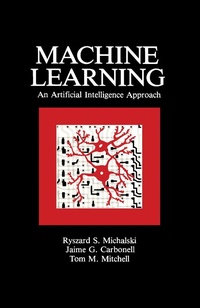
Machine Learning
An Artificial Intelligence Approach (Volume I)
1st Edition
Published on 28. June 2014
572 pages
978-0-08-051054-5 (ISBN)
Description

Machine Learning: An Artificial Intelligence Approach contains tutorial overviews and research papers representative of trends in the area of machine learning as viewed from an artificial intelligence perspective. The book is organized into six parts. Part I provides an overview of machine learning and explains why machines should learn. Part II covers important issues affecting the design of learning programs-particularly programs that learn from examples. It also describes inductive learning systems. Part III deals with learning by analogy, by experimentation, and from experience. Parts IV and V discuss learning from observation and discovery, and learning from instruction, respectively. Part VI presents two studies on applied learning systems-one on the recovery of valuable information via inductive inference; the other on inducing models of simple algebraic skills from observed student performance in the context of the Leeds Modeling System (LMS). This book is intended for researchers in artificial intelligence, computer science, and cognitive psychology; students in artificial intelligence and related disciplines; and a diverse range of readers, including computer scientists, robotics experts, knowledge engineers, educators, philosophers, data analysts, psychologists, and electronic engineers.
More details
Other editions
New editions
E-Book
02/2020
2nd Edition
Academic Press
€91.95
Available for download
Additional editions
Ryszard S. Michalski | Jaime G. Carbonell | Tom M. Mitchell
Machine Learning an Artificial Intelligence Approach (Volume I)
Book
01/1984
Morgan Kaufmann
€68.00
Shipment within 15-20 days
Ryszard S. Michalski | Jaime G. Carbonell | Tom M. Mitchell
Machine Learning
An Artificial Intelligence Approach (Volume I)
Book
01/1955
Morgan Kaufmann
€80.65
Article exhausted; check different version
Content
PrefacePart One General Issues in Machine Learning Chapter 1 An Overview of Machine Learning 1.1 Introduction 1.2 The Objectives of Machine Learning 1.3 A Taxonomy of Machine Learning Research 1.4 An Historical Sketch of Machine Learning 1.5 A Brief Reader's Guide Chapter 2 Why Should Machines Learn? 2.1 Introduction 2.2 Human Learning and Machine Learning 2.3 What is Learning? 2.4 Some Learning Programs 2.5 Growth of Knowledge in Large Systems 2.6 A Role for Learning 2.7 Concluding RemarksPart Two Learning from Examples Chapter 3 A Comparative Review of Selected Methods for Learning from Examples 3.1 Introduction 3.2 Comparative Review of Selected Methods 3.3 Conclusion Chapter 4 A Theory and Methodology of Inductive Learning 4.1 Introduction 4.2 Types of Inductive Learning 4.3 Description Language 4.4 Problem Background Knowledge 4.5 Generalization Rules 4.6 The Star Methodology 4.7 An Example 4.8 Conclusion 4.A Annotated Predicate Calculus (APC)Part Three Learning in Problem-Solving and Planning Chapter 5 Learning by Analogy: Formulating and Generalizing Plans from Past Experience 5.1 Introduction 5.2 Problem-Solving by Analogy 5.3 Evaluating the Analogical Reasoning Process 5.4 Learning Generalized Plans 5.5 Concluding Remark Chapter 6 Learning by Experimentation: Acquiring and Refining Problem-Solving Heuristics 6.1 Introduction 6.2 The Problem 6.3 Design of LEX 6.4 New Directions: Adding Knowledge to Augment Learning 6.5 Summary Chapter 7 Acquisition of Proof Skills in Geometry 7.1 Introduction 7.2 A Model of the Skill Underlying Proof Generation 7.3 Learning 7.4 Knowledge Compilation 7.5 Summary of Geometry Learning Chapter 8 Using Proofs and Refutations to Learn from Experience 8.1 Introduction 8.2 The Learning Cycle 8.3 Five Heuristics for Rectifying Refuted Theories 8.4 Computational Problems and Implementation Techniques 8.5 ConclusionsPart Four Learning from Observation and Discovery Chapter 9 The Role of Heuristics in Learning by Discovery: Three Case Studies 9.1 Motivation 9.2 Overview 9.3 Case Study 1: The AM Program; Heuristics Used to Develop New Knowledge 9.4 A Theory of Heuristics 9.5 Case Study 2: The Eurisko Program; Heuristics Used to Develop New Heuristics 9.6 Heuristics Used to Develop New Representations 9.7 Case Study 3: Biological Evolution; Heuristics Used to Generate Plausible Mutations 9.8 Conclusions Chapter 10 Rediscovering Chemistry with the BACON System 10.1 Introduction 10.2 An Overview of BACON.4 10.3 The Discoveries of BACON.4 10.4 Rediscovering Nineteenth Century Chemistry 10.5 Conclusions Chapter 11 Learning from Observation: Conceptual Clustering 11.1 Introduction 11.2 Conceptual Cohesiveness 11.3 Terminology and Basic Operations of the Algorithm 11.4 A Criterion of Clustering Quality 11.5 Method and Implementation 11.6 An Example of a Practical Problem: Constructing a Classification Hierarchy of Spanish Folk Songs 11.7 Summary and Some Suggested Extensions of the MethodPart Five Learning from Instruction Chapter 12 Machine Transformation of Advice into a Heuristic Search Procedure 12.1 Introduction 12.2 Kinds of Knowledge Used 12.3 A Slightly Non-Standard Definition of Heuristic Search 12.4 Instantiating the HSM Schema for a Given Problem 12.5 Refining HSM by Moving Constraints between Control Components 12.
