

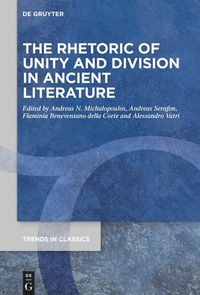
The Rhetoric of Unity and Division in Ancient Literature
Description

This volume, comprising 24 essays, aims to contribute to a developing appreciation of the capacity of rhetoric to reinforce affiliation or disaffiliation to groups. To this end, the essays span a variety of ancient literary genres (i.e. oratory, historical and technical prose, drama and poetry) and themes (i.e. audience-speaker, laughter, emotions, language, gender, identity, and religion).
More details
Other editions
Additional editions
Persons
A. Michalopoulos , Athens; A. Serafim , Cyprus; F. Beneventano della Corte , Siena; A. Vatri , Oxford.
Content
- Intro
- Contents
- Acknowledgements
- List of Tables
- Unity and Division in Ancient Literature: Current Perspectives and Further Research
- Part I: Authors, Speakers and Audience
- The Rhetoric of (Dis)Unity in the Attic Orators
- Creating a Cultural Community: Aeschines and Demosthenes
- "I, He, We, You, They": Addresses to the Audience as a Means of Unity/Division in Attic Forensic Oratory
- Rhetoric of Disunity Through Arousal of Hostile Emotions in Eisangelia Cases
- "It Takes More Love to Kill a Son than to Vindicate Him": How Maxims May Contribute to Affiliation
- Part II: Emotions
- Projective Uses of Emotions, Out-groups and Personal Characterization: The Case of Against Aristogeiton I (Dem. 25)
- Xenophon on Strategies to Maintain Unity in Armies under Stress
- Part III: Drama and Poetry
- Divided Audiences and How to Win Them Over: The Case of Aristophanes' Acharnians
- Fighting Against an Intruder: A Comparative Reading of the Speeches of Pentheus (3.531-563) and Niobe (6.170-202) in Ovid's Metamorphoses
- Humorous Unity and Disunity between the Characters in Vergil's Eclogues 1 and 2
- Part IV: Historical and Technical Prose
- Disunity and the Macedonians in the Literature of Alexander: Plutarch, Arrian and Curtius Rufus
- Divisive Scholarship: Affiliation Dynamics in Ancient Greek Literary Criticism
- The Rhetoric of Homonoia in Dio Chrysostom's Civic Orations
- Finding Unity through Knowledge: Narrative and Identity-Building in Greek Technical Prose
- Part V: Gender and the Construction of Identity
- Vanishing Mothers. The (De)construction of Personal Identity in Attic Forensic Speeches
- Cato vs Valerius/Men vs Women: Rhetorical Strategies in The Oppian Law Debate in Livy's Ab Urbe Condita
- Humanitas: A Double-edged Sword in Apuleius the Orator?
- Part VI: Religious Discourse
- Rhetoric of the Mortals, Rhetoric of the Gods. Deigmata, Phasmata and the Construction of Evidence
- Ciceronian vs Socratic Dialogue in the De divinatione
- Unity and Disunity in Paulinus of Nola Poem 24
- Note on Editors and Contributors
- General Index
- Index Locorum
