

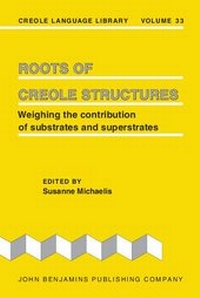
Roots of Creole Structures
Weighing the contribution of substrates and superstrates
1st Edition
Published on 29. October 2008
XVII, 425 pages
978-90-272-8996-4 (ISBN)
Description

This book reflects an ongoing shift in the study of contact languages: After a period of history-free universalism, it directs the attention to the individual historical circumstances under which the pidgin and creole languages arose. The contributions deal with different areas of language structure including phonology, morphology, and syntax, providing a wealth of structural and sociohistorical data that any comprehensive theory of contact languages will have to account for. Each of the papers provides a thorough description of a structural phenomenon against the background of the sociohistorical contact situation. The languages covered in the book are: Guiné-Bissau Creole, Haitian Creole, Hawai'i Creole, Indo-Portuguese creoles, Jamaican Creole, Lingua Franca, North American French, Mauritian Creole, Santomense, Saramaccan, Seychelles Creole, Sranan, Surinamese Maroon creoles, Vincentian Creole, and Zamboangueño Chavacano.
More details
Other editions
Additional editions
Susanne Maria Michaelis
Roots of Creole Structures
Weighing the contribution of substrates and superstrates
Book
10/2008
John Benjamins Publishing Co
€111.30
Shipment within 10-15 days
Person
Content
- Roots of Creole Structures
- Editorial page
- Title page
- LCC data
- Table of contents
- List of contributors
- Standard abbreviations
- Preface
- The problem of multiple substrates
- 1. Introduction
- 2. The historical context of creole genesis
- 3. Early English Jamaica
- 4. Sources of slaves in early English Jamaica
- 4.1 The recorded trade: Trans-Atlantic slave voyages to early English Jamaica
- 4.2 The unrecorded trade
- 4.3 Other sources of slaves
- 4.4 Ethnolinguistic origins of enslaved Africans in early English Jamaica
- 5. The myth of Akan dominance
- 6. The linguistic evidence
- 7. Conclusion
- References
- The superstrate is not always the lexifier
- 1. Introduction
- 2. The lexifier and the superstrate: The problem
- 3. Lingua Franca in Algiers
- 3.1 Historical background
- 3.2 The Lingua Franca corpus: Available evidence
- 3.3 Lingua Franca sources: Barbary Coast overview
- 4. Sociolinguistic evidence
- 4.1 Metalinguistic commentary by eyewitnesses in Algiers 1596-1830
- 4.1.1 Haedo (Spain 1612)
- 4.1.2 Dan (France 1637)
- 4.1.3 Dapper (Holland 1668)
- 4.1.4 Olufs (Denmark 1747)
- 4.1.5 Rehbinder (Germany 1798)
- 4.1.6 Pananti (Italy 1817)
- 4.1.7 Broughton (England 1839)
- 4.1.8 The Dictionnaire (French conquest from 1830)
- 4.2 Observations on eyewitness commentaries
- 5. Lexicon
- 5.1 Romance doublets
- 5.2 Cross-family doublets
- 5.3 Non-Romance lexemes
- 5.4 Blends
- 5.5 Congruence, feature pool or koiné
- 6. Discussion
- 6.1 A diachronic solution
- 6.2 Synchronic analysis of Lingua Franca in Algiers (social and linguistic factors)
- 6.3 Algiers as a place of multilingual contacts
- 7. Conclusion and implications
- References
- In praise of the cafeteria principle
- 1. Introduction
- 2. Historical background
- 2.1 The development of Hawai'i Creole
- 2.2 The substrate languages
- 3. Relative clauses
- 3.1 Data from Hawai'i Creole
- 3.1.1 Postnominal relative clauses
- 3.1.2 Prenominal relative clauses
- 3.2 Contributing languages
- 3.2.1 Hawaiian
- 3.2.2 Cantonese
- 4. Perfect aspect
- 4.1 Data from Hawai'i Creole
- 4.1.1 Postverbal marker awredi (already)
- 4.1.2 Preverbal marker pau
- 4.1.3 Preverbal marker ste (stay)
- 4.2 Contributing languages
- 4.2.1 Cantonese
- 4.2.2 Hawaiian
- 4.2.3 Portuguese
- 5. Substrate influence in other areas
- 5.1 Adjectival predication
- 5.2 Negative possessive/existential marker
- 5.3 Clausal complements
- 6. Cafeteria principle revisited
- 6.1 Mechanisms
- 6.1.1 Language transfer
- 6.1.2 Substrate reinforcement
- 6.2 Constraints
- 7. Concluding discussion
- Special abbreviations
- References
- Tense marking and inflectional morphology in Indo-Portuguese creoles
- 1. Introduction
- 1.1 The nature of inflectional morphology
- 1.2 Brief outline of the data
- 1.3 The survival of verbal inflection in creoles
- 1.4 Overall structure of the paper
- 2. The historical, social and linguistic background
- 3. Formal aspects of verbal inflection
- 3.1 Conjugation classes, theme vowels and verbal endings
- 3.2 Verbal paradigms in Portuguese
- 3.3 Summary
- 4. Verbal inflection in Indo-Portuguese creoles
- 4.1 Empirical data
- 4.1.1 Overview
- 4.1.2 Indo-Portuguese verbal paradigms
- 4.1.3 The loss of suffixes in Indo-Portuguese
- 4.2 The grammatical status of Indo-Portuguese theme vowels
- 4.2.1 Preliminary discussion
- 4.2.2 Genuine theme vowels in Indo-Portuguese
- 4.3 Summary
- 5. Accounting for the survival of overt verbal inflection
- 5.1 Decreolization, creole expansion or adult second language acquisition?
- 5.2 Adult second language acquisition
- 5.2.1 The absence of overt inflection in the basic variety
- 5.2.2 The "Post-Basic Variety"
- 5.3 Superstrate influence
- 5.4 Cross-linguistic evidence
- 5.5 Summary
- 6. New developments
- 6.1 The fourth conjugation class
- 6.2 The theme vowel -u
- 6.2.1 Origin(s)
- 6.2.2 Grammatical status
- 6.3 Summary
- 7. Final summary and conclusion
- Vowel epenthesis and creole syllable structure
- 1. Introduction
- 2. Epenthesis in Modern Sranan
- 3. The development of epenthesis in Sranan
- 3.1 Herlein 1718: Epenthesis of a context-free default vowel
- 3.2 Van Dyk 1765: Emergent vowel harmony
- 3.3 Schumann 1783: Towards the present-day system
- 3.4 The development: Summary
- 3.5 A truly historical development?
- 4. The optimality-theoretic formalization
- 4.1 An autosegmental model of OT
- 4.2 Modern Sranan rankings
- 4.3 The historical development
- 5. Substrate influence in Sranan epenthesis
- 5.1 The origin of Sranan's syllable structure constraints and default vowel
- 5.2 The development of vowel harmony
- 5.3 Default vowel and harmony unified
- 6. Superstrate influence in creole syllable structure
- 7. Conclusion
- References
- The origin of the Portuguese words in Saramaccan
- 1. Introduction
- 2. Sociolinguistic context
- 3. How did the Portuguese words get into Saramaccan?
- 4. The problem
- 5. The Kikongo factor
- 6. Searching for a Kikongo-dominated or Kimbundu-dominated social context
- 6.1 Surinam?
- 6.2 Cayenne?
- 6.3 Dutch Pernambuco?
- 6.4 Pre-Dutch Pernambuco?
- 6.5 Provisional conclusions
- 6.6 Additional evidence from continuity of Jewish families
- 7. Conclusion
- References
- Encoding path in Mauritian Creole and Bhojpuri
- 1. Introduction
- 2. The ecosystem: Mauritian Creole and Bhojpuri
- 2.1 Multilingualism in Mauritius
- 2.2 Bhojpuri, its varieties, and its relation to other Indian languages
- 2.3 Contact between Mauritian Creole and Bhojpuri
- 2.3.1 Creole influences on Bhojpuri
- 2.3.2 Bhojpuri influence on Creole
- 3. The expression of Path
- 3.2 The semantic categories: Ablative, allative and essive
- 3.2 The unmarked expression
- 3.3 The marked expression: Comparison with Lesser Antillean Creole
- 3.4 Different functions and uses of depi (& depuis) in Mauritian Creole
- 3.4.1 Local point of departure (ablative)
- 3.4.2 Local point of departure and arrival (ablative + allative)
- 3.4.3 Temporal beginning
- 3.4.4 Temporal beginning and endpoint
- 3.4.5 Temporal endpoint
- 3.4.6 Extended uses
- 3.4.7 Depi in old texts
- 4. The contribution of French and Bhojpuri to Mauritian Creole Path expressions
- 4.1 French influence
- 4.2 Bhojpuri influence
- 4.2.1 The hypothesis - marking at the lectal level
- 4.2.2 The particle se in Bhojpuri: contact with Creole
- 4.2.3 Testing our hypothesis: the use of depi in Creole not influenced by Bhojpuri
- 5. Conclusions and hypotheses
- 5.1 The structural level
- 5.2 The sociolinguistic level
- 5.3 The interpretive level: explaining language contact in oral contextuality
- Special abbreviations
- References
- Corpus and websites:
- On the principled nature of the respective contributions of substrate and superstrate languages to a creole's lexicon
- 1. Introduction
- 2.First prediction of relabelling: Principled division of properties of a creole's lexical entries between its source languages
- 3. Second prediction of relabelling: Superstrate lexical entries that have no corresponding entries in the substrate languages will not make their way into the creole
- 4. Third prediction of relabelling: Only substrate lexical entries for which there is an available "appropriate" superstate form can be relabelled
- 5. Fourth prediction of relabelling: The substrate languages will determine the parametric options of a creole
- 6. Fifth prediction of relabelling: The respective contributions of the substrate and superstrate languages to a creole's word order
- 7. Conclusion
- References
- Valency patterns in Seychelles Creole
- 1. Introduction
- 2. Socio-historical background
- 3. Superstrate, convergence and substrates
- 3.1 Possessive pronouns
- 3.2 Numerals
- 4. Ditransitive verb constructions
- 4.1 Ditransitive construction types
- 4.2 Ditransitives in Seychelles Creole
- 4.3 Ditransitive constructions in other creoles
- 5. Experiencer constructions
- 6. Simple path constructions ('to go to', 'to come from')
- 7. Caused-path constructions
- 7.1 Verbs of putting and removal
- 7.2 Verbs of pushing and pulling
- 8. Other similarities between Seychelles Creole and Bantu syntax: The polysemous relator (av)ek 'with, and'
- 8.1 Conjunctive noun phrase construction ('A and B')
- 8.2 Passive agent ('A was hit by B')
- 8.3 Expression of distance ('close to', 'far from')
- 9. Discussion and conclusion
- List of special abbreviations
- References
- A first step towards the analysis of tone in Santomense
- 1. Introduction: Previous views on Santomense tone
- 2. Four tone patterns in disyllabic nouns
- 3. Minimal pairs
- 4. Grammatical tone
- 5. Tone in monosyllabic pronouns
- 6. Origins of Santomense tones
- References
- Balanta, Guiné-Bissau Creole Portuguese and Portuguese
- 1. Introduction
- 2. Determiners
- 2.1 Determiners in Portuguese
- 2.1.1 Articles
- 2.1.2 Other determiners
- 2.1.3 Omission of the determiner
- 2.2 Determiners in Guiné-Bissau Creole Portuguese
- 2.2.1 Definite markers
- 2.2.2 Indefinite article
- 2.2.3 Omission of the determiner
- 2.3 Determiners in Balanta
- 2.3.1 Interrogative and definite determiners
- 2.3.2 Indefinite determiner
- 2.3.3 Omission of the determiner
- 3. Nouns and adjectives
- 3.1 Gender
- 3.2 Number
- 3.3 Adjectives
- 3.3.1 Adjectives in Portuguese
- 3.3.2 Adjectives in Guiné-Bissau Creole Portuguese
- 3.3.3 Adjectives in Balanta
- 4. Personal pronouns
- 5. Conclusions
- List of special abbreviations
- Symbols
- Acknowledgements
- References
- Zamboangue o Chavacano and the potentive mode
- 1. Zamboangueño Chavacano
- 2. Philippine verbal modes
- 3. Visayan stative and potentive morphology employed in Zamboangueno
- 3.1 The prefix ma-
- 3.2 The prefixes maka- and ka-
- 4. Zamboangueño expression of the potentive mode
- 4.1 Abilitative constructions with puede
- 4.2 Visayan calques using puede
- 4.3 Potentive-type constructions with puede
- 5. Conclusion
- Special abbreviations
- References
- Between contact and internal development
- 1. Introduction
- 2. The historical context
- 2. 1 Overview of the contact settings
- 2.2 Marronage
- 3. Broad Overview of the TMA system in the creoles of Suriname and in Gbe
- 4. The origin of the TMA system of the creoles of Suriname: A multi-causal approach
- 4.1S ubstrate influence: The perfective aspect category
- 4.2 Internal change: The imperfective aspect category
- 4.3 Superstrate influence: The relative past time category
- 4.4 Leveling: The case of o and sa
- 5. Conclusion
- Special abbreviations
- References
- The formation of deverbal nouns in Vincentian Creole
- 1. Introduction
- 1.1 Sociohistorical profile of St Vincent and the Grenadines
- 2. Derivational morphology in creoles
- 2.1 Overview and implications
- 2.2 The formation of deverbal nouns in VinC: Our claims
- 2.3 Substantiating directionality
- 3. Derivational processes
- 3.1 Suffixation
- 3.1.1 Deverbal nouns of events/actions
- 3.1.2 Resultative deverbals
- 3.1.3 Agentive deverbals
- 3.2 Conversion
- 3.2.1 Monosyllabic conversions
- 3.2.2 Onomatopoeic deverbal nouns
- 3.2.3 Phonological alternations
- 3.2.4 Boomerang deverbal nouns
- 3.2.5 Analysing transcategorial change
- 3.3 Inversion and deverbal compound noun formation
- 4. Summary and conclusions
- References
- A la recherche du "superstrat"
- 1. Introduction
- 2. The role of North American French in the study of creolization
- 3. Sociohistorical background on North American French
- 4. Three case studies
- 4.1 The subject pronouns
- Discussion
- 4.2 The object pronouns
- Discussion
- 4.3 The syntax of pour
- Discussion
- 5.Conclusions
- Special abbreviations
- References
- Personal name index
- Language index
- Places and Peoples index
- Part 1. Place index
- Part 2. Peoples index
- Subject index
- The series Creole Language Library
