

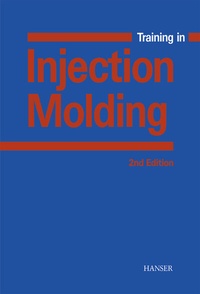
Training in Injection Molding
A Text and Workbook
1st Edition
Published on 18. March 2013
159 pages
978-3-446-40182-2 (ISBN)
Description

This text/workbook covers the entire field of injection molding - from materials, to processing, to issues of occupational safety, and to the recycling of injection molded parts. Key questions help readers work through the lesson with specific objectives in mind. Review questions allow readers to test their knowledge.
Reviews: "... accomplishes its intended purpose of being an excellent [general] teaching aid." Injection Molding
Contents:
- Basic Principles of Plastics
- The Injection Molding Machine
- The Plasticating and Injection Unit
- The Mold
- The Clamping Unit
- Drive Systems and Controls
- The Injection Molding Process
- Mold Design
- Quality Assurance in Injection Molding
- Recycling of Plastics Waste
- The Modern Injection Molding Company
- Occupational Safety Around Injection Molding Machines
- Glossary of Injection Molding Technology
More details
Other editions
Additional editions
Walter Michaeli | Helmut Greif | Gernot Kretzschmar
Training in Injection Molding
A Text and Workbook
Book
07/2001
2nd Edition
Hanser
€89.99
Article exhausted; check different version
Persons
Content
- Intro
- Foreword
- Preface
- Lessons
- Key Questions
- Prerequisite Knowledge
- Review Questions
- An Example: The Compact Disk (CD)
- Appendices
- Acknowledgments
- Contents
- Introduction Injection Molding - An Ideal Manufacturing Method
- Key Questions
- Contents
- Injection Molding - A Young Production Method
- Injection Molding - A Discontinuous Single-State Process
- Injection Molding - The Injection Molding Machine and Mold
- Lesson 1 Basic Principles of Plastics
- Key Questions
- Contents
- 1.1 Classification and Identification of Polymeric Materials (Plastics and Elastomers)
- 1.2 Deformation Characteristics of Plastics
- 1.3 Molding Compounds and Shaping Methods
- 1.4 Plastics Melts
- 1.4.1 Viscosity
- 1.4.2 Shear Stress and Shear Rate
- 1.4.3 Viscosity and Temperature
- Review Questions
- Lesson 2 The Injection Molding Machine
- Key Questions
- Contents
- Prerequisite Knowledge
- 2.1 Classification of Injection Molding Machines
- 2.2 Structural Units of Injection Molding Machines
- 2.3 Special Injection Molding Processes
- 2.3.1 Structural Foam Molding
- 2.3.2 Multi-Injection Molding Process
- 2.3.3 Injection-Compression Molding
- 2.3.4 Back-Injection Technology
- Review Questions
- Lesson 3 The Plasticating and Injection Unit
- Key Questions
- Contents
- Prerequisite Knowledge
- 3.1 Tasks of the Plasticating and Injection Unit
- 3.2 Plasticating
- 3.3 Injection
- Review Questions
- Lesson 4 The Mold
- Key Questions
- Contents
- Prerequisite Knowledge
- 4.1 Tasks and Modes of Operation
- 4.2 Gating and Runner System
- 4.2.1 Basic Principles
- 4.2.2 Gate Design
- 4.3 Cavity
- 4.4 Heating/Cooling Systems
- 4.5 Ejection System
- Review Questions
- Lesson 5 The Clamping Unit
- Key Questions
- Contents
- Prerequisite Knowledge
- 5.1 Function and Structure
- 5.2 Mechanical Clamping Units
- 5.3 Hydraulic Clamping Units
- Review Questions
- Lesson 6 Drive System and Controls
- Key Questions
- Contents
- Prerequisite Knowledge
- 6.1 Drive System
- 6.1.1 Hydraulic Drive
- 6.1.2 Electric Drives
- 6.2 Controls
- Review Questions
- Lesson 7 The Injection Molding Process
- Key Questions
- Contents
- Prerequisite Knowledge
- 7.1 Phases of an Injection Molding Cycle
- 7.2 Start
- 7.2.1 Mold and Clamping Unit
- 7.2.2 Plasticating Unit
- 7.2.3 Controls
- 7.2.4 Hydraulic- and Electrical Systems
- 7.3 Injection Phase
- 7.3.1 Mold and Clamping Unit
- 7.3.2 Plasticating Unit
- 7.3.3 Controls
- 7.3.4 Hydraulics
- 7.4 Holding Pressure Phase
- 7.4.1 Mold and Clamping Unit
- 7.4.2 Plasticating Unit
- 7.4.3 Controls
- 7.4.4 Hydraulics
- 7.4.5 Cooling Phase
- 7.4.6 Feed Phase
- 7.5 Cooling Phase
- 7.5.1 Cooling Time Equation
- 7.5.2 Mold and Clamping Unit
- 7.5.3 Plasticating Unit
- 7.5.4 Control and Hydraulic Systems
- 7.6 Feed Phase
- 7.6.1 Mold and Clamping Unit
- 7.6.2 Plasticating Unit
- 7.7 Removal from the Mold
- 7.7.1 Mold and Clamping Unit
- 7.7.2 Plasticating Unit
- 7.7.3 Hydraulics and Controls
- Review Questions
- Lesson 8 Mold Design
- Key Questions
- Contents
- Prerequisite Knowledge
- 8.1 Tasks and Specifications of Injection Molding Tools
- 8.2 The Designer's Tasks
- 8.3 Mold Layout
- 8.3.1 Overview
- 8.3.2 Rheological Mold Layout
- 8.3.3 Thermal Mold Layout
- 8.3.4 Mechanical Mold Layout
- Review Questions
- Lesson 9 Quality Assurance in Injection Molding
- Key Questions
- Contents
- Prerequisite Knowledge
- 9.1 Quality
- 9.2 Quality Assurance
- 9.3 Quality Management
- 9.3.1 The Quality Assurance Concept
- 9.4 Integrated Management Systems
- Review Questions
- Lesson 10 Recycling of Plastics Waste
- Key Questions
- Contents
- Prerequisite Knowledge
- 10.1 Reutilization of Plastics
- 10.2 Recycling of Production Waste
- 10.3 Recycling ofIndustrial and Domestic Plastics Waste
- Review Questions
- Appendix I The Modem Injection Molding Company
- Key Questions
- Contents
- Prerequisite Knowledge
- I.1 Structure of an Injection Molding Company
- I.2 Order Processing Organization within an Injection Molding Company
- I.3 Specifications for Injection Molding Companies
- Appendix II Occupational Safety Around Injection Molding Machines
- Key Questions
- Contents
- II.1 European Regulations
- II.1.1 Accident Prevention Regulations for Injection Molding Machines
- II.1.2 Endangerment and Essential Danger Areas
- II.1.3 Accident Prevention Regulation (APR) for Injection Molding Machines
- II.1.4 Implementation Instructions for APR on Injection Molding Machines
- II.2 U.S. Regulations
- II.2.1 Safety Procedures
- II.2.2 Safety Regulations and Information
- Appendix III Selected Literature
- Appendix IV Glossary of Injection Molding Technology
- Answers to Review Questions
- Lesson 1
- Lesson 2
- Lesson 3
- Lesson 4
- Lesson 5
- Lesson 6
- Lesson 7
- Lesson 8
- Lesson 9
- Lesson 10
