

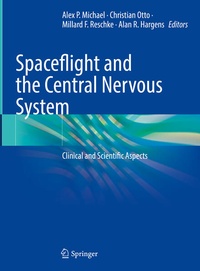
Spaceflight and the Central Nervous System
Clinical and Scientific Aspects
Published on 28. December 2022
VII, 140 pages
978-3-031-18440-6 (ISBN)
Description

This book consolidates the current knowledge of how short and long-duration spaceflight affects the anatomy and physiology of the central nervous system. It also incorporates the methodology and constraints of studying the central nervous system in space.
Chapters detail advances in imaging techniques available to assess intracranial and intraocular pathology as well as translational medicine with an emphasis on brain cancer and neurodegenerative disease in spaceflight. Additionally, the book offers theoretical background information, tested laboratory protocols, and step-by-step methods for reproducible lab experiments to aid neuroscientists and neurobiologists in laboratory testing and experimentation.
Spaceflight and the Central Nervous System is the first to comprehensively include all aspects of spaceflight-induced changes in the central nervous system. It is an invaluable resource for basic and clinical laboratory trainees and researchers in aerospace medicine and physiology or for those looking to gain specific knowledge in spaceflight neuroscience.
Chapters detail advances in imaging techniques available to assess intracranial and intraocular pathology as well as translational medicine with an emphasis on brain cancer and neurodegenerative disease in spaceflight. Additionally, the book offers theoretical background information, tested laboratory protocols, and step-by-step methods for reproducible lab experiments to aid neuroscientists and neurobiologists in laboratory testing and experimentation.
Spaceflight and the Central Nervous System is the first to comprehensively include all aspects of spaceflight-induced changes in the central nervous system. It is an invaluable resource for basic and clinical laboratory trainees and researchers in aerospace medicine and physiology or for those looking to gain specific knowledge in spaceflight neuroscience.
More details
Other editions
Additional editions
Alex P. Michael | Christian Otto | Millard F. Reschke
Spaceflight and the Central Nervous System
Clinical and Scientific Aspects
Book
12/2022
Springer
€235.39
Shipment within 15-20 days
Persons
Alex P. Michael, MD
Christian Otto, MD Director of Teleoncology, Memorial Sloan Kettering Cancer CenterFormer Lead Scientist for NASA's Visual Impairment Intracranial Pressure Risk Group
Alan R. Hargens Department of Orthopaedic SurgeryUniversity of CaliforniaSan Diego, CA
Neurological Surgeon, Mercy Clinic Neurosurgery
Christian Otto, MD Director of Teleoncology, Memorial Sloan Kettering Cancer CenterFormer Lead Scientist for NASA's Visual Impairment Intracranial Pressure Risk Group
Alan R. Hargens Department of Orthopaedic SurgeryUniversity of CaliforniaSan Diego, CA
Millard F. Reschke
Johnson Space Center
NASA Neuroscience
Houston, TX
Content
1. History of Spaceflight and the Central Nervous System.- 2. Cardiovascular Physiology and Fluid Shifts in Space.- 3. Effects of Microgravity and Space Radiation on the Nervous system.- 4. Cognitive Performance and Neuromapping.- 5. Spine Biomechanics and Pathology.- 6. Vestibular System.- 7. Why the study of intraocular pressure is important to understand and prevent SANS.- 8. Central Nervous System (CNS) Neoplasms in Microgravity.- 9. Space Renaissance and Neurodegeneration.- 10. Summary and Future Directions.
