

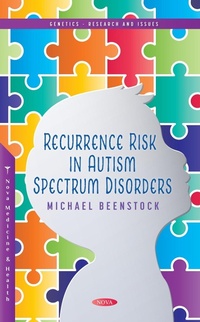
Recurrence Risk in Autism Spectrum Disorders
Published on 19. October 2021
238 pages
978-1-68507-244-5 (ISBN)
Description

The study of autism development disorders has been dominated by the neurodevelopmental paradigm for almost 50 years. This book challenges the exclusivity of the neurodevelopmental paradigm by using unique population cohort data to study recurrence risk of ASD in Israel. Randomness in the timing of ASD diagnoses of index children is exploited, as in a natural experiment, to randomize within-group reproductive stoppage. Some parents of children on the spectrum consciously refrained from reproductive stoppage by having further children. Other parents had further children before their index child was diagnosed. The former parents raised their further children having gained experience in raising children on the spectrum. The latter parents raised their children under a veil of ignorance, to be broken when their index children were diagnosed. Whereas neurodevelopmental theory predicts that recurrence risk is the same for both types of parents, behavioral theory predicts that they should be different. Population cohort data for Israel corroborate the predictions of behavioral theory. Indeed, corroboration applies in four different tests. More generally, the author calls for a level playing field in which behavioral theory of recurrence risk is placed on an equal footing as the dominant neurodevelopmental paradigm. He also argues for methodological pluralism in which the epidemiological toolbox is augmented with methods from statistics and econometrics. In summary, the author offers a critique of the current state of research on recurrence risk of ASD.
More details
Other editions
Additional editions
Michael Beenstock
Recurrence Risk in Autism Spectrum Disorders
Book
11/2021
Nova Science Publishers Inc
€210.94
Shipment within 15-20 days
Content
- Intro
- Contents
- Preface
- Chapter 1
- Recurrence Risk
- Audiences
- Plan of Study
- Chapter 2
- Recurrence Risk Theory
- Behavioral Genetics
- Behavioral Theory
- Sibling Interaction
- A Natural Experiment
- Paradigmic Ambiguity
- Chapter 3
- Methodology for Recurrence Risk
- Sampling
- Stratified Random Samples
- Clinical Samples
- Snowball and Recruited Samples
- Population Cohort Data
- Causality
- The Identification Problem
- Instrumental Variables and Natural Experiments
- Experiments with Humans
- Selection Bias
- Manski Bounds: Methodological Minimalism
- Incidental Truncation Method
- Inverse Probability Weighting (IPW)
- Confounding
- Family Metrics
- Clustering and Sibling Interaction
- Specific Effects
- Censoring
- Failure Time or Survival Analysis
- Logit and Probit Models
- Count Data
- Chapter 4
- Empirical Estimates of Recurrence Risk
- Data
- Population Cohort Data
- Clinical and Recruited Data
- Administrative Records
- Recurrence Risk: Absolute, Relative and Conditional
- Censoring
- Conditional Recurrence Risk
- Familial Recurrence Risk
- Chapter 5
- Population Cohort Data for Israel
- The National Insurance Institute
- The Incidence of ASD
- The Trend in ASD Prevalence
- International Comparisons of ASD Prevalence
- The Study Group
- Demographic Characteristics
- Age at Diagnosis
- Reproductive Stoppage
- The Veil of Ignorance and Shadow of ASD
- Age Gaps
- Recurrence Risk
- Chapter 6
- Within-Group Reproductive Stoppage in Israel
- Between-Group Stoppage
- Within-Group Stoppage
- Observables and Unobservables
- Bringing Theory to Data
- Relative Non-Stoppage
- Results
- Absolute Stoppage
- Relative Stoppage
- Discussion
- Chapter 7
- Behavioral Influences on Recurrence Risk
- Discussion
- Chapter 8
- Selection Bias in Estimates of Recurrence Risk
- Methods
- Endogenous Selection: Incidental Truncation Method (ITM)
- Exogenous Selection: Inverse Probability Weighting (IPW)
- Results
- Bringing Theory to Data
- Recurrence Risk Models
- Discussion
- Limitations
- Chapter 9
- What Have We Learned About Recurrence Risk?
- Parents
- Practitioners
- Epidemiology: Theory
- Epidemiology: Methodology
- Policy Makers
- Chapter 10
- The Transition into Adulthood with Autism Spectrum Disorders
- The Study Group
- Earnings
- Multivariate Analysis of the Transition into Adulthood
- Methodology
- Results
- Causality v Spurious State Dependence
- Discussion
- Limitations
- References
- Author Contact Information
- Index of Names
- Index of Terms
- Blank Page
- Blank Page
