

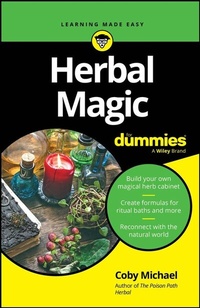
Herbal Magic For Dummies
Description

Tap into the magical properties of plants with this guide to spells and rituals from around the world
Herbal Magic For Dummies introduces you to the use of green magic to connect with the powers and energies of plants. Many books on plant magic focus only on European or Wiccan traditions-but this one takes you a step further, so you can upgrade your grimoire with occult knowledge from all times and places. With this book as your guide, you can bring herbs, essential oils, flowers, and other plants into your spell work with ease. Select the most powerful supplies from spell shops and other sources and engage responsibly with plants directly from the earth. You'll also get a useful primer on intention setting and imbuing herbs and plants with magic energy. This resource is perfect for the burgeoning green magic user.
Inside:
- Learn the history of plant magic and discover traditions from around the world
- Tap into the spiritual energies and powers of different herbs, flowers, and beyond
- Practice rituals and spells that have been passed through the ages, and develop your own
- Select the right plants for each green magic spell you cast
Connect with the earth while practicing your craft with Herbal Magic For Dummies.
More details
Other editions
Additional editions
Person
Coby Michael is an occult herbalist and magical practitioner specializing in the use of plants in ritual and ceremony. He is author of The Poison Path Herbal and runs The Poisoner's Apothecary, an online store and educational resource.
Content
INTRODUCTION 1
About This Book 1
Foolish Assumptions 3
Icons Used in This Book 3
Beyond the Book 4
Where to Go from Here 4
PART 1: PLANTING THE SEED 5
CHAPTER 1: Meeting Your Herbal Allies 7
CHAPTER 2: Working with Herbal Magic Formulas 33
CHAPTER 3: Understanding Herbal Correspondences 65
PART 2: CRAFTING SPELLS AND RITUALS 93
CHAPTER 4: Preparing Herbs for Magic 95
CHAPTER 5: Protecting Yourself and Setting Boundaries 109
CHAPTER 6: Cleansing, Purifying, and Banishing with Herbs 127
CHAPTER 7: Attracting Abundance and Prosperity 149
CHAPTER 8: Supporting the Healing of Body and Spirit 167
CHAPTER 9: Cultivating Love and Sensuality 187
CHAPTER 10: Creating Your Own Herbal Magic 203
PART 3: PARTNERING WITH NATURE 215
CHAPTER 11: Growing a Magical Herb Garden 217
CHAPTER 12: Protecting the Environment 223
PART 4: THE PART OF TENS 229
CHAPTER 13: Ten Herbs to Enhance Your Magic 231
CHAPTER 14: Ten Tips for Building Your Magical Apothecary 247
INDEX 253
Chapter 1
Meeting Your Herbal Allies
IN THIS CHAPTER
Meeting magical herbal allies
Tapping into the energy of herbs
Understanding the diversity of herbal traditions
Building the foundations of herbal knowledge
Magical herbalism conjures images of bubbling cauldrons and shimmering potions from childhood fairy tales, but when you take a closer look, you discover that it's not something from the supernatural realm. Magical herbalism is based on an ancient and intuitive understanding of the world that you live in.
In this chapter, you find that magic, like science, operates on its own system of rules. This chapter explores traditions of herbal magic from around the world and the beliefs and concepts that form the foundation of those traditions. You get to know some of the most influential figures in Western Herbalism and discover how their theories and practices, which may seem rather fantastical from today's perspective, have formed the basis of modern medicine.
Aligning Intention through Magic
Magic, in its most essential form, is the practice of aligning intention with unseen forces to produce change in the physical, mental, emotional, or spiritual realms. Magic is one of humanity's oldest beliefs found in every culture and is not merely superstition or fantasy, but a complex system of interaction between the human will and the subtle energies that permeate all levels of existence. From occult, metaphysical, and spiritual perspectives, magic is a technology of the universe, an ancient and evolving art that seeks to harness the deeper laws of Nature, spirit, and consciousness.
In occult traditions - occult meaning hidden - magic is often understood as the manipulation of hidden forces. Occult practice involves ritual, symbolism, and the use of sacred texts, tools, and formulas to influence reality. Practitioners view the universe as a web of interconnected energies governed by universal laws, and these laws are applied to affect magical acts. Magic, then, becomes a disciplined method of working within these systems, using precise rituals, divine names, planetary timing, and esoteric symbols to apply spiritual forces to create material effects.
The metaphysical perspective emphasizes magic as a natural expression of the mind's power to shape reality. Metaphysical practitioners view consciousness as the primary creative force, drawing on New Age thought - a movement focused on individual spiritual awakening, psychology, and mysticism (inner transformation through communion with the Divine). Belief (acceptance of something's truth or existence), intention (will or desire directed toward a goal), visualization (holding a mental image of something), and vibration (the energetic frequency found in all) are the core mechanisms through which reality is shaped. According to this view, thoughts are energy, and when focused with clarity and emotion, they manifest outcomes in alignment with the practitioner's inner state. Magic, therefore, isn't supernatural, but an extension of the laws of cause and effect operating on more subtle planes.
In traditional spiritual contexts, magic is often viewed as a sacred act that arises from communion with the divine, the higher self, or the spirit world. Magic was part of humankind's earliest religions and still exists today taking on new forms. Magic becomes prayer in motion, ritualized reverence, and co-creation with spiritual allies, deities, ancestors, and elemental forces (the creative and destructive forces of Nature). This approach emphasizes harmony, spiritual ethics, and the soul's journey toward growth and union with the greater whole. Magic isn't just a tool for getting what you want, but a way of living in alignment with spiritual truth and cosmic balance.
Across all these perspectives, magic is ultimately a participatory art and spiritual science, one that calls the practitioner into a deeper awareness of self, Nature, and the unseen patterns that shape life. Whether through candle spells, herbal formulas, or meditation, magic allows you to engage with reality in a way that is co-creative.
Discovering that Not All Plants Are Herbs
While the terms plants and herbs are often used interchangeably, they refer to different levels of classification. All herbs are plants, but not all plants are considered herbs. A plant is a broad term that includes all living organisms in the plant kingdom, ranging from towering trees and ornamental flowers to grasses, shrubs, and aquatic vegetation. An herb, on the other hand, is typically defined as a plant with soft, nonwoody stems that is valued for its flavor, fragrance, medicinal properties, or spiritual significance. Herbs are often used in their fresh or dried form and may include leaves, flowers, seeds, or roots, depending on the specific plant and its purpose.
In medicinal and culinary contexts, herbs are highly prized for their practical applications. Culinary herbs, such as basil, rosemary, and thyme, enhance flavor and aroma in food, while medicinal herbs, like echinacea, chamomile, and peppermint, are used in teas, tinctures, and salves for their healing properties.
Unlike many other plants, herbs are often used in small quantities but have potent effects. Their essential oils and other chemical compounds that are responsible for an herb's medicinal properties make them powerful tools in both traditional and modern herbal medicine. While many trees and shrubs also offer medicinal value, they're not always referred to as herbs unless the soft parts of the plant are used for healing.
Spiritually, herbs have long held a central place in rituals, ceremonies, and energetic practices across cultures. Whether burned as incense, placed in charms, or used in baths and anointing oils, herbs like sage, mugwort, and frankincense are used to purify, protect, and attract specific energies.
While the distinction between plant and herb is useful in certain contexts, such as botanical classification or gardening, all herbs are, fundamentally, plants. The terms are often used interchangeably in everyday language, especially when referring to botanical materials used for healing, cooking, or spiritual work. However, recognizing the unique role that herbs play within the larger plant kingdom can deepen one's appreciation for their versatility and potency.
Treating Herbs as Magical Allies
In magical practice, herbs are far more than passive ingredients or symbolic additions to spellwork: They're conscious, living allies (a concept known as animism). Just as practitioners may work with deities, ancestors, or elemental forces, herbs are part of the vast network of spirits and energies that can be called upon for assistance. Each plant carries its own intelligence, personality, and spiritual essence. These plant spirits are ancient, wise, and often eager to form relationships with those who approach them with respect and sincerity. When you include herbs, roots, woods, or resins in your rituals, you're entering into a form of partnership, inviting the presence and power of the plant's spirit into your magical workings.
Animism is the belief that all things possess a spirit or consciousness. This worldview sees the natural world as animated by an unseen spiritual essence, recognizing trees, rivers, rocks, animals, and even weather patterns as sentient or spiritually alive. Rather than placing humans above Nature, animism emphasizes interconnectedness, relationship, and reciprocity between all beings. Rooted in many Indigenous and ancient traditions across the globe, animism forms the spiritual foundation for viewing the world not as a collection of inert objects but as a living web of relationships in which each part holds meaning and agency.
In the context of plant-based spiritual practices, animism invites the practitioner to engage with herbs, roots, and trees not merely as tools or ingredients, but as conscious allies. Each plant is approached with reverence, as a being with its own unique energy, wisdom, and preferences. This perspective transforms magical herbalism into spiritual partnership where you're not using the herbs but working with them.
By honoring the spirit of the plant, practitioners can deepen their intuitive connection, receive guidance, and build more effective and ethically grounded rituals. Animism encourages you to listen to the plants you work with, fostering a practice that is not only spiritually enriching but also rooted in humility and gratitude.
Each herb has its own unique qualities and area of expertise. Some are protective guardians, such as rosemary or basil, while others are known for opening the heart to love, like damiana or rose. Mugwort may enhance dreams and psychic insight, while patchouli anchors spells in physical reality. Understanding these energetic signatures allows the practitioner to work in harmony with the natural strengths of each plant. However, simply using herbs as tools is not enough - you must also honor them as sentient beings, able to perceive or feel things. You can do so through offerings, spoken gratitude, conscious harvesting, or taking a moment to connect with the plant's energy before use. In doing so, you deepen your connection to the green world and cultivate a more reciprocal and respectful form of magic.
Working with herbs in this way...
