

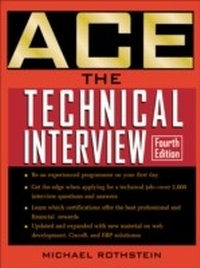
Ace the Technical Interview
1st Edition
Published on 27. October 2000
424 pages
978-0-07-148376-6 (ISBN)
Description

Land the job you want with this computer career guide--packed with interviewing techniques and thousands of answers to the toughest interview questions. Updated to cover new technologies for online jobs, SAP, Linux, Java servlets, and much more. Get the competitive edge in today's job market with this best-selling book!
More details
Other editions
Additional editions
Michael F. Rothstein | Daniel Rothstein
Ace the Technical Interview
Book
10/2000
4th Edition
Osborne/McGraw-Hill
€28.50
Article exhausted; check different version
Content
- Cover Page
- Ace the Technical Interview
- Copyright Page
- Contents
- Contributors
- Preface
- Acknowledgements
- Introduction
- 1. The Technical Interview: What You Need to Know, Say, and Do
- Gaining the Competitive Edge
- Getting Interviews
- Agencies
- The Résumé
- Preinterview Preparations
- Doing Your Homework
- Objectives
- Refresh
- Personal Appearance
- References
- Disabilities
- Different Types of Interviewers
- Screeners
- Deciders
- Personalities
- One-on-One
- Outnumbered
- The Interview
- Body Language
- Evaluating
- Responding
- Controlling the Interview
- Turning the Interview Around: Interviewing the Interviewer
- Fielding Hard-to-Handle Questions
- Managing Uncomfortable Situations
- Postinterview Follow-Up
- Negotiating for a Salaried Position
- Negotiating for a Consulting Contract
- Managing Your Expectations
- Summary
- Bibliography
- 2. HTML and XML
- Introduction
- An Introduction to HTML
- An Introduction to XML
- Level of Expertise
- Questions and Answers - HTML
- HTML - Intermediate Level
- HTML - Advanced Level
- Questions and Answers - XML
- XML - Intermediate Level
- XML - Advanced Level
- 3. Java
- Introduction
- Questions and Answers
- Beginner Questions
- Intermediate Questions
- Advanced Questions
- 4. Active Server Pages
- Introduction
- Questions and Answers
- Beginner Questions
- Intermediate Questions
- Advanced Questions
- 5. Structured Query Language (SQL)
- Datatypes
- Creating, Altering, and Dropping
- Views
- SQL Statements
- Date, Time, and Timestamp
- Triggers
- Application Programming
- Authorizations
- Joins
- Indexes
- Locks
- Explain
- Performance
- 6. Oracle
- What Is Oracle?
- Architecture
- Datafiles and Tablespaces
- Redo Log Files
- Control Files
- Oracle Memory Structures
- System Global Area (SGA)
- Oracle Background Processes
- Program Global Area (PGA)
- Accessing Data
- Oracle8i Features (Version 8.1.6)
- Beginning Skills
- Intermediate Skills
- Advanced Skills
- 7. DB2
- Database Objects:
- The Optimizer
- Index Keys
- Index Structure
- What is Multiple Index Access?
- Utilities:
- Questions and Answers:
- DB2 Creation and Control
- Performance and Indexes:
- Stored Procedures:
- Some DB2 design considerations:
- Referential Integrity:
- Applications:
- Utilities:
- 8. Visual Basic 6
- A Visual Basic Job Interview
- Questions and Answers
- Beginner
- Intermediate
- Advanced
- 9. C and C++
- Requirements for a Successful Candidate
- Advantages/Disadvantages of C++
- Advantages
- Disadvantages
- Interview Types
- An Illustration of Experience in Coding
- Beginner Questions
- Intermediate Questions
- Advanced Questions
- 10. PL/SQL
- New Features of Oracle 8i
- Questions and Answers
- Beginners
- Questions and Answers
- Advanced
- 11. Unix
- Introduction
- The Unix Job Interview
- Questions and Answers
- Beginner Questions
- Intermediate Questions
- Advanced Questions
- 12. LINUX
- Introduction
- The Linux Job Interview
- Questions and Answers
- Beginner Questions
- Intermediate Questions
- Advanced Questions
- 13. Client/Server Systems
- Keeping Pace with Change
- The Client/Server Environment: An Overview
- Networking Operating Systems
- Database Management Systems
- Methodologies and Design Techniques
- Graphical Development and Data Access Tools
- Application Programming Languages
- Enterprise Client/Server Software Packages and Groupware
- Benefits of Client/Server Architectures
- Questions and Answers
- Entry Level
- Intermediate Level
- Senior/Advanced Level
- Bibliography
- 14. CISCO
- General Networking Questions
- Cisco Troubleshooting Questions
- Routing Protocol Review
- Routed Protocol Review
- Traffic Management/Security
- LAN Switching
- WAN Connectivity
- Network Design
- 15. SAP R/3
- Beginner
- Questions and Answers
- Intermediate
- Questions and Answers
- Advanced
- Questions and Answers
- 16. Oracle Applications
- Oracle Applications Technical Environment
- Application Developer/AOL
- System Administration
- Flexfields
- Oracle Alerts
- Oracle Applications Functional Environment
- General Ledger
- Purchasing
- Accounts Payable
- Order Entry
- Accounts Receivable
- Oracle Assets
- Oracle Inventory
- Bills of Material
- Work In Process (WIP):
- Material Requirements Planning (MRP)
- Human Resources Management (HR)
- New Features in Oracle Applications 11i
- Questions and Answers: Technical Environment
- Questions and Answers: Functional Environment
- General Ledger and Fixed Assets
- Purchasing and Accounts Payables
- Order Entry & Accounts Receivable
- Inventory
- Bills of Material, WIP, and MRP
- Appendix A: Lookup Tables
- Appendix B: Options Tables
- Appendix C: Open Interfaces List (API)
- Appendix D: Vendor Interface (Pseudo Code)
- Appendix E: Environment variables file (APPLSYS.env)
