

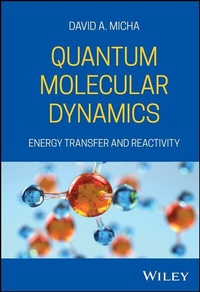
Quantum Molecular Dynamics
Description

Presents theoretical, computational, and practical aspects of collision-induced phenomena with emphasis on the treatment of physical and chemical kinetics using quantum molecular dynamics
Quantum Molecular Dynamics provides a state-of-the-art overview of molecular collisions for energy-transfer and reactivity phenomena in gases. Grounded in the quantal theory of scattering and its semiclassical limits, this comprehensive volume covers key concepts and theory, computational approaches, and various applications for specific physical systems.
Detailed chapters describe elastic, inelastic and reactive collisions, that lead to energy transfer, electronic transitions, chemical reactions, and more. Starting from the electronic structure and atomic conformation of molecules, the text proceeds from introductory material to advanced modern treatments relevant to applications to new materials, the environment, biological phenomena, and energy and fuels production.
- Provides a thorough introduction to collision dynamics with realistic intermolecular forces
- Covers thermal rates and cross sections of molecular collisions phenomena
- Examines electronic excitation and relaxation phenomena mediated by molecular collisions
- Discusses many-atom scattering theory as an introduction to more advanced descriptions
- Presents the computational aspects required to calculate and compare cross-sections with experimental data
- Includes worked examples and applications to different physical systems
Quantum Molecular Dynamics is an important resource for researchers and advanced undergraduate and graduate students in physical, theoretical, and computational chemistry, chemical physics, materials science, as well as chemists, engineers, and biologists working in the energy and pharmaceutical industries and the environment.
More details
Other editions
Additional editions
Person
David A. Micha is a Professor of Chemistry and Physics at the University of Florida. His many research interests include intermolecular forces, collisional energy transfer, electron transfer, photoinduced dynamics, reactions in gas phase collisions, energy and electron transfer, and photodynamics at solid surfaces. Dr. Micha has also been co-organizer of the international "Sanibel Symposium on Theory and Computation for the Molecular and Materials Sciences" in the USA since 1985. He is a co-editor of several science books, and author of numerous science publications. He has been the organizer of several Pan-American Workshops on Molecular and Materials Sciences.
Content
Preface x
1 Collisional Phenomena, Cross Sections, and Rates 1
1.1 Electronic and Nuclear Motions in Collisional Phenomena 1
1.2 Collisional Cross Sections 4
1.2.1 Definition of a Cross Section 4
1.2.2 Conservation Laws 5
1.2.3 Collisions in the Center of Mass Frame 5
1.2.4 Classification of Collision Processes 7
1.3 Quantal Description of Collisions 8
1.3.1 Time-Dependent Quantal States 8
1.3.2 Time-Independent Steady States 10
1.4 Examples of Physical Systems and Phenomena 11
1.4.1 Overview of Phenomena 11
1.4.2 Electronically Adiabatic Heavy-Particle Collisions 12
1.4.3 Electronically Diabatic Heavy-Particle Collisions 19
1.4.4 Electron and Photon Scattering by Molecules 22
1.5 Transport, Energy Relaxation, and Reaction Rates in Gases 26
1.6 Concepts and Methods in the Quantal Modelling 27
References 27
2 Elastic Collisions 33
2.1 Elastic Collision Cross Sections 34
2.1.1 Classical Mechanics Treatment 34
2.1.2 Quantal Treatment 39
2.1.3 Scattering Resonances and Quantal Exchange Symmetry 41
2.2 Integral Equation and Approximations 43
2.2.1 Green Functions and Integral Equations 43
2.2.2 Born Expansion 45
2.2.3 Eikonal Wavefunctions and Semiclassical Treatments 45
2.3 Partial-Wave Analysis 52
2.3.1 Radial Wavefunctions and Phase Shifts 52
2.3.2 Exceptional Cases 56
2.3.3 Radial Integral Equations 57
2.3.4 Resonance Energies and Angular Momenta 59
2.4 Numerical Methods for Scattering 61
2.4.1 Numerical Procedures for Differential Equations 61
2.4.2 Numerical Procedures for Integral Equations 63
2.4.2.1 Stepwise Solutions of the Volterra Integral Equation 63
2.4.2.2 Piecewise Solutions 64
2.4.2.3 Expansion of Amplitude Densities 65
2.4.2.4 Improvements by a Variational Procedure 66
2.4.3 Numerical Procedures for Semiclassical Scattering 67
2.4.4 Extraction of Potential Functions by Inversion 69
2.5 Examples 70
2.5.1 Atom-Atom Collisions 70
2.5.2 Electron Scattering by Atoms 71
References 72
3 Inelastic Collisions: Dynamics 75
3.1 Inelastic Collision Cross Sections 76
3.1.1 Kinematics of Inelastic Collisions 76
3.1.2 Classical Dynamics Treatment 79
3.1.3 Quantal Treatment 81
3.1.4 Semiclassical Treatment 83
3.1.4.1 Eikonal Description 83
3.1.4.2 Trajectories Description 87
3.2 Coupled-Channel Equations 89
3.2.1 Differential Equations and Boundary Conditions 89
3.2.2 Integral Equations 89
3.2.3 Partial-Wave Expansion 91
3.3 Matrix Form of Partial-Wave Equations 93
3.3.1 Differential Equations and Boundary Conditions 93
3.3.2 Integral Equations 95
3.4 Collisions Involving Two Coupled Channels 98
3.4.1 Two Open Channels 98
3.4.2 Resonances for One Open- and One Closed-Channel 99
3.5 Distorted-Waves Treatment 101
3.5.1 General Distortion Potential 101
3.5.2 Multichannel Distorted Partial-Wave Treatment 103
3.6 Optical Potential Models 105
3.6.1 Physical Models of Optical Potentials 105
3.6.2 Basis-Set Partitioning Method 107
References 108
4 Inelastic Collisions: Adiabatic Energy Transfer 111
4.1 Adiabatic Energy Transfer Cross Sections 112
4.1.1 Kinematics of Adiabatic Energy Transfer 112
4.1.2 Quantal and Semiclassical Equations for Rovibrational Energy Transfer 113
4.1.2.1 Differential Equations and Boundary Conditions 113
4.1.2.2 Integral Equations 116
4.1.2.3 Distorted-Wave Approximation 118
4.1.2.4 Semiclassical Equations 120
4.2 Numerical Methods 122
4.2.1 Step-by-Step Propagation of Wavefunctions 122
4.2.2 Piecewise Propagation 123
4.2.3 Propagation of Amplitude Densities 126
4.2.4 Variational Calculation of Scattering Amplitudes 126
4.2.5 Integration of Semiclassical Coupled Equations 128
4.3 Electronically Adiabatic Rotational Transitions 130
4.3.1 Expansion in a Basis Set of Rotor States 130
4.3.2 Helicity Representation and the Body-Fixed Frame 134
4.3.3 Atom-Polyatomic and Molecule-Molecule Collisions 136
4.4 T-R Transfer Calculations and Comparisons with Experimental Values 139
4.4.1 Approximate Treatments 139
4.4.1.1 Distorted-Wave Approximation 139
4.4.1.2 Coupled-States and Infinite-Order Sudden Approximations 140
4.4.1.3 Semiclassical Dynamics Treatments 141
4.4.2 Numerical Results 142
4.4.2.1 Numerical Results for Atom-Diatom Collisions 142
4.4.2.2 Numerical Results for Diatom-Diatom Collisions 145
4.5 Translational-Rotational-Vibrational (T-R-V) Transfer 146
4.5.1 Landau-Teller Model of T-V Transfer 146
4.5.2 Atom-Diatomic T-R-V Transfer 148
4.5.3 T-R-V Transfer Involving Polyatomic Molecules 150
4.5.4 Rates of Energy Transfer 153
4.5.4.1 Reduced Dimensionality and Optical Potential Treatments 153
4.5.4.2 Thermal Rates from Cross Sections 154
References 154
5 Electronically Diabatic Collisions 159
5.1 Expansion in an Electronic Basis Set 160
5.2 Electronic Representations 167
5.2.1 Adiabatic Representation and Momentum Couplings 167
5.2.2 Nonadiabatic Representations 168
5.2.3 Two-State Case 170
5.2.4 Fixed-Nuclei, Adiabatic, and Condon Approximations 171
5.2.5 Approximate Nonadiabatic Coupling for Same-Symmetry States 175
5.3 Collisional Coupling of Molecular Electronic States 176
5.3.1 Quantal Transition Amplitudes and Cross Sections 176
5.3.2 Non-Crossing Rule 180
5.3.3 Quantal Cross Sections of Atom-Atom Collisions 182
5.3.4 Short-Wavelength Approximation 185
5.4 Semiclassical Description 190
5.4.1 Eikonal Wavefunctions 190
5.4.2 Calculation of Nonadiabatic Dynamics for Coupled Electronic States 199
5.4.3 Short-Wavelength Approximation and Two-State Models 204
5.4.4 First-Principles Dynamics Treatments 210
5.4.4.1 Nonadiabatic Multistate Dynamics 210
5.4.4.2 First-Principles Eik/TDHF Treatment 215
5.4.4.3 Nuclear-Electronic Dynamics Treatment 217
5.5 Electronic Rearrangement for Several Interatomic Variables 218
5.5.1 Potential Energy Surfaces and Their Couplings: Multistate Cases 218
5.5.2 Crossings in Several Dimensions: Conical Intersections and Seams 219
5.5.3 Geometrical Phase and Generalizations 225
References 227
6 Reactive Collisions 233
6.1 Arrangement Channels and Coordinate Transformations 234
6.1.1 A Three-Atom System 234
6.1.2 Curvilinear and Hyper-spherical Coordinates 236
6.1.3 Arrangements and Potential Energies 237
6.2 Classical Reaction Dynamics 239
6.2.1 Atomic Rearrangements 239
6.2.2 Reaction Probabilities 240
6.3 Quantal Theory of Adiabatic Reactions 243
6.3.1 Wavemechanical Treatment 243
6.3.2 Integro-differential Equations for Reaction Amplitudes 246
6.3.3 Coupled Arrangement Channels Method 250
6.3.4 Rearrangements in a Three-atom System 251
6.4 Calculation of Adiabatic Reaction Cross Sections 252
6.4.1 Approximation of Distorted Waves for Rearrangement Collisions 252
6.4.2 Variational Calculations with Expansions in Normalizable Functions 256
6.4.3 Treatments Using Matching of Wavefunctions 260
6.4.4 Treatments Using Hyperspherical Coordinates 264
6.5 Electronically Diabatic Reactions 266
6.5.1 Quantal Treatment 266
6.5.2 Eikonal and Semiclassical Treatments 272
6.6 First-Principles (Ab initio) Treatments of Reactive Collisions 273
6.6.1 Time-dependent Eikonal Method 273
6.6.2 Wavepacket-spawning Transitions 275
6.6.2.1 Coherent-paths Treatment 276
6.7 Reduced Dimensionality, Optical-potential, and Machine-learning Treatments 277
6.7.1 Reduced Dimensionality Models 277
6.7.2 Optical Potentials Treatment 278
6.7.3 Machine-learning Procedures 279
References 281
7 The Quantum Scattering Operator and the Statistical Density Operator 287
7.1 Scattering Operators and Transition Rates 287
7.1.1 Time-dependent Treatment 287
7.1.2 Time-independent Treatment 289
7.1.3 Rates of Change of Observables 292
7.2 Partitioning the Space of State Wavefunctions 293
7.2.1 Effective Hamiltonian Operators 293
7.2.2 Optical Potentials and Scattering Resonances 295
7.3 Many-Atom Scattering Operators 297
7.3.1 Reactions in Three-atom Systems 297
7.3.2 Multiple Scattering 299
7.3.3 Coupled Arrangement-channel Effective-Hamiltonian Equations 300
7.4 Density Operator Treatments 302
7.4.1 Equation of Motion for the Density Operator 302
7.4.2 Partitioning of the Density Operator 304
7.4.3 Quantum-Classical Density Operator 306
7.4.3.1 Eikonal Representation 306
7.4.3.2 Wigner-Transform Treatment 307
7.5 Density Operator Treatments for Reactive Collisions 314
References 314
Index 319
1
Collisional Phenomena, Cross Sections, and Rates
CONTENTS
- 1.1 Electronic and Nuclear Motions in Collisional Phenomena
- 1.2 Collisional Cross Sections
- 1.3 Quantal Description of Collisions
- 1.4 Examples of Physical Systems and Phenomena
- 1.5 Transport, Energy Relaxation, and Reaction Rates in Gases
- 1.6 Concepts and Methods in the Quantal Modelling
- References
1.1 Electronic and Nuclear Motions in Collisional Phenomena
Matter consisting of particles such as atoms or molecules in a gas, where interparticle average distances are large compared to the size of the constituent particles, can be described in terms of pair interactions during collisions, insofar the probability of finding a third particle nearby is small and its effect on the interaction pair is negligible.
Collisions in a gas can be described in terms of the properties of constituent particles, their positions and velocities, and their interaction potential energies [1-4]. This can sometimes be done with classical mechanics or more generally within quantum mechanics. For colliding particles A and B, it is convenient to describe their relative motion in terms of their interparticle distance and their relative velocities. The rate of encounters (or number of collisions per unit time) is proportional to the relative flux (or number of collisions per unit time and unit area traversed by the relative-motion trajectories), with the proportionality factor equal to a collisional cross section, a measure of the diameters of the particles dependent on their relative velocity.
If the gas has been in contact with a medium of a given temperature, it will eventually reach thermal equilibrium through energy exchange during collisions, and rate processes can be assumed to occur near thermal equilibrium. This remains stable insofar individual pair interactions occur in a diluted system with low particle densities.
There is extensive literature on concepts and applications of molecular collision phenomena and their relation to experimental methods such as molecular beam scattering and spectroscopy. At the introductory level, some (among many others) relevant books are in references [5-10]. At an intermediate level, a classic text is [11] among others [12-17], dealing with quantitative treatments. Advanced treatments with extensive use of the quantum formalism of scattering theory are found in [18-24]. Applications involving models, and calculations of cross sections of interest in the interpretation of experimental results obtained with molecular beam and spectroscopic techniques, are available in [25-35], and the use of cross sections as inputs in molecular reaction rates, gaseous transport, and kinetics, can be found in [36-45]. Mathematical and computational methods developed for the calculation of cross sections can be found in [46-51]. Applications to surface phenomena are also covered in several books, among them [52-54].
The interaction of molecules with photons leading to photoinduced phenomena such as dissociation and ionization and related theory can be found in [15, 55-57], and scattering of electrons by atoms and molecules are found in [11, 58, 59]. In addition, many recent relevant chapters about molecular collisions in gases and at surfaces and about molecular interactions with photons are found in volumes of several edited series on advances, such as Advances in Chemical Physics; Advances in Quantum Chemistry; Advances in Atomic, Molecular and Optical Physics; and Annual Review of Physical Chemistry.
Given all this literature on molecular collisional phenomena and applications, it is relevant to point out why there is a need for yet another presentation of these subjects. It helps to introduce subjects in some detail, starting from fundamental concepts and proceeding to advanced methods, as done in what follows here in every chapter. Also, many new developments have occurred in recent years in new computational methods prompted by the derivation of new algorithms and by the availability of more powerful computer hardware and software. Many new results have been generated involving complex phenomena and for larger molecular systems. Recent developments in information sciences and artificial intelligence provide large amounts of organized relevant data and ways to retrieve it. The language of concepts and methods in what follows provides tools to access desired data. They provide new insights and data useful in many applications. Some of these new methods and results are integrated into what follows after covering the traditional subjects on molecular collisions and gaseous kinetics. The presentation in each chapter begins at a level accessible to undergraduate students with knowledge of differential equations and special functions, who are familiar with introductions to quantum mechanics, and proceeds to present recent developments.
Insights on the quantum dynamics of molecular interactions involving a many-atom system can best be derived from the interplay of accurate experimental measurements, such as those obtained from crossed molecular beams or from time-resolved spectroscopy, and detailed theoretical treatments from quantum mechanics and statistics. Theory provides an interpretation of measurements and resulting data on molecular interactions and dynamics, while experimental measurements provide checks on the accuracy of models and calculations.
Figure 1.1 shows relationships mediated by quantum chemistry, molecular dynamics, and statistical mechanics, leading from electrons, nuclei, and photons present in molecules and electromagnetic fields, to physical properties. Collisional cross sections, transport coefficients, and reaction rates follow from potential energy functions by means of molecular dynamics and statistical mechanics. Obtained from reference [4].
Figure 1.1 Relationships mediated by quantum chemistry, molecular dynamics, and statistical mechanics, leading from electrons, nuclei, and photons present in molecules and electromagnetic fields, to physical properties. Collisional cross sections, transport coefficients, and reaction rates follow from potential energy functions by means of molecular dynamics and statistical mechanics.
Obtained from reference [4] / John Wiley & Sons.
1.2 Collisional Cross Sections
1.2.1 Definition of a Cross Section
Let us consider a collision process
where the collision species A, B, C, and D may be electrons, atoms, molecules, ions, photons, or even a surface. The index p is a collection of quantum numbers specifying the internal (electronic and rovibrational) state of A, and similarly for the others. The pair (p, q) and the initial relative motion momentum define the reactant-channel state , and similarly ß is used for products C and D and final momentum .
For two stationary beams with velocities and colliding in a laboratory (LAB) frame, as shown in Figure 1.2, with an incoming flux of A relative to B, equal to the number of A particles moving toward B per unit area and unit time, with nA (or nB) the number of particles A (or B) per unit volume, the increment of the a ß reaction rate (pairs/unit time) may be expressed as
Here = is the relative velocity of the particles, t is the reaction volume, and dOC is an increment of solid angle subtended by the detector of emerging product species C.
Figure 1.2 Two stationary beams with velocities and colliding in a laboratory (LAB) frame, leading to the formation of species C and D. Here t is the reaction volume and dOC is an increment of solid angle subtended by the detector of particle C.
Hence nB t is the number of particles B in the reaction volume and nA is the flux of particles A relative to each B. The function is a differential cross section in the laboratory frame, with units of area. The integral cross section is defined by
1.2.2 Conservation Laws
As long as each pair collision may be considered an isolated event, we must have conservation of the total mass, momentum, angular momentum, and energy of the system. Indicating the final values with primed symbols, we have conservation of
- (a) Mass,...
