

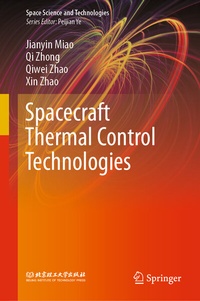
Spacecraft Thermal Control Technologies
1st Edition
Published on 19. August 2020
XIV, 360 pages
978-981-15-4984-7 (ISBN)
Description

This book presents fundamental theories, design and testing methodologies, and engineering applications concerning spacecraft thermal control systems, helping readers gain a comprehensive understanding of spacecraft thermal control systems and technologies. With abundant design methods, advanced technologies and typical applications to help them grasp the basic concepts and principles of engineering applications, it is mainly intended for engineering and technical staff engaged in spacecraft thermal control areas.
The book discusses the thermal environments commonly used for space flight missions, rules and regulations for system design, thermal analysis and simulation, and thermal testing methods, as well as the design and validation of the thermal control systems for Chinese spacecraft, such as the Shenzhou spacecraft and Chang'e Lunar Lander and Rover. It also introduces them to communication and remote sensing satellites and presents advanced thermal control technologies developed in recent years, including heat transfer, heat insulation, heating, refrigeration and thermal sensor technologies.
Addressing the design and validation of thermal control systems for various types of Chinese spacecraft, the book offers a valuable theoretical and practical reference guide for researchers and engineers alike.
The book discusses the thermal environments commonly used for space flight missions, rules and regulations for system design, thermal analysis and simulation, and thermal testing methods, as well as the design and validation of the thermal control systems for Chinese spacecraft, such as the Shenzhou spacecraft and Chang'e Lunar Lander and Rover. It also introduces them to communication and remote sensing satellites and presents advanced thermal control technologies developed in recent years, including heat transfer, heat insulation, heating, refrigeration and thermal sensor technologies.
Addressing the design and validation of thermal control systems for various types of Chinese spacecraft, the book offers a valuable theoretical and practical reference guide for researchers and engineers alike.
Reviews / Votes
"This book is very well written, containing informative details about the subject matter discussed in each chapter. The book is full of mathematical formulae, graphs and pictures. . this book is definitely worth reading. The days spent reading this book were most interesting and I have learned much new information. If you are a student in the field, scientist, professor or simply a fanatic for space and the universe this is the book that you need to read." (Sara Gligoroska, Johnson Matthey Technology Review, Vol. 65 (4), 2021)More details
Series
Language
English
Place of publication
Singapore
Singapore
Publishing group
Springer Singapore
Target group
Professional and scholarly
Product notice
Reflowable
Illustrations
XIV, 360 p. 229 illus., 20 illus. in color.
File size
15,07 MB
ISBN-13
978-981-15-4984-7 (9789811549847)
DOI
10.1007/978-981-15-4984-7
Schweitzer Classification
Other editions
Additional editions
Jianyin Miao | Qi Zhong | Qiwei Zhao
Spacecraft Thermal Control Technologies
Book
08/2020
Springer
€267.49
Shipment within 3-4 weeks
Persons
Jianyin Miao is an MIT Visiting Professor, Director of the Beijing Key Laboratory of Space Thermal Control Technology and Head Scientist of Heat Pipes at the China Academy of Space Technology. He is also the Academic Leader for space thermal control technology at the China Aerospace Science and Technology Corporation, and a member of the editorial committee of Spacecraft Engineering. Dr. Miao has carried out innovative work on spacecraft thermal control and made outstanding contributions to the success of China's Chang'e-3 lunar missions.
Qi Zhong is a Research Fellow and an expert on aerospace thermal control at the Institute of Spacecraft System Engineering, CAST. He is also an Academic and Technological Leader at the China Aerospace Science and Technology Corporation. Actively engaged in spacecraft thermal control subsystem design, thermal analysis research and thermal control subsystem development, he has received 6 awards for scientific and technological achievements, holds 20 invention patents and has published more than 40 papers.
Dr. Qiwei Zhao is a Professor of Space Thermophysics at Institute of Spacecraft System Engineering,CAST and a member of the editorial committee of Spacecraft Engineering. Dr. Zhao was responsible for the thermal control design and testing of Chinese tracking and data relay satellites. He has also been an advisor on thermal control design for the development of various communication satellite platforms, e.g. the DFH-4S, DFH-4E and DFH-5.
Professor Xin Zhao serves on the professional committee of the Science and Technology Commission of Institute of Spacecraft System Engineering. He has been actively engaged in research on technologies for thermal control design and thermal analysis. For the past few decades, he has served as the Chief Designer of thermal control subsystems for many spacecraft. He has received several national or ministerial science and technology awards including the Second Class Prize of the National Science and Technology Progress Award.
Qi Zhong is a Research Fellow and an expert on aerospace thermal control at the Institute of Spacecraft System Engineering, CAST. He is also an Academic and Technological Leader at the China Aerospace Science and Technology Corporation. Actively engaged in spacecraft thermal control subsystem design, thermal analysis research and thermal control subsystem development, he has received 6 awards for scientific and technological achievements, holds 20 invention patents and has published more than 40 papers.
Dr. Qiwei Zhao is a Professor of Space Thermophysics at Institute of Spacecraft System Engineering,CAST and a member of the editorial committee of Spacecraft Engineering. Dr. Zhao was responsible for the thermal control design and testing of Chinese tracking and data relay satellites. He has also been an advisor on thermal control design for the development of various communication satellite platforms, e.g. the DFH-4S, DFH-4E and DFH-5.
Professor Xin Zhao serves on the professional committee of the Science and Technology Commission of Institute of Spacecraft System Engineering. He has been actively engaged in research on technologies for thermal control design and thermal analysis. For the past few decades, he has served as the Chief Designer of thermal control subsystems for many spacecraft. He has received several national or ministerial science and technology awards including the Second Class Prize of the National Science and Technology Progress Award.
Content
Introduction.- Space Environment.- Design of Spacecraft Thermal Control Subsystem.- Typical Thermal Control Technologies for Spacecraft.- Typical Thermal Control Design Cases of Spacecraft.- Thermal Analysis Technology.- Spacecraft Thermal Testing.
