

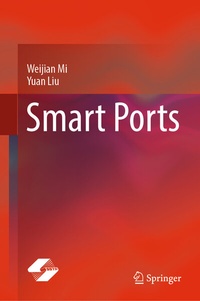
Smart Ports
Description

This book demonstrates the concept of ecological system of the smart ports. The innovation is emphasized as the essence of the ecological system as well as the prerequisite and foundation of sustainable development of smart ports. The main supporting technologies of smart ports, including cyber-physical system, middle-office system, blockchain, artificial intelligence, machine vision, AR/VR, system simulation and emulation, digital monitoring and diagnosis, etc., are introduced with concepts and development descriptions as well as practical application cases. It could be used as demonstration and reference for the administrative staff, engineers and technicians as well as researchers in construction and operation of smart ports.
More details
Other editions
Additional editions
Persons
Weijian Mi received his Ph.D. in Mechanical Engineering from Tongji University. He is now Full Professor of College of Logistics Engineering, Shanghai Maritime University. He now serves as Executive Director of China Logistics Association, Director of Fault Diagnosis Technology Committee of China, Executive Director of China Mechanical Engineering Society, Secretary General of Testing and Controlling branch of China Construction Machinery Association, Vice Chairman of Shanghai Vibration Engineering Society, and Associate Managing Editor of Chinese Journal of Construction Machinery and Journal of Shanghai Maritime University . Professor Mi directs a research team working on Port Intelligence and Port Machinery Maintenance. His current research interests include terminal operation and resource optimization, port logistics simulation optimization, and port machinery fault diagnosis. Professor Mi has led his research team to win the National Award for Progress in Science and Technology (second class), Golden Award of Next Generation Automated Container Terminal Challenge in Singapore, and the Shanghai Award for Progress in Science and Technology (second class).
Yuan Liu, from Shanghai Maritime University, China, received her PhD from Tongji University. She has studied as visiting scholar at Vienna University of Technology, Austria, and taught Manufacturing Processes at Saint Martine's University, US. Now she mainly teaches Statics and Mechanics of Materials, Engineering Design Methodology, Manufacturing Processes, etc. Her research interests are rolling contact fatigue between rail and wheel, safety evaluation and management of metal structures of large port machinery, intelligent logistics of ports, etc. Dr. Liu has published 8 papers as the first author in
JOURNAL OF APPLIED SCIENCE
,
Engineering Mechanics
,
JOURNAL OF COASTAL RESEARCH
and other domestic and foreign journals, among which 1 paper were included in SCI and 3 in EI. Her industrial experience includes work and research in metal structure tests of cranes in Tianjin Port, Shanghai Port, Zhanjiang Port, etc., in China.
