

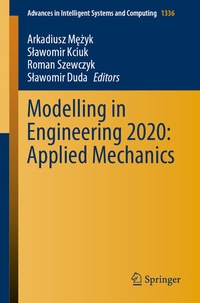
Modelling in Engineering 2020: Applied Mechanics
Published on 12. February 2021
IX, 289 pages
978-3-030-68455-6 (ISBN)
Description

This book includes the outcomes of the 59th Symposium "Modelowanie w Mechanice" (Engineering Modelling in Mechanics) held in Ustron from 22 February to 26 February 2020. The International Conference has an over 58-year-old history and is organized by the Department of Theoretical and Applied Mechanics of Silesian University of Technology under the patronage of the Polish Society of Theoretical and Applied Mechanics, Gliwice Branch.
Subjects of the conference are modelling of mechatronic systems, machinery dynamics, control systems, sensitivity analysis and optimization, numerical modelling and experimental methods in mechanics, biomechanics, heat flow analysis, fluid mechanics, etc. The papers are dealing with interdisciplinary problems in which mechanical phenomena are of decisive importance.
The potential reader of this book will find their set of papers concentrated on the use of computer-aided design, virtual modelling, numerical simulations, fast prototyping and experimental tests of mechanical systems. It is an area of versatile and interdisciplinary research trends with one of the mainstreams focusing on applied mechanics .
Subjects of the conference are modelling of mechatronic systems, machinery dynamics, control systems, sensitivity analysis and optimization, numerical modelling and experimental methods in mechanics, biomechanics, heat flow analysis, fluid mechanics, etc. The papers are dealing with interdisciplinary problems in which mechanical phenomena are of decisive importance.
The potential reader of this book will find their set of papers concentrated on the use of computer-aided design, virtual modelling, numerical simulations, fast prototyping and experimental tests of mechanical systems. It is an area of versatile and interdisciplinary research trends with one of the mainstreams focusing on applied mechanics .
More details
Series
Edition
1st ed. 2021
Language
English
Place of publication
Cham
Switzerland
Publishing group
Springer International Publishing
Target group
Professional and scholarly
Product notice
Reflowable
Illustrations
IX, 289 p. 243 illus., 202 illus. in color.
File size
69,59 MB
ISBN-13
978-3-030-68455-6 (9783030684556)
DOI
10.1007/978-3-030-68455-6
Schweitzer Classification
Other editions
Additional editions
Arkadiusz Mezyk | Slawomir Kciuk | Roman Szewczyk
Modelling in Engineering 2020: Applied Mechanics
Book
02/2021
Springer
€213.99
Shipment within 7-9 days
Content
- Intro
- Foreword
- Contents
- Mechatronics Systems Modelling Challenges and Threats
- 1 Mechatronics Systems
- 2 Mechatronics Systems Modelling [1]
- 3 Challenges and Threats
- 4 Summary
- References
- The Effects of the Aeration Phenomenon on the Performance of Hydraulic Shock Absorbers
- 1 Introduction
- 2 Theoretical Background
- 2.1 Shock Absorber Device
- 2.2 Gas Solubility
- 2.3 Automatic Shape Identification
- 2.4 Savitzky-Golay Filters
- 2.5 Signal Processing
- 2.6 Statistical Methods in the Design of Experiments (DOE)
- 3 Formulation of the Mathematical Model
- 3.1 Force Equilibrium Equation
- 3.2 Modeling Flow Through Restrictions
- 3.3 Aeration Effect as a Two-Phase Flow
- 4 Experimental Setup
- 4.1 Tooling
- 4.2 Measurement Chain
- 4.3 Design of the Experiment
- 5 Data Analysis
- 6 Conclusions
- References
- Development of Unmanned Cargo VTOL Aircraft
- 1 Introduction
- 2 Research Methodology and Design Assumptions
- 3 CAD Design and Mechanical Construction
- 3.1 Fuselage
- 3.2 Wing
- 3.3 Engine Nacelles and Fairings
- 3.4 Cargo Compartment
- 4 CFD Analysis
- 5 Conclusions
- References
- Model Tests of the Effect of the Column Centre of Gravity Position on the Value of the Passive Safety Coefficient ASI During Impact
- 1 Introduction
- 2 Test Stand
- 3 Results
- 4 Conclusion
- References
- Implications of the Lifting Method on Stress Distribution in the Conveyor Belt
- 1 Introduction
- 2 Numerical Studies
- 2.1 Conveyor Belt Lifting with a Chain
- 2.2 Conveyor Belt Lifting with a Pipe
- 3 Conclusions
- References
- The Active Synthesis in Vibration Reduction Using the Example of Driving Systems
- 1 Introduction
- 2 Synthesis of Driving Systems
- 3 Active Synthesis of Driving Systems
- 4 Numerical Example
- 5 Conclusions
- References
- Creating an Integrated Model of a Technical System with Use of the Mechatronic Features
- 1 Introduction
- 2 Definition of the Mechatronic Features
- 3 Object of the Integration Process
- 4 Model of the Drive in the Mechatronic Features Description
- 5 The Integrated Model of the Technical System with Use of the Mechatronic Features
- 6 Conclusions
- References
- Analysis of Off-Grid Hybrid Solar - Wind Power Plant
- 1 Introduction
- 2 Design Assumptions
- 3 Configuration of Wind - Solar Hybrid Power Generation System
- 4 Analysis of Results Obtained from Numerical Simulations
- 5 Conclusions
- References
- The Automatic License Plate Recognition System Based on Video Sequences Using Artificial Neural Networks
- 1 Introduction
- 2 Overview of the ALPR System
- 3 Development of the ALPR System Application
- 4 Conclusions
- References
- Analysis of the Form the Constructional Orthosis Sloppy Foot
- 1 Introduction
- 2 Analysis of Available Solutions
- 3 Description of the Case
- 4 Concepts for Dog Paw Stabilization Device
- 4.1 Concept I
- 4.2 Concept II
- 4.3 Concept III
- 5 The Multi Criteria Analysis
- 6 Summary
- References
- Optimization of the Drilling Process in Multi-hole Objects
- 1 Introduction
- 2 Subject Matter
- 3 Hole Drilling Algorithm
- 4 Optimization Algorithm
- 5 Summary
- References
- Comparative Tests of Static Properties of Steel and Polymer Concrete Machine Tool Body Elements
- 1 Introduction
- 2 Research Object
- 2.1 Test Stand
- 3 Test Results and Conclusions
- References
- The Use of Beta Statistical Distribution in Speed Modeling Of Military High Mobility Wheeled Vehicle In Proving Ground Tests
- 1 Introduction
- 2 Vehicle Usage Model for Qualification Tests
- 3 Vehicle Speed Distributions for Profile Ground Tests
- 4 The Analysis of Possible Vehicle Speeds
- 5 Conclusions
- References
- Identification of the Mathematical Model of the Bucket Conveyor
- 1 Introduction
- 2 Assumptions
- 3 Structure of the Measuring System
- 4 Model Identification
- 4.1 Assessment of the Model Structure
- 5 Conclusions
- References
- Selected Problems of the Numerical Capacity Assessment for Floating Systems
- 1 Introduction
- 2 Subject of Research and Methodology
- 3 Research Methodology
- 4 Selected Aspects of Numerical Analysis of the Floating Systems Strength
- 5 Conclusions
- References
- Investigation of Helicopter Impact on Structural Vibrations of Elevated Helipads
- 1 Introduction
- 2 Measurement Method
- 3 Results
- 4 Conclusions
- References
- The Use of Alginate Mass to Obtain Limb Geometry for the Sake of Human and Animal Limb Prosthesis
- 1 Introduction
- 2 Methods of Obtaining Geometry of a Limb Stump
- 3 Material and Method of Casting the Human and Dog Limb
- 4 3D Scanning and Printing of Limb
- 5 Summary
- References
- Intelligent Drive in Industry 4.0 - Protection of Toothed Belt Transmission on the Basis of Its Digital Twin
- 1 Introduction
- 2 Methods
- 2.1 Concept of Digital Twin Auto Validation
- 2.2 Concept of Integrating Real Object with Its Numerical Replica - Simulation Control
- 2.3 Concepts for Automatic Reasoning on Operational Status, Using Digital Twin
- 3 Results
- 4 Discussion and Conclusions
- 4.1 Further Research Perspectives
- References
- Assessment Method of Machinery Technical Safety in the Aspect of Virtual Commissioning of Machines
- 1 Introduction
- 2 Technical Safety Assessment Method
- 2.1 Formal and Legal Analysis of the Respective Requirements, Based on the Existing Information Resources
- 2.2 Selection of the Risk Assessment Model
- 2.3 Selection of the Hazard Analysis Type Depending on the System Life Cycle Stage
- 2.4 Correlation of the Adequate Hazard Analysis Methods with a Selected Type of Analysis
- 2.5 Determination of the Risk Estimation Tool
- 2.6 Adopting a Model Determining the Acceptable Risk Value
- 2.7 Selecting the Risk Reduction Model
- 3 Summary
- References
- Testing the Motion Resistance of Angular Contact Spindle Bearings for Different Ways of Preload Implementation
- 1 Introduction
- 2 Test Rig
- 3 Measuring Setup and Sample Results
- 4 Test Results
- 5 Summary
- References
- Example of Using Smoothed Particle Hydrodynamic Method in the Design of Angler Fishing Float
- 1 Introduction
- 2 Experimental Hydrodynamic Research
- 3 Numerical Model
- 4 Comparing Results from Measurements with Numerical Simulation
- 5 Conclusion
- References
- Analysis of the Impact of Dynamic Loads on Transmission Shafts of a Civil Aircraft
- 1 Introduction
- 2 Analysis of Dynamic Load
- 2.1 Random Vibration Case
- 2.2 High Level Short Duration (HLSD) Vibration Case (High Constant Amplitude Harmonic Excitation)
- 3 Application of the Steady State Dynamics Theory for Problem Analysis
- 4 Correlation Numerical Environment with Test Data
- 5 Finite Element Analysis of Transmission Shaft for Critical Load Case
- 6 Discussion of Results, Conclusions and Sketching the Direction of Further Research and Analysis
- References
- Numerical Analysis of Fragmentation and Bullet Resistance of Various Steel Thicknesses and Composite Plates
- 1 Introduction
- 2 Fragmentation Resistant Analysis
- 2.1 Steel plate's Analysis
- 2.2 Epoxy/aramid Composite
- 3 Steel plate's Analysis of Bullet-Proofing
- 4 Conclusion
- References
- Structural Analysis of 6R Robotic Arm. Comparison of Different Complexity Models
- 1 Introduction
- 2 Problem
- 3 Robotic Arm Design
- 4 Methodology
- 5 Experiment
- 6 Results
- 6.1 Model Type Comparison (Case 1A, 2A, 3A)
- 6.2 Mass Type Comparison (Case 1A and 1B)
- 6.3 Model and Mass Comparison (Case 1B, 2B, 3B)
- 7 Conclusion
- 8 Future Plans
- References
- Finite Element Analysis of Stress Distribution in the Node Region of Isogrid Thin-Walled Panels
- 1 Introduction
- 2 Experimental Investigations
- 3 Numerical Analyses
- 4 Comparison of Results
- 5 Conclusions
- References
- Author Index
