

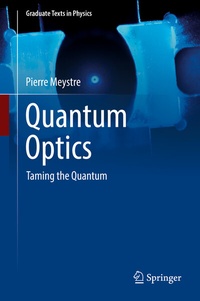
Quantum Optics
Description

This book is a thoroughly modern and highly pedagogical graduate-level introduction to quantum optics, a subject which has witnessed stunning developments in recent years and has come to occupy a central role in the 'second quantum revolution'. The reader is invited to explore the fundamental role that quantum optics plays in the control and manipulation of quantum systems, leading to ultracold atoms, circuit QED, quantum information science, quantum optomechanics, and quantum metrology. The building blocks of the subject are presented in a sequential fashion, starting from the simplest physical situations before moving to increasingly complicated ones. This pedagogically appealing approach leads to quantum entanglement and measurement theory being introduced early on and before more specialized topics such as cavity QED or laser cooling. The final chapter illustrates the power of scientific cross-fertilization by surveying cutting-edge applications of quantum optics and optomechanics in gravitational wave detection, tests of fundamental physics, searches for dark matter, geophysical monitoring, and ultraprecise clocks. Complete with worked examples and exercises, this book provides the reader with enough background knowledge and understanding to follow the current journal literature and begin producing their own original research.
Reviews / Votes
"Quantum Optics is highly recommended. . comprehensive in its advanced treatment of the theory's mathematical and physical foundations, and in its description of the key experiments and devices; clearly written and well illustrated. A suggested prerequisite is a rigorous introductory course on quantum optics. . the exemplary, detailed treatments of entanglement, measurements, laser cooling and optical lattices, gravity, and dark matter and energy are notable. Problem sets and references augment the reader's understanding." (Barry R. Masters, Optics & Photonics News, osa-opn.org, January 27, 2022)More details
Other editions
New editions
Additional editions
Person
Pierre Meystre obtained his Physics Diploma and PhD from the Swiss Federal Institute of Technology (EPFL) in Lausanne and his Habilitation in Theoretical Physics from the Ludwig Maximilian University of Munich. He joined the Max-Planck Institute for Quantum Optics in 1977, following a postdoctoral position at the University of Arizona College of Optical Sciences. He returned to Tucson in 1986, where he is now emeritus Regents Professor of Physics and Optical Sciences. He also served as Lead Editor of Physical Review Letters and as Editor in Chief of the American Physical Society. His research interests include theoretical quantum optics, ultracold science, and quantum optomechanics. He has published well over 300 papers, and is the author of the text "Elements of Quantum Optics", now in its 4 th edition, together with Murray Sargent III, and of the monograph "Atom Optics." He was a recipient of the Humboldt Foundation Research Prize for Senior US Scientists, the R. W. Wood Prize of the Optical Society of America, and the Willis E. Lamb Award for Laser Science and Quantum Optics. He is a Fellow of the American Physical Society, the Optical Society of America, and the American Association for the Advancement of Science, and Honorary Professor at East China Normal University.
Content
Chapter 1. Semiclassical atom-light interaction.- Chapter 2. Electromagnetic field quantization.- Chapter 3. The Jaynes-Cummings model.- Chapter 4. Composite systems and entanglement.- Chapter 5. Coupling to reservoirs.- Chapter 6. Quantum measurements.- Chapter 7. Tailoring the environment - cavity QED.- Chapter 8. Mechanical effects of light.- Chapter 9. Laser cooling.- Chapter 10. Bose-Einstein condensation.- Chapter 11. Quantum optomechanics.- Chapter 12. Outlook.
