

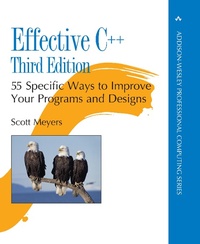
Effective C++
55 Specific Ways to Improve Your Programs and Designs
3rd Edition
Published on 12. May 2005
320 pages
978-0-13-270206-5 (ISBN)
Description

"Every C++ professional needs a copy of Effective C++. It is an absolute must-read for anyone thinking of doing serious C++ development. If you've never read Effective C++ and you think you know everything about C++, think again."
- Steve Schirripa, Software Engineer, Google "C++ and the C++ community have grown up in the last fifteen years, and the third edition of Effective C++ reflects this. The clear and precise style of the book is evidence of Scott's deep insight and distinctive ability to impart knowledge."
- Gerhard Kreuzer, Research and Development Engineer, Siemens AG The first two editions of Effective C++ were embraced by hundreds of thousands of programmers worldwide. The reason is clear: Scott Meyers' practical approach to C++ describes the rules of thumb used by the experts - the things they almost always do or almost always avoid doing - to produce clear, correct, efficient code.
The book is organized around 55 specific guidelines, each of which describes a way to write better C++. Each is backed by concrete examples. For this third edition, more than half the content is new, including added chapters on managing resources and using templates. Topics from the second edition have been extensively revised to reflect modern design considerations, including exceptions, design patterns, and multithreading.
Important features of Effective C++ include:
Expert guidance on the design of effective classes, functions, templates, and inheritance hierarchies.
Applications of new "TR1" standard library functionality, along with comparisons to existing standard library components.
Insights into differences between C++ and other languages (e.g., Java, C#, C) that help developers from those languages assimilate "the C++ way" of doing things.
- Steve Schirripa, Software Engineer, Google "C++ and the C++ community have grown up in the last fifteen years, and the third edition of Effective C++ reflects this. The clear and precise style of the book is evidence of Scott's deep insight and distinctive ability to impart knowledge."
- Gerhard Kreuzer, Research and Development Engineer, Siemens AG The first two editions of Effective C++ were embraced by hundreds of thousands of programmers worldwide. The reason is clear: Scott Meyers' practical approach to C++ describes the rules of thumb used by the experts - the things they almost always do or almost always avoid doing - to produce clear, correct, efficient code.
The book is organized around 55 specific guidelines, each of which describes a way to write better C++. Each is backed by concrete examples. For this third edition, more than half the content is new, including added chapters on managing resources and using templates. Topics from the second edition have been extensively revised to reflect modern design considerations, including exceptions, design patterns, and multithreading.
Important features of Effective C++ include:
Expert guidance on the design of effective classes, functions, templates, and inheritance hierarchies.
Applications of new "TR1" standard library functionality, along with comparisons to existing standard library components.
Insights into differences between C++ and other languages (e.g., Java, C#, C) that help developers from those languages assimilate "the C++ way" of doing things.
More details
Edition
3rd edition
Language
English
Place of publication
Boston
United States
Publishing group
Pearson Education (US)
Target group
College/higher education
ISBN-13
978-0-13-270206-5 (9780132702065)
Copyright in bibliographic data and cover images is held by Nielsen Book Services Limited or by the publishers or by their respective licensors: all rights reserved.
Schweitzer Classification
Other editions
Additional editions
Scott Meyers
Effective C++: 55 Specific Ways to Improve Your Programs and Designs
55 Specific Ways to Improve Your Programs and Designs
Book
06/2005
3rd Edition
Addison Wesley
€48.99
Shipment within 10-20 days
Person
Scott Meyers is one of the world's foremost authorities on C++, providing training and consulting services to clients worldwide. He is the author of the best-selling Effective C++ series of books (Effective C++, More Effective C++, and Effective STL) and of the innovative Effective C++ CD. He is consulting editor for Addison Wesley's Effective Software Development Series and is a founding member of the Advisory Board for The C++ Source (http://www.artima.com/cppsource). He holds a Ph.D. in Computer Science from Brown University. His web site is http://www.aristeia.com.
Content
Chapter 1: Accustoming Yourself to C++
Chapter 2: Constructors, Destructors, and Assignment Operators
Chapter 3: Resource Management
Chapter 4: Designs and Declarations
Chapter 5: Implementations
Chapter 6: Inheritance and Object-Oriented Design
Chapter 7: Templates and Generic Programming
Chapter 8: Customizing new and delete
Chapter 9: Miscellany
Appendix A: Beyond Effective C++
Appendix B: Item Mappings Between Second and Third Editions
Index
Chapter 2: Constructors, Destructors, and Assignment Operators
Chapter 3: Resource Management
Chapter 4: Designs and Declarations
Chapter 5: Implementations
Chapter 6: Inheritance and Object-Oriented Design
Chapter 7: Templates and Generic Programming
Chapter 8: Customizing new and delete
Chapter 9: Miscellany
Appendix A: Beyond Effective C++
Appendix B: Item Mappings Between Second and Third Editions
Index
