

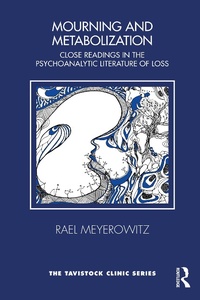
Mourning and Metabolization
Close Readings in the Psychoanalytic Literature of Loss
1st Edition
Published on 30. November 2022
438 pages
978-1-000-77632-4 (ISBN)
Description

By bringing together perspectives from psychoanalysis and literary studies and considering the reciprocal relation between ideas about mourning and our internal worlds, this book provides a guide to thinking theoretically about loss and how we deal with it.
Rael Meyerowitz conceptualizes the work of psychic internalization required by loss in terms of bodily digestion and metabolization. In this way, successful mourning can be likened to the proper processing of physical sustenance, while failed mourning is akin to indigestion, as expressed in various forms of melancholia, mania, depression, and anxiety. Borrowing from the methodology of literary criticism, the book conducts a detailed treatment of these themes by drawing on a series of psychoanalytic works, including those of Freud, Ferenczi, Karl Abraham, Klein, Loewald, Torok, Nicolas Abraham, and Green, while paying close critical attention to a selection of literary works such as those by William Faulkner, Wallace Stevens, and Sylvia Plath.
Aimed at clinicians as well as readers with a more academic interest in psychoanalytic theory and language, the close-reading format offered by this book will also enable students in psychoanalytic and psychotherapy courses to engage deeply with some central texts and key concepts in psychoanalysis.
Rael Meyerowitz conceptualizes the work of psychic internalization required by loss in terms of bodily digestion and metabolization. In this way, successful mourning can be likened to the proper processing of physical sustenance, while failed mourning is akin to indigestion, as expressed in various forms of melancholia, mania, depression, and anxiety. Borrowing from the methodology of literary criticism, the book conducts a detailed treatment of these themes by drawing on a series of psychoanalytic works, including those of Freud, Ferenczi, Karl Abraham, Klein, Loewald, Torok, Nicolas Abraham, and Green, while paying close critical attention to a selection of literary works such as those by William Faulkner, Wallace Stevens, and Sylvia Plath.
Aimed at clinicians as well as readers with a more academic interest in psychoanalytic theory and language, the close-reading format offered by this book will also enable students in psychoanalytic and psychotherapy courses to engage deeply with some central texts and key concepts in psychoanalysis.
Reviews / Votes
'This is three books in one. Rael Meyerowitz surveys how key figures in psychoanalysis - Freud, Ferenczi, Klein, Loewald, Green and others - have thought about loss and mourning. He sets these in historical relation to each other, showing how each one's ideas built on what had gone before. And he discusses these texts as works of literature, drawing fascinating connections with poetry and fiction beyond the psychoanalytic field. All this in eight very readable chapters - an impressive achievement. Academically stimulating, deeply informed psychoanalytically, and warm and personal at the same time, this is a splendid book.'Michael Parsons, British Psychoanalytical Society and French Psychoanalytic Association, author of The Dove that Returns, The Dove that Vanishes (2000) and Living Psychoanalysis (2014)
'Rael Meyerowitz approaches central psychoanalytic concepts with a refreshingly open, thorough, and independent mind, a mind informed not only by close reading of classic and other texts but also by his earlier training in, and ongoing passion for, literature and literary criticism. This is a thought-provoking book, for students, practitioners, and others alike.'
Mike Brearley, British Psychoanalytical Society, author of The Art of Captaincy (1985) and On Form (2017).
'I have had the pleasure of working with Dr. Meyerowitz for several years, in the Fitzjohn's Unit of the Tavistock Clinic, trying to address the needs of patients with severe mental health problems, and I have always felt these patients to be in the best of hands. Now I can see that Rael's clinical sure-footedness is buttressed by impressively deep learning and imagination in the theory of psychoanalysis. I therefore recommend this book without hesitation to clinicians and theoreticians alike.'
Francis Grier, editor-in-chief, International Journal of Psychoanalysis
More details
Series
Edition
1. Auflage
Language
English
Place of publication
London
United Kingdom
Publishing group
Taylor & Francis Ltd
Target group
College/higher education
Professional and scholarly
ISBN-13
978-1-000-77632-4 (9781000776324)
Copyright in bibliographic data and cover images is held by Nielsen Book Services Limited or by the publishers or by their respective licensors: all rights reserved.
Schweitzer Classification
Other editions
Additional editions
Book
11/2022
1st Edition
Routledge
€52.50
Shipment within 10-20 days
Book
11/2022
1st Edition
Routledge
€187.60
Shipment within 10-20 days
Person
Rael Meyerowitz is a psychoanalyst and psychotherapist in London. With a background in literature and philosophy, he teaches extensively on psychoanalytic topics and their intersection with other disciplines. He is the co-editor of Turning the Tide (2018), on the work of the Tavistock and Portman NHS Foundation Trust's Fitzjohn's Unit.
Content
Introduction: Mourning and the internal world in psychoanalysis and literature 1. Sigmund Freud: Early explorations - mapping the territory of the mind 2. Sigmund Freud: Later models - identification, internal structure, and the ubiquity of loss 3. Sandor Ferenczi: Inventing introjection; Karl Abraham: Phenomenologist of depression 4. Melanie Klein: Positioning the object and rebuilding the internal world 5. Hans Loewald: Turning ghosts into ancestors - internalisation and emancipation 6. Nicolas Abraham and Maria Torok: Rescuing introjection from the crypts of incorporation 7. Andre Green: Fading and framing - the metaphorical mother lost and restored Conclusion: Meaning, mourning, and mortality in Freud and Auden
