

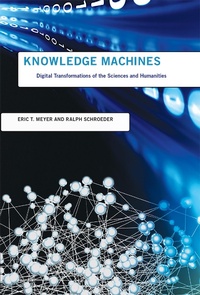
Knowledge Machines
Description

In Knowledge Machines, Eric Meyer and Ralph Schroeder argue that digital technologies have fundamentally changed research practices in the sciences, social sciences, and humanities. Meyer and Schroeder show that digital tools and data, used collectively and in distributed mode—which they term e-research—have transformed not just the consumption of knowledge but also the production of knowledge. Digital technologies for research are reshaping how knowledge advances in disciplines that range from physics to literary analysis.
Meyer and Schroeder map the rise of digital research and offer case studies from many fields, including biomedicine, social science uses of the Web, astronomy, and large-scale textual analysis in the humanities. They consider such topics as the challenges of sharing research data and of big data approaches, disciplinary differences and new forms of interdisciplinary collaboration, the shifting boundaries between researchers and their publics, and the ways that digital tools promote openness in science.
This book considers the transformations of research from a number of perspectives, drawing especially on the sociology of science and technology and social informatics. It shows that the use of digital tools and data is not just a technical issue; it affects research practices, collaboration models, publishing choices, and even the kinds of research and research questions scholars choose to pursue. Knowledge Machines examines the nature and implications of these transformations for scholarly research.
More details
Other editions
Additional editions
Persons
Ralph Schroeder is Professor at the Oxford Internet Institute at the University of Oxford.
Content
List of Abbreviations ix
List of Illustrations xi
1 A Digital Research Revolution? 1
2 Conceptualizing e-Research 23
3 The Rise of Digital Research 45
4 Aggregating People and Machines: Collaborative Computation 69
5 Distributed Data 95
6 Digital Research across the Disciplines: The Sciences and Social Sciences 125
7 Digital Research across the Disciplines: Humanities and Access to Knowledge 147
8 Open Science 175
9 Limits of e-Research 187
10 Knowledge Machines 197
Notes 225
References 237
Index 263
