

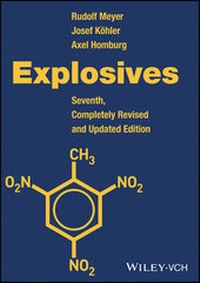
Explosives
Description

Some 500 monographic entries, arranged alphabetically, consider the physicochemical properties, production methods, and safe applications of over 120 explosive chemicals. In addition, 70 fuels, additives, and oxidizing agents are discussed as well as the corresponding test methods. Trade, company, and military short names are provided for many of the materials listed, while further key features include a combined index and glossary with terms and abbreviations in English, French, and German, as well as conversion tables and many literature references. Finally, this indispensable source also contains safety data and transport regulations.
More details
Other editions
Additional editions
Persons
From 1987 through 1997 Dr. Homburg was chairman of the board at Dynamit Nobel AG, switching to the supervisory board upon his retirement in 1998, where he remained a member until 2002. He was born in 1936 in Hanover (Germany), and studied at the Technische Hochschule in Darmstadt (Germany), where he gained his doctorate in the field of jet engines and rocket technology. From 1963 to 1968 he was a scientific assistant at the TH Darmstadt, before joining the "Propellants" department at Dynamit Nobel AG in 1969. In 1972 he became head of the main R&D department for explosives, the business unit he represented when he joined the board in 1983. Axel Homburg sits on various national and international committees, and has been chairman of the board of trustees at the Fraunhofer Institute for chemical Technology (ICT) since 1994 and a member of the board of trustees at the Federal Institute for Materials Research and Testing (BAM) since 1989.
Content
A
Abel Test
This test on chemical stability was proposed by Abel in 1875. The test parameter determined is the time after which a moist potassium iodide starch paper turns violet or blue when exposed to gases evolved by one gram of the explosive at 82.2 °C (180 °F).
In commercial nitroglycerine explosives, for example, this coloration only develops after 10 min or more. In a more sensitive variant of the method, Zinc iodide - starch paper is employed.
The Abel test is still used in quality control of commercial nitrocellulose, but is currently no longer employed in stability testing of propellants.
Acceptor1)
Empfängerladung; charge réceptrice
A charge of explosives or blasting agent receiving an impulse from an exploding Donor charge.
Acremite
This is the name given by the US inventor Acre to his mixture of about 94% ammonium nitrate with 6% fuel oil. This mixture was at first prepared in a primitive manner by the users themselves to obtain a very cheap explosive for open pit mining under dry conditions. Like ANFO, the material has widely displaced conventional cartridged explosives.
Actuator
Mechanical device operated by a solid propellant.
Adiabatic
Processes or phenomena assumed to occur in a closed system without energy exchange with the surroundings.
adiabatic flame temperature
The temperature obtained by thermodynamics calculations for the products of combustion of energetic materials neglecting energy loss to the surroundings.
isobaric adiabatic flame temperature
Adiabatic flame temperature attained under constant pressure conditions.
isochoric adiabatic flame temperature
Adiabatic flame temperature attained under constant volume conditions.
adiabatic temperature
The temperature attained by a system undergoing a volume or pressure change in which no heat enters or leaves the system.
Adobe Charge
Auflegerladung; pétardage
Synonymous with Mud Cap
ADR
Abbreviation for "Accord Européen Relatif au Transport des Marchandises Dangereuses par Route" (European Agreement Concerning the international Carriage of Dangerous Goods by Road). It is based on the Recommendations on the Transport of Dangerous Goods Model Regulations (United Nations).
Aerozin
A liquid fuel for rocket engines that is composed of 50% anhydrous hydrazine and 50% asym-dimethylhydrazine.
AGARD
Abbreviation for the NATO Advisory Group for Aeronautical Research and Development.
Airbag
Gasgenerator
The basic idea of the airbag as a passive restraint system in a motor vehicle was already patented for the first time in 1951 in Germany. However, it took nearly 20 years before development began on two basic types - pyrotechnic and hybrid gas generators. Both types are manufactured nearly exclusively in series production and were included in cars starting in 1975. Mainstream applications of airbag restraint systems in almost every car started in 1990.
Figure 1 Sectional diagram of a pyrotechnical gas generator for airbags.
Nowadays four main types of gas generating principles are used for airbag inflators in cars. Pyrotechnic gas generators inflate the bag by gaseous combustion products of pyrotechnic compositions. Hybrid gas generators are based on a combination of pressurized gas and pyrotechnic (heating) charge to deliver the gas. Both types are widely used in driver, passenger, side and curtain airbag applications. So-called cold gas generators utilize pressurized helium for bag inflation and are usually used for knee and side airbag systems. The latest development in gas generating principles uses a combustible mixture of pressurized hydrogen, oxygen and inert gas being applied for driver and passenger applications. Hybrid and pyrotechnic gas generators are the most common types used and are described in detail below. Their construction is shown schematically in Figures 1 and 2.
In the hybrid system the pre-pressurized gas (nitrogen, argon/helium) is stored in pressure containers fitted with a burst disc. Opening this membrane by pyrotechnic means allows the gas to flow out into the airbag. The cooling of the expanding gas is compensated or even overcompensated by the pyrotechnic charge. Since the total amount of pyrotechnic mixture is small in quantitative terms, the compulsory threshold values of the toxic impurities contained in the working gas can be adhered to relatively easily. This fact, in addition to the ideal temperature of the working gas, is the main advantage of hybrid gas generators.
Figure 2 Sectional diagram of a hybrid gas generator for airbags.
The disadvantages are the larger weight compared to pyrotechnic gas generators, the more complex production technology needed and the subjection to pressure vessel regulation.
The unique feature of almost all pyrotechnical gas generators is the concentric assembly of three different chambers with designs corresponding to their pressure conditions and functions. The innermost chamber contains the booster unit consisting of a plug, squib and booster charge. An auto ignition charge is usually integrated in the booster setup, whose task is to ignite the pyrotechnic mixture without electric current in case of high temperatures, e.g. in case of fire. During standard electrical ignition the thin resistance wire of the igniter is heated and the ignition train started. The booster charge usually used in earlier times was boron/potassium nitrate. Nowadays pyrotechnic formulations with good ignition properties are used in pelletized grain design contributing noticeably to the overall gas yield of the generator. The hot gases and particles generated by this charge enter the concentrically arranged combustion chamber and ignite the pyrotechnic main charge. Both chambers are designed for high pressures up to 60 MPa. The pyrotechnic main charge consists generally of compressed pellets which generate the working gas and slag residues by a combustion process. The products leave the combustion chamber through nozzles and enter the low pressure region of the filter compartment, where the slag is removed from the gas flow. The filter compartment is equipped with various steel filters and deflector plates. The gas then flows through the filter compartment nozzles into the bag.
Table 1 Effluent gas limits according USCAR-24 regulation.
Effluent Gas Vehicle Level Limit (ppm) Driver-Side Limit (ppm) Chlorine (Cl2) 1 0.25 Carbon monoxide (CO) 461 115 Carbon dioxide (CO2) 30 000 7500 Phosgene (COCl2) 0.33 0.08 Nitric oxide (NO) 75 18.75 Nitrogen dioxide (NO2) 5 1.25 Ammonia (NH3) 35 9 Hydrogen chloride (HCl) 5 1.25 Sulphur dioxide (SO2) 5 1.25 Hydrogen sulfide (H2S) 15 3.75 Benzene (C6H6) 22.5 5.63 Hydrogen cyanide (HCN) 4.7 1.18 Formaldehyde (HCHO) 1 0.25The basic task of each gas generator is to provide sufficient nontoxic gas (see Table 1) within the required time frame of 11-30 ms to inflate the airbag to the specified pressure. The first pyrotechnic mixture used in airbag gas generators was based on sodium azide. During combustion, sodium azide reacts with oxidizing agents, which bond chemically the elemental sodium as the nitrogen is released. Established oxidizers were alkali and alkaline earth nitrates, metal oxides (e.g. CuO, Fe2O3), metal sulfides (MoS2) and sulfur. If necessary slag forming agents (e.g. SiO2, aluminosilicates) were also added. Advances in environmental awareness led consequently to the replacement of sodium azide, though pure nitrogen as a working gas was generated by this composition. Another factor to the detriment of sodium azide was the relative low specific gas yield and the unsolved disposal procedure for this type of pyrotechnic mixture.
With regard to azide-free gas mixtures, there have been numerous patents and initial applications since the early 1990s. These new gas mixtures generate more gas per gram (gas yields from gas mixtures containing NaN3: 0.30-0.35 l/g) and thus enable smaller and to some extent a more lightweight construction of the gas generators.
They can be classified into two categories:
- High-nitrogen organic compounds (C, H, O, N) are combined with inorganic oxidizers:
The fuels are, for example, 5-aminotetrazole, azodicarbonamide, Guanidine nitrate, Nitroguanidine, dicyandiamide, Triaminoguanidine nitrate and similar compounds, as well as salts of, for example, 5-nitrobarbituric acid, urea derivatives and also nitramines and similar compounds. The oxidizers are, for example,...
