

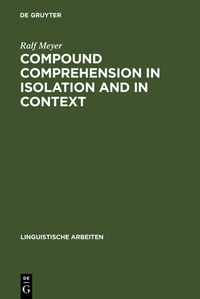
Compound Comprehension in Isolation and in Context
The contribution of conceptual and discourse knowledge to the comprehension of German novel noun-noun compounds
1st Edition
Published on 22. November 2010
XV, 225 pages
978-3-11-135324-1 (ISBN)
Description

No detailed description available for "Compound Comprehension in Isolation and in Context".
More details
Other editions
Additional editions
Ralf Meyer
Compound Comprehension in Isolation and in Context
The contribution of conceptual and discourse knowledge to the comprehension of German novel noun-noun compounds
Book
01/1993
1st Edition
De Gruyter
€169.95
Article exhausted; check different version
Ralf Meyer
Compound Comprehension in Isolation and in Context
The contribution of conceptual and discourse knowledge to the comprehension of German novel noun-noun compounds
Book
01/1993
1st Edition
De Gruyter
€119.95
Shipment within 7-9 days
Content
- Intro
- Vorwort
- 0 Introductory Remarks
- 0.1 Types of Noun-Noun Compounds
- 0.2 Overview of the Work
- 1 Some Requirements for a Semantic Theory of Novel Noun-Noun Compounds
- 1.1 Dynamics of Compound Meaning
- 1.2 Knowledge Dependence of Compound Meaning
- 1.3 Discourse Dependence of Compound Meaning
- 1.4 Underdeterminacy of Compound Meaning
- 1.5 The Choice of the Representational Language
- 1.6 Discussion and Conclusion
- 2 Previous Work on Word Semantics and Compounding
- 2.1 Theories of Word Meaning
- 2.1.1 Default Information as a Basis for Dynamics of Word Meaning
- 2.1.2 Lexical Stereotypes as a Basis for Dynamics of Word Meaning
- 2.1.3 The Two-Level-Approach for Semantics
- 2.2 Conceptual Categories for Compounds
- 2.3 The Interpretation of Nominal Compounds in Montague-Grammar
- 2.4 Other Semantic Approaches
- 2.5 Novel Noun-Noun Compounds as Anaphorical Elements: Discourse Influence on Compound Interpretation
- 2.6 Psycholinguistic Models on Concept Combination as a Basis for Compound Interpretation
- 2.7 The Interpretation of Compounds in Artificial Intelligence
- 2.8 Discussion and Conclusion
- 3 Categorization of the Compounding Mechanism into a General Theory of Word Formation
- 3.1 Word Formation as a Part of the Syntax
- 3.2 Word Formation as an Autonomous Module
- 3.3 Word Formation as a Property of the Conceptual System
- 3.4 Discussion and Conclusion
- 3.4.1 Conclusion One: The Structure of Lexical Knowledge
- 3.4.2 Conclusion Two: On the Morphology of Noun-Noun Compounds
- 4 A Semantic Model for the Integration of Conceptual and Discourse Knowledge
- 4.1 On Genericity of the Modifier
- 4.2 Discourse Representation Theory DRT
- 4.3 Syntax and Semantics of DRLC
- 4.4 Knowledge Representation in DRSs
- 4.4.1 Properties of Knowledge Representations
- 4.4.2 Knowledge Representation in KL-ONE Lookalikes
- 4.4.3 Translation of TBox-Expressions into DRLC
- 4.5 Lexical Meaning of Nouns: Approaching the Two-Level Semantics in DRT
- 4.6 Syntax and Semantics of DRLex
- 4.7 Lexical DRSs for Nouns and NN-Compounds
- 4.8 Conceptual Shifts of Single Nouns
- 4.9 Conclusion
- 5 Relational Ambiguity of Isolated Novel Noun-Noun Compounds
- 5.1 Relational Nouns and Sortal Nouns in NN-Compounds
- 5.2 Possible Sources for Relations in NN-Compounds
- 5.3 Relations from Lexical Representations
- 5.4 The Conceptual Basis
- 5.4.1 Prototypical Properties of Substances
- 5.4.2 Spatial Functions of Three-Dimensional Objects
- 5.4.2.1 A Short Digression into Semantics of Local Prepositions
- 5.4.2.2 Location Relations in Novel NN-Compounds
- 5.4.3 The Made-Of, Part-Of and Has-Part Relations
- 5.4.4 Object-Specific Relations
- 5.4.5 Conjunctive Compounds
- 5.4.6 Summary and Conclusion
- 5.5 A Network of Compounding Rules
- 5.6 Conceptual Shifts of Novel NN-Compounds
- 5.7 Summary and Conclusion
- 6 Utterance Meanings of Novel Noun-Noun Compounds in Discourse
- 6.1 Current Assumptions on Discourse Comprehension and Their Implications for Semantics of Novel NN-Compounds
- 6.1.1 Local Discourse Constraints
- 6.1.2 Global Discourse Constraints
- 6.2 Some Preceding Remarks
- 6.2.1 Extensions of DRLex
- 6.2.2 The Treatment of Definite NPs
- 6.2.3 The Principle for Novel NN-Compound Interpretation in Context
- 6.3 Conjunctive Compounds in Discourse
- 6.4 Script-Driven NN-Compound Interpretation
- 6.5 Giving of a Relation in Discourse
- 6.5.1 Anaphoric Compounds
- 6.5.2 Cataphoric Compounds
- 6.6 Compounds in Discourse without Anaphoric Links
- 6.7 Genericity of the Modifier Revisited
- 6.8 Conceptual Shifts of Novel NN-Compounds Revisited
- 6.9 Discussion and Conclusion
- 7 Summary and Outlook
- 7.1 The Model for Computing Utterance Meanings of Novel Noun-Noun Compounds
- 7.2 Open Problems
- References
