

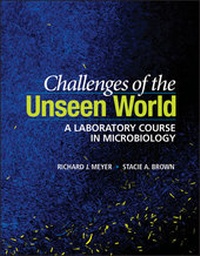
Challenges of the Unseen World
A Laboratory Course in Microbiology
1st Edition
Published on 6. August 2020
204 pages
978-1-55581-995-8 (ISBN)
Description

Solving real-world health challenges in a learning environment
You are at an exciting gateway into the world of microorganisms. With nothing more than basic lab equipment such as microscopes, Petri dishes, media, and a handful of reagents, you will learn to isolate, grow, and identify bacteria that live all around us. This is no ordinary microbiology laboratory course; not only will you learn how to streak plates, use a microscope, perform a Gram stain, and prepare serial dilutions and spread plates--fundamental skills found in every microbiologist's toolkit--you will solve a series of public health-related challenges that many professional microbiologists encounter in their work.
By the end of this course, you will:
* Determine the origin of a nosocomial infection. Using foundational and molecular methods, you will determine whether the infections occurring in hospitalized patients are the result of contaminated medical items.
* Select the antibiotic to treat a patient with Crohn's disease. You will find minimum inhibitory concentrations of various antibiotics for a Pseudomonas strain associated with Crohn's disease.
* Pinpoint the source of lettuce contaminated with E. coli. Using molecular tools you will investigate a common food safety challenge, antibiotic-resistant E. coli and the potential for spread of this resistance in the environment.
* Find the farm releasing pathogens into a stream used for drinking water. Using bacteriophage load in water samples, you will locate the source of fecal contamination in the water supply of a village in an underdeveloped country.
* Evaluate the potential of bacteria to cause a urinary tract infection. You will test for biofilms, quorum sensing behavior, and chemotaxis and assess which disinfectants would be most effective for sanitizing contaminated surfaces.
Microbiology educators and researchers Richard Meyer and Stacie Brown have created this hands-on, engaging introduction to the essential laboratory skills in the microbial sciences that is sure to change the way you view the world around you.
You are at an exciting gateway into the world of microorganisms. With nothing more than basic lab equipment such as microscopes, Petri dishes, media, and a handful of reagents, you will learn to isolate, grow, and identify bacteria that live all around us. This is no ordinary microbiology laboratory course; not only will you learn how to streak plates, use a microscope, perform a Gram stain, and prepare serial dilutions and spread plates--fundamental skills found in every microbiologist's toolkit--you will solve a series of public health-related challenges that many professional microbiologists encounter in their work.
By the end of this course, you will:
* Determine the origin of a nosocomial infection. Using foundational and molecular methods, you will determine whether the infections occurring in hospitalized patients are the result of contaminated medical items.
* Select the antibiotic to treat a patient with Crohn's disease. You will find minimum inhibitory concentrations of various antibiotics for a Pseudomonas strain associated with Crohn's disease.
* Pinpoint the source of lettuce contaminated with E. coli. Using molecular tools you will investigate a common food safety challenge, antibiotic-resistant E. coli and the potential for spread of this resistance in the environment.
* Find the farm releasing pathogens into a stream used for drinking water. Using bacteriophage load in water samples, you will locate the source of fecal contamination in the water supply of a village in an underdeveloped country.
* Evaluate the potential of bacteria to cause a urinary tract infection. You will test for biofilms, quorum sensing behavior, and chemotaxis and assess which disinfectants would be most effective for sanitizing contaminated surfaces.
Microbiology educators and researchers Richard Meyer and Stacie Brown have created this hands-on, engaging introduction to the essential laboratory skills in the microbial sciences that is sure to change the way you view the world around you.
More details
Other editions
Additional editions
Richard J. Meyer | Stacie A. Brown
Challenges of the Unseen World
A Laboratory Course in Microbiology
Book
04/2018
1st Edition
American Society for Microbiology
€65.00
Article not available at the moment
Persons
Richard J. Meyer, Ph.D., is a professor in the Department of Molecular Biosciences at the University of Texas at Austin. He joined the Department of Microbiology in the University of Texas at Austin in 1978, and has been at that institution ever since. From the beginning of his career, Meyer has been interested in the hands-on aspect of teaching biology to undergraduates. He developed the introductory microbiology laboratory course currently used at the University of Texas at Austin. It was the pedagogical approaches that are used in this course that inspired him to develop the manual you hold in your hands. Over more than forty years, Meyer's research was on the molecular mechanisms of replication and conjugative transfer of broad host-range plasmids.
Stacie A. Brown, Ph.D., is director of first year biology laboratories and a member of the biology department at Southwestern University. Prior to her current position, she taught microbiology courses for biology majors and pre-nursing students while also overseeing the microbiology labs, at Texas State University. For several years, she also taught microbiology labs and courses at the University of Texas at Austin. Her experience teaching microbiology labs to thousands of undergraduates ensures that the challenge-based microbiology labs in this manual will work in any introductory laboratory course in undergraduate microbiology.
Stacie A. Brown, Ph.D., is director of first year biology laboratories and a member of the biology department at Southwestern University. Prior to her current position, she taught microbiology courses for biology majors and pre-nursing students while also overseeing the microbiology labs, at Texas State University. For several years, she also taught microbiology labs and courses at the University of Texas at Austin. Her experience teaching microbiology labs to thousands of undergraduates ensures that the challenge-based microbiology labs in this manual will work in any introductory laboratory course in undergraduate microbiology.
