

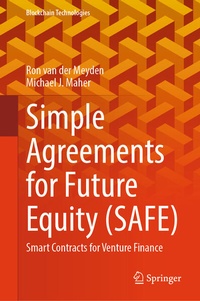
Simple Agreements for Future Equity (SAFE)
Description

This book presents a case study of the development of a smart contract, from the analysis of the legal contract to the structural design of the smart contract and implementation on the Ethereum blockchain. It identifies approaches to avoid or lessen the impact of pitfalls. And it discusses strategies to address the interaction between parties to the smart contract and legal authorities. The legal contract that is implemented is the simple agreement for future equity (or SAFE), which is widely used for financing startup companies. The analysis of this contract has the additional advantage that it clarifies issues in the conversion of a SAFE contract to equity that are a source of confusion in practice. This book is of interest to anyone in the field of digital finance, as well as to venture capitalists and entrepreneurs making use of SAFEs.
More details
Other editions
Additional editions
Persons
Dr. Michael J. Maher obtained his Ph.D. from the University of Melbourne. Currently, he is Director at Reasoning Research Institute in Canberra. His research interests are in the areas of computational law, defeasible reasoning, argumentation, constraint logic programming.
Dr. Ron van der Meyden is Professor in the School of Computer Science and Engineering at UNSW, Sydney. His research interests include: computer security; logic in computer science; logic of knowledge and belief; temporal logic; distributed systems; blockchain; and smart contracts.
Content
The Need for SAFEs.- SAFE Contract Terms.- Accounting Views of Convertible Instruments.- Methods for Converting a Pre-Money SAFE.- Conversion of Post-Money SAFEs.- Game-Theoretic Aspects of SAFE Conversion.- Equity Financing with Multiple SAFEs.- Liquidity Events with Multiple SAFEs.- Dissolution Events.- Towards a Better SAFE.- Summary of the Analysis.- Blockchain and Smart Contracts.- Difficulties in Formalizing SAFE Contracts.- Strategies for Formalization.- Architecture for SAFE Smart Contracts.- Evaluation.- Interaction with Law.- Privacy and Platform Issues.- Issues in Implementing other SAFE Clauses.- Conclusion.
