

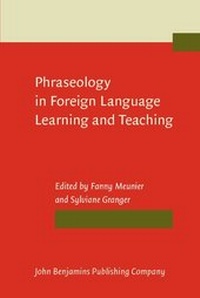
Phraseology in Foreign Language Learning and Teaching
1st Edition
Published on 6. February 2008
XI, 259 pages
978-90-272-9131-8 (ISBN)
Description

This book addresses the key role of phraseology in second language acquisition and instruction. It is divided into three main sections: Extracting and Describing Phraseological Units investigates the role played by native and learner corpora in the extraction and description of multiword units, two initial and crucial steps in informing language pedagogy; Learning Phraseological Units deals with the learning aspect, an oft-neglected yet essential dimension of phraseology in second/foreign language pedagogy, this section also addresses issues in new literacies; and Recording and Exploiting Phraseological Units focuses on pedagogical tools, notably monolingual and bilingual dictionaries and textbooks. This stimulating collection presents cutting edge research in the field and identifies major avenues for future theoretical and applied work. It is of particular relevance to researchers and teachers interested in the patterned nature of language.
More details
Other editions
Additional editions
Fanny Meunier | Sylviane Granger
Phraseology in Foreign Language Learning and Teaching
Book
02/2008
John Benjamins Publishing Co
€111.30
Shipment within 10-15 days
Persons
Content
- Phraseology in Foreign Language Learningand Teaching
- Title page
- LCC data
- dedication page
- Table of contents
- List of contributors
- Acknowledgements
- Phraseology
- Acknowledgement
- References
- Introduction
- Section I. Extracting and describing phraseological units
- Phraseology and language pedagogy
- 1. Introduction
- 2. The phraseology of high frequency verbs
- 2.1 Retrieval of significant collocations
- 2.2 Eight verbs under the microscope
- 2.3 Semantic prosody and semantic preference
- 3. Phraseology and language pedagogy: concluding remarks
- References
- Essential collocations for learners of English
- 1. Introduction
- 2. Basic framework
- 2.1 Definitions and classifications
- 2.2 Criteria
- 3. A multi-dimensional framework
- 3.1 A detailed view of the three dimensions
- 3.2 The statistical dimension as a starting point for a revised account of collocation
- 3.3 The semantic and lexical dimensions as supporters
- 4. The role of direction and weight
- 4.1 Collocational direction
- 4.2 Collocational attraction
- 5. Conclusion
- Acknowledgement
- References
- Dictionaries
- Corpus
- Phraseology effects as a trigger for errors in L2 English
- 1. Formulaic effects and fossilization
- 2. Pluralized adjectives: What happened to the good olds times?
- 3. Pluralized mass nouns: A huge amount of informations in our goggle-box
- 4. Third person -s: Modern life seem to be very chaotic
- 5. Adverb placement: People accept passively this brainwashing
- 6. Phraseological effects: Blending, bonding and burying
- References
- Contrasting English-Spanish interpersonal discourse phrases
- 1. Introduction
- 2. English-Spanish contrastive metadiscourse studies
- 2.1 English-Spanish studies on interactional phrases in EFL student writing
- 3. The present study
- 4. Results and discussion
- 5. Conclusion
- References
- Exemplification in learner writing
- 1. Introduction
- 2. Data and methodology
- 3. Exemplification in native writing
- 4. Exemplification in learner writing
- 4.1 Shared multi-word units
- 4.2 Multi-word units specific to French learner writing
- 5. Transfer of L1 multi-word units
- 6. Pedagogical implications
- 7. Conclusion
- Acknowledgements
- References
- Section II. Learning phraseological units
- Why can't you just leave it alone?
- 1. Introduction
- 2. Memorization and language learning
- 3. What happens when we memorize text
- 4. Profiling learner proficiency on the basis of memorization
- 4.1 The data set
- 4.2 Data analysis
- 5. Deviation profiling
- 5.1 Distributions of deviations
- 5.2 Differences by L1
- 5.3 Individual profiles
- 6. Conclusion
- References
- Appendix
- Phraseology and English for academic purposes
- 1. Introduction
- 2. Phraseology and pedagogy in EAP
- 2.1 Why are phrases important in EAP?
- 2.2 What phrases should we teach in EAP?
- 2.3 What pedagogical approach should we use?
- 3. What barriers do our students encounter in using formulaic sequences in their writing?
- 4. Conclusion
- References
- Multiword expressions and the digital turn
- 1. Introduction
- 2. The challenge to learners
- 3. The challenges to lexicography
- 4. Knowledge representation
- 5. Toward an alternative view of lexical knowledge and digital resources
- 6. Lexical representations as passive
- 7. An illustration: Collocator
- 8. Lexical knowledge discovery
- 9. Learning multiword expressions and the nature of the World Wide Web
- 10. Conclusion
- Acknowledgements
- References
- Section III. Recording and exploiting phraseological units
- Phraseology in learners' dictionaries
- 1. Introduction
- 2. Definitions of collocation
- 3. Coverage of semantically transparent items in encoding dictionaries
- 3.1 Spoken English
- 3.2 Written English
- 4. Semantically transparent collocations in learner language
- 5. Lexicographic treatment of fully transparent collocations: Suggestions for improvement
- 5.1 Selection
- 5.2 Classification
- 6. Conclusion
- References
- 1. Dictionaries
- 2. Other literature
- Compilation, formalisation and presentation of bilingual phraseology
- 1. Introduction
- 2. Lexicographical issues in bilingual phraseology
- 2.1 Difficulties in processing bilingual phraseology
- 2.2 Are bilingual phraseological dictionaries necessary?
- 3. Semantically oriented modelling of bilingual phraseology
- 3.1 Compilation and formalisation of bilingual phraseology
- 3.2 A unit of meaning as an access point to the foreign language lexicon
- 4. Presentation of bilingual phraseology
- 4.1 Designing of conceptual frameworks
- 4.2 Presentation within a multifunctional electronic dictionary
- 5. Conclusion
- References
- The phraseological patterns of high-frequency verbs in advanced English for general purposes
- 1. Introduction
- 2. Selection, sequencing and presentation of vocabulary content
- 3. The TeMa corpus
- 4. Methodology: Extracting and classifying phraseological patterns
- 5. Pedagogical exploitation
- 5.1 Exercise focus
- 5.2 Learning activities
- 5.3 Lexical focus
- 6. Conclusion
- Acknowledgements
- References
- Textbooks
- Section IV. Concluding remarks
- Phraseology in language learning and teaching
- References
- Author index
- Subject index
