

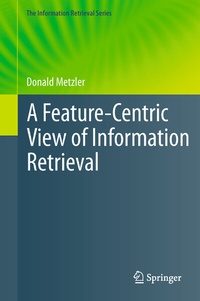
A Feature-Centric View of Information Retrieval
Description

Commercial Web search engines such as Google, Yahoo, and Bing are used every day by millions of people across the globe. With their ever-growing refinement and usage, it has become increasingly difficult for academic researchers to keep up with the collection sizes and other critical research issues related to Web search, which has created a divide between the information retrieval research being done within academia and industry. Such large collections pose a new set of challenges for information retrieval researchers.
In this work, Metzler describes highly effective information retrieval models for both smaller, classical data sets, and larger Web collections. In a shift away from heuristic, hand-tuned ranking functions and complex probabilistic models, he presents feature-based retrieval models. The Markov random field model he details goes beyond the traditional yet ill-suited bag of words assumption in two ways. First, the model can easily exploit various types of dependencies that exist between query terms, eliminating the term independence assumption that often accompanies bag of words models. Second, arbitrary textual or non-textual features can be used within the model. As he shows, combining term dependencies and arbitrary features results in a very robust, powerful retrieval model. In addition, he describes several extensions, such as an automatic feature selection algorithm and a query expansion framework. The resulting model and extensions provide a flexible framework for highly effective retrieval across a wide range of tasks and data sets.
A Feature-Centric View of Information Retrieval provides graduate students, as well as academic and industrial researchers in the fields of information retrieval and Web search with a modern perspective on information retrieval modeling and Web searches.
Reviews / Votes
From the reviews:
"This book is organized in 6 chapters (Introduction, Classical retrieval models, Feature-based ranking, Feature-based query expansion, Query-dependent feature weighting, Model learning), two appendices (Data sets and Evaluation metrics) and a comprehensive bibliography. . The book is recommended for an advanced master's or PhD-level course in information retrieval, being also a valuable reference for the researchers with professional interests in this domain." (Mirel Cosulschi, Zentralblatt MATH, Vol. 1235, 2012)More details
Other editions
Additional editions

Person
Donald Metzler is a Research Scientist in the Natural Language Group at the University of Southern California's Information Sciences Institute. Prior to that he was a Research Scientist in the Search and Computational Advertising group at Yahoo! Research. He received his Ph.D. from the University of Massachusetts in 2007. He is an active member of the information retrieval and Web search communities, having served on the program committees of SIGIR, WWW, WSDM, HLT, EMNLP, and ICML. He has published over 35 research papers, and has 16 patents pending. His research interests include information retrieval, Web search, computational advertising, and applications of machine learning to large-scale text problems.
