

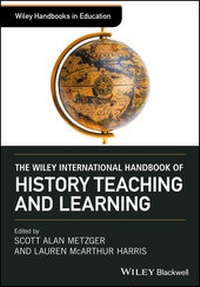
The Wiley International Handbook of History Teaching and Learning
Description

The Wiley International Handbook of History Teaching and Learning draws on contributions from an international panel of experts. Their writings explore the growth the field has experienced in the past three decades and offer observations on challenges and opportunities for the future. The contributors represent a wide range of pioneering, established, and promising new scholars with diverse perspectives on history education.
Comprehensive in scope, the contributions cover major themes and issues in history education including: policy, research, and societal contexts; conceptual constructs of history education; ideologies, identities, and group experiences in history education; practices and learning; historical literacies: texts, media, and social spaces; and consensus and dissent. This vital resource:
* Contains original writings by more than 40 scholars from seven countries
* Identifies major themes and issues shaping history education today
* Highlights history education as a distinct field of scholarly inquiry and academic practice
* Presents an authoritative survey of where the field has been and offers a view of what the future may hold
Written for scholars and students of education as well as history teachers with an interest in the current issues in their field, The Wiley International Handbook of History Teaching and Learning is a comprehensive handbook that explores the increasingly global field of history education as it has evolved to the present day.
More details
Other editions
Additional editions
Persons
SCOTT ALAN METZGER is Associate Professor of Social Studies Education at Penn State University.
LAUREN McARTHUR HARRIS is Associate Professor of History Education at Arizona State University.
Content
Notes on Contributors ix
Foreword xiii
Peter Seixas
Acknowledgments xix
Introduction: History Education in (and for) a Changing World 1
Scott Alan Metzger and Lauren McArthur Harris
Section I Policy, Research, and Societal Contexts of History Education 11
1 History Curriculum, Standards, and Assessment Policies and Politics: U.S. Experiences 13
Tim Keirn
2 History Education Research and Practice: An International Perspective 37
Mark Baildon and Suhaimi Afandi
3 Research Methodologies in History Education 61
Terrie Epstein and Cinthia S. Salinas
4 Narratives of Black History in Textbooks: Canada and the United States 93
LaGarrett J. King and Crystal Simmons
Section II Conceptual Constructs of History Education 117
5 Historical Thinking: Definitions and Educational Applications 119
Stéphane Lévesque and Penney Clark
6 Historical Reasoning: Conceptualizations and Educational Applications 149
Carla van Boxtel and Jannet van Drie
7 Historical Consciousness: Conceptualizations and Educational Applications 177
Anna Clark and Maria Grever
8 Historical Empathy: Perspectives and Responding to the Past 203
Jason L. Endacott and Sarah Brooks
9 Historical Agency: Stories of Choice, Action, and Social Change 227
Kent den Heyer
10 Global and World History Education 253
Brian Girard and Lauren McArthur Harris
Section III Ideologies, Identities, and Group Experiences in History Education 281
11 Critical Theory and History Education 283
Avner Segall, Brenda M. Trofanenko, and Adam J. Schmitt
12 National, Ethnic, and Indigenous Identities and Perspectives in History Education 311
Carla L. Peck
13 Gender and Sexuality in History Education 335
Margaret Smith Crocco
14 "Difficult Knowledge" and the Holocaust in History Education 365
Sara A. Levy and Maia Sheppard
Section IV History Education: Practices and Learning 389
15 History Teacher Preparation and Professional Development 391
Stephanie van Hover and David Hicks
16 Teaching Practices in History Education 419
S. G. Grant
17 Assessment of Learning in History Education: Past, Present, and Possible Futures 449
Denis Shemilt
18 Reconceptualizing History for Early Childhood Through Early Adolescence 473
Linda S. Levstik and Stephen J. Thornton
19 Teaching Controversial Historical Issues 503
Tsafrir Goldberg and Geerte M. Savenije
Section V Historical Literacies: Texts, Media, and Social Spaces 527
20 Reading in History Education: Text, Sources, and Evidence 529
Abby Reisman and Sarah McGrew
21 Writing and Argumentation in History Education 551
Jeffery D. Nokes and Susan De La Paz
22 Film Media in History Teaching and Learning 579
Richard J. Paxton and Alan S. Marcus
23 Digital Simulations and Games in History Education 603
Cory Wright-Maley, John K. Lee, and Adam Friedman
24 Learning History Beyond School: Museums, Public Sites, and Informal Education 631
Jeremy D. Stoddard
Index 657
Foreword: History Educators in a New Era
Peter Seixas
University of British Columbia
Scott Metzger and Lauren Harris's volume is an extraordinary testament to the robust growth and development of an international field that existed only in the most embryonic form three decades ago. The chapters herein are evidence of the remarkable number and quality of its scholars, publications, programs, and projects. In recent years, a broad, international dialogue has developed, in part based on earlier, more insular movements in Germany, the United Kingdom, the Netherlands, the United States, and elsewhere. Networks, communications, and conferences-including the American Educational Research Association's (AERA) Teaching History special interest group-have vastly enlarged the scope of history education research, fostered its nuance, and facilitated its depth. From this point forward, this collection of reviews will be both the authoritative survey of where the field has been and the launching pad for what should be coming next. It is appearing, however, at a dangerous moment, globally, for the liberal arts, education, and research, for democratic values generally, and for history and history education specifically.
The deep forces of destabilization include increasingly polarized wealth, migrations from desiccated equatorial regions of the globe, and new modes of communication which are increasingly rapid, pervasive, dispersed, accessible, and open to manipulation. Perversely, ascendant ideologies foster public policies that may promote the acceleration of all of these trends.
While the threat to liberal traditions is global, nowhere is it more palpable than in the US after the surprise election of Donald Trump. Does the US represent just an endpoint on a global continuum, or-with its exponential supremacy in military expenditures, its outlier status from health care to gun ownership, and its vastly disproportionate concentration of the world's wealth-is it, in fact, exceptional? In either case, Trump's inauguration speech provided a benchmark for the wider populist phenomenon. "From this day forward," he promised, "a new vision will govern our land" (Inaugural Address, 2017).
Of course, a diktat does not make the past vanish. On the other hand, Trump's advent can be seen as the beginning of a new era in the US and beyond. Trump's radical proposals and erratic modus operandi challenged domestic institutions of governance, the press, education, the economy, environmental protection, healthcare, and welfare-as well as long-term relative international stability achieved through post-World War II defense alliances and trade pacts. Moreover, his words appeared to resonate among populist politicians with similar proclivities in other historically democratic nations. Le Pen in France, Farage in the UK, and Wilders in the Netherlands challenged the progressive consensus that held the European Union together. On the borders of Europe, states that since the end of the Cold War appeared to be working toward inclusion in a larger, open, Western democratic project have embraced nationalist autocracy under the leadership of Erdogan in Turkey and Putin in Russia.
On the other hand, Trump's inaugural promise to forget the past and look only toward the future was, in some ways, nothing new. The idea that we are living in an age when the future will differ from what came before us is the condition of modernity: All that is solid, as Marx famously wrote, melts into air. From the late 18th century, in the words of Reinhard Koselleck (1985), "it became a rule that all previous experience might not count against the possible otherness of the future. The future would be different from the past, and better, to boot" (p. 267; see also Clark and Grever in Chapter 7).
François Hartog (2015) takes a further step, offering an ongoing "crisis of the present" as the defining characteristic of the era since the fall of the Berlin Wall and the end of the Soviet Union, where "the distance between the space of experience and the horizon of expectation [has] been stretched to its limit, to breaking point . with the result that the production of historical time seems to be suspended" (p. 17). Writing originally in 2003, Hartog anticipated the unease of our own moment.
Many of the modern, liberal traditions that have been challenged by Trump and his fellow travelers were recently so fundamental to the generations living now that we barely gave them a passing thought. Academics hardly needed to rally to defend the idea of truth because the only threat was from some of our own poststructuralist provocateurs, delivered in prose so tortured that it had little apparent impact on the broader public sphere. When the Trump administration began in 2017 with a flurry of unsubstantiated allegations and "alternative facts" rhetoric, the game changed and the stakes were raised.
The implications for history education and its scholars, internationally, are profound. If we need to revisit our stances on the concept of truth, so too do we need to re-examine those on research and knowledge, interpretation and evidence, community and nation, identity and difference, and citizenship and solidarity.
It is quite unremarkable to note the prominence in recent decades of "considerations of the role of sociocultural identity markers such as positionality and situatedness in knowledge production" (Crocco in Chapter 13, italics in the original; see also Seixas, 2000, pp. 28-29). But where does positionality leave knowledge, in relation to the purveyor of "alternative facts" who claims they are the truth from their own position in Memphis or Moscow? Of course, highlighting people's varieties of experience and belief, and differences in relation to power and privilege, is at the core of the social, educational, and historical sciences. But building knowledge must ultimately emerge through dialogue, debate, and discussion as a common project, conducted on a common basis of civility and with a shared respect for evidence. In the current climate, we cannot afford to toy with separate islands of identity-based theory, research methods, "epistemologies," or even "ontologies." Notions such as women's ways of knowing and multicultural epistemologies-to the extent that they close down dialogue and debate or, conversely, open up "anything goes" as long as it is deeply held or strongly believed-pose new dangers.
The problem of teaching about historical interpretations, similarly, needs to be examined through a different lens in this political environment. Most history education scholars in recent decades, myself included, have seen a central challenge in destabilizing the notion that what is in the textbook-or any contemporary account-is the story of what happened. We have focused on the categorical difference between interpretations of the past and the past itself. That difference has not vanished nor has the importance of teaching it, but the burden is upended. That is, our central challenge will have to focus on helping students to understand the limits of interpretation, the constraints that bind what we say to the evidence that we have, and the importance of defending interpretations that are supported by the weight of evidence, not as just one among many possible ways of seeing things.
Insofar as contemporary political, economic, and social conditions start to shift popular culture's grand narratives of nation and world civilizations, there are further implications for history educators. The triumph of Trump, the ballot on Brexit, and the popularity of Le Pen have made visible a tectonic shift in popular narrative templates (to use Wertsch's, 2004, term). As with geology, the hidden forces of change have long been at work beneath the surface, building pressure. The earthquake that is Trump rattled the world with a dire picture of Americans wracked by pain, carnage, depletion, disrepair, and decay, robbed by post-War allies, and impoverished by parasites within. Le Pen and Wilders imagined their countries overrun and cultures besieged by non-White hordes. Those pictures apparently resonated with a large number of their fellow citizens. How will their populist vision affect the academic history and history education communities, whose scholars have focused on the flaws and cracks in the grand narratives: in the US, imperialism, the economic foundations of slavery, genocidal policies toward Native Americans, the persistence of Jim Crow since Reconstruction, the growth of economic inequality since the 1970s; and in Europe, the history of colonialism and, varying with national setting, collusion with Nazis during the Holocaust? Perhaps we will find ourselves countering nationalist distortions by a new appreciation for a (qualified) narrative-open, of course, to reasoned critique-of progressive opportunity and open democracy that long have been the staple of school teaching and textbooks.
Many history education researchers have focused on students' gender, sexual, and racialized identities as fundamental elements in students' understanding of the past. Sociocultural theory, in the context of history education research, examines connections between a community's collective memory and students' construction of their own identities. Vice versa, it examines how students' social location shapes their...
