

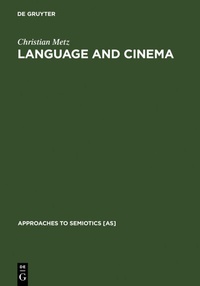
Language and Cinema
1st Edition
Published on 21. November 2011
303 pages
978-3-11-081604-4 (ISBN)
Description

No detailed description available for "Language and Cinema".
More details
Other editions
Additional editions
Christian Metz
Language and Cinema
Book
01/1974
1st Edition
De Gruyter Mouton
€119.95
Shipment within 10-20 days
Christian Metz
Language and Cinema
Book
01/1974
1st Edition
De Gruyter Mouton
€169.95
Article exhausted; check different version
Persons
Content
- Intro
- 1. Within the Cinema : The Filmic Fact
- 2. Within the Filmic Fact: The Cinema
- 2.1. 'Cinema' in another sense
- 2.2. From material to codical homogeneity: a premature conclusion
- 2.3. The same code in several 'language systems'
- several codes in the same 'language system'
- 2.4. Cinematic specificity, cinematic language system (I)
- 2.5. Cinematic-filmic, cinematic-non-filmic, filmic-non-cinematic
- 3. Film in an Absolute Sense
- 3.1. 'The Film'/'The Cinema'
- 3.2. The zone common to the film and cinema. Its limits
- 4. Plurality of Cinematic Codes
- 4.1. General and particular codes
- 4.2. Plurality along two axes
- 4.3. 'Cinematic language system' (II)
- 5. From Code to System
- Message to Text
- 5.1. 'The study of films': two different approaches
- 5.2. Code/singular system
- 5.3. General and particular codes (II)
- 5.4. Terminological points
- 5.5. 'Structure of the message' or structure of the text?
- 6. Textual Systems
- 6.1. The film as a unique totality
- 6.2. The system of the film as displacement
- 6.3. Cinematic and extra-cinematic: from duality to mixture
- 6.4. Readings: several textual systems for a single text
- 7. Textuality and 'Singularity'
- 7.1. Filmic texts smaller or larger than a film
- 7.2. Group of films and class of films
- 7.3. From 'particular code' to sub-code (III)
- 7.4. The pansemic tendency of certain figures
- 7.5. Code/sub-code (IV)
- 7.6. The systemic and the textual
- 7.7. Textuality and generality
- 7.8. 'Film' in the absolute sense (II)
- 8. Paradigmatic and Syntagmatic
- 8.1. The syntagmatic and the textual
- 8.2. The syntagmatic and the paradigmatic
- syntagmatics and paradigmatics
- 8.3. Degrees of preexistence of the 'object studied'
- 8.4. Circularity of paradigmatics and syntagmatics
- 8.5. Syntagmatic and consecutive
- 8.6. Paradigmatic and syntagmatic in textual systems
- 9. The Problem of Distinctive Units
- 9.1. Several types of minimal units in the same text
- 9.2. Several types of cinematic units in the film
- 9.3. The determination of minimal units and the overall study of grammar
- 9.4. Several types of extra-cinematic units in the film
- 9.5. Distinctive units: diversity of size
- 9.6. Distinctive units: diversity of form
- 9.7. Critique of the notion 'cinematic sign'
- 10. 'Specific/Non-Specific': Relativity of the Classification Used
- 10.1. 'Form/material/substance' according to Hjelmslev
- 10.2. Semiotic interference between language systems
- 10.3. Distinctive features of the material of the signifier
- 10.4. The intermixing of specificities: Multiple specificity, degrees of specificity, modes of specificity
- 10.5 Cinema and television
- 10.6. Language system as a combination of codes
- 10.7. Non-specific codes. Codes of content and codes of expression
- 10.8. Hjelmslev reconsidered: 'substance'
- 11. Cinema and writing
- 11.1. Cinema and writing as recordings
- 11.2. Cinema and writing as transmissions
- 11.3. Cinema and writing as 'printings'
- 11.4. Cinema and writing as 'compositions'
- 11.5. The cinema in relation to the 'writings' of Writing Degree Zero
- 11.6. Cinema and ideography
- Conclusion: Cinematic Language System and Filmic Writing
- References
- Subject index
- Index of Names
- Index of Films
