

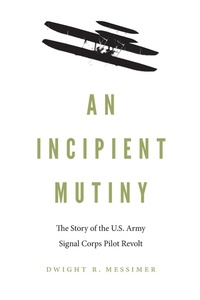
An Incipient Mutiny
The Story of the U.S. Army Signal Corps Pilot Revolt
Published on 1. January 2020
328 pages
978-1-64012-258-1 (ISBN)
Description

An Incipient Mutiny traces the creation of the U.S. Army Signal Corps Aeronautical Division in 1907 up to the establishment of the Air Service of the National Army in 1918. It is a shocking account of shortsightedness, mismanagement, criminal fraud, and cover-up that led ultimately to a pilot revolt against the military establishment. Dwight R. Messimer focuses on the personalities of the pilots who initiated the rebellion and on the Signal Corps officers whose mismanagement brought it on.
The official air force histories say nothing about the poor construction and design flaws in the airplanes that the Signal Corps used, which were responsible for the deaths of 25 percent of the pilots, a death rate so high that no life insurance company would issue them a policy. At the same time, there were airplanes on the market that were superior in every way to the planes the army was using and less expensive as well. The loss of human life, then, could not have been more senseless.
The official air force histories say nothing about the poor construction and design flaws in the airplanes that the Signal Corps used, which were responsible for the deaths of 25 percent of the pilots, a death rate so high that no life insurance company would issue them a policy. At the same time, there were airplanes on the market that were superior in every way to the planes the army was using and less expensive as well. The loss of human life, then, could not have been more senseless.
Reviews / Votes
"In an intensely human story of ambitions and bureaucratic infighting, Dwight Messimer has made an outstanding contribution to aviation history through his extensive research and detailed use of primary sources, army documents, and personal letters and accounts. It concludes with a masterful, edge-of-your-seat courtroom account rivaling The Court Martial of Billy Mitchell."-Cdr. Alan D. Zimm, U.S. Navy (Ret.), author of Attack on Pearl Harbor: Strategy, Combat, Myths, Deceptions"Drawing on long-neglected primary sources, Dwight Messimer tells the story of bureaucratic rivalry, personality clashes, and rival military theories that led to mutiny and scandal among the United States' earliest U.S. Army aviators. A riveting story in itself, An Incipient Mutiny is a valuable addition to our understanding of why the United States, the world's leader in aeronautics in 1903, fell so far behind the rest of the world in military aviation by World War I."-Jonathan Roth, author of Roman Warfare and director of the Charles Burdick Military History Project
"In this straightforward, well-researched, and engaging work, Dwight Messimer highlights early U.S. military aviation challenges. . . . Focusing on a highly publicized court martial that facilitated Army Aviation's much-needed reorganization, the author adroitly weaves the interplay of aircraft technology and aviation administration-both in their infancy-within the context of legal precision and the full spectrum of human behaviors."-Forrest L. Marion, historian for the Air Force Historical Research Agency and author of Flight Risk: The Coalition's Air Advisory Mission in Afghanistan, 2005-2015
More details
Language
English
Place of publication
Dulles
United States
File size
7,78 MB
ISBN-13
978-1-64012-258-1 (9781640122581)
Copyright in bibliographic data and cover images is held by Nielsen Book Services Limited or by the publishers or by their respective licensors: all rights reserved.
Schweitzer Classification
Other editions
Additional editions
Book
01/2020
Potomac Books Inc
€37.50
Shipment within 3-4 weeks
Person
Dwight R. Messimer has written a dozen books on military and naval history, including Find and Destroy: Antisubmarine Warfare in World War I and The Baltimore Sabotage Cell: German Agents, American Traitors, and the U-boat Deutschland during World War I.
Content
- Cover
- Title Page
- Copyright Page
- Contents
- List of Illustrations
- Introduction
- 1. The Army's Balloons, 1892-1908
- 2. Benjamin D. Foulois, 1909-1911
- 3. Paul Ward Beck, 1911-1912
- 4. The Benjamin Foulois-Paul Beck Feud, 1911-1913
- 5. The Flying Club, 1911-1912
- 6. The First Signs of Trouble, 1912
- 7. Upheavals, 1913
- 8. An Incipient Mutiny, March 1913
- 9. Beck Makes His Move, 1913
- 10. Cowan's Flight Pay, 1913-1915
- 11. The Seeds of Rebellion, 1911-1914
- 12. William Lay Patterson, 1914-1915
- 13. The Rift, 1914-1915
- 14. Rebellion, 1915
- 15. The Reaction, 1915
- 16. The Turnaround, 1915
- 17. Court-Martial, 1915
- 18. The Garlington Board and the Kennedy Committee, 1916
- 19. Separation Achieved, 1917-1918
- Epilogue
- Notes
- Bibliography
- Index
