

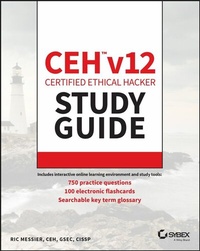
CEH v12 Certified Ethical Hacker Study Guide with 750 Practice Test Questions
Description

Information security and personal privacy remains a growing concern for businesses in every sector. And even as the number of certifications increases, the Certified Ethical Hacker, Version 12 (CEH v12) maintains its place as one of the most sought-after and in-demand credentials in the industry.
In CEH v12 Certified Ethical Hacker Study Guide with 750 Practice Test Questions, you'll find a comprehensive overview of the CEH certification requirements. Concise and easy-to-follow instructions are combined with intuitive organization that allows you to learn each exam objective in your own time and at your own pace. The Study Guide now contains more end of chapter review questions and more online practice tests. This combines the value from the previous two-book set including a practice test book into a more valuable Study Guide.
The book offers thorough and robust coverage of every relevant topic, as well as challenging chapter review questions, even more end of chapter review questions to validate your knowledge, and Exam Essentials, a key feature that identifies important areas for study. There are also twice as many online practice tests included. You'll learn about common attack practices, like reconnaissance and scanning, intrusion detection, DoS attacks, buffer overflows, wireless attacks, mobile attacks, Internet of Things vulnerabilities, and more. It also provides:
* Practical, hands-on exercises that reinforce vital, real-world job skills and exam competencies
* Essential guidance for a certification that meets the requirements of the Department of Defense 8570 Directive for Information Assurance positions
* Complimentary access to the Sybex online learning center, complete with chapter review questions, full-length practice exams, hundreds of electronic flashcards, and a glossary of key terms
The CEH v12 Certified Ethical Hacker Study Guide with 750 Practice Test Questions is your go-to official resource to prep for the challenging CEH v12 exam and a new career in information security and privacy.
More details
Other editions
Additional editions

Person
ABOUT THE AUTHOR
RIC MESSIER, CEH, GCIH, GSEC, CISSP, CCSP, is a consultant, educator, and author of numerous books on information security and digital forensics. With decades of experience in information technology and information security, Ric has held the varied roles of programmer, system administrator, network engineer, security engineering manager, VoIP engineer, consultant, and professor and he is currently a Principal Consultant with Mandiant.
Content
- Cover
- Title Page
- Copyright Page
- About the Author
- Contents at a Glance
- Contents
- Introduction
- What Is a CEH?
- The Subject Matter
- About the Exam
- Who Is Eligible
- Exam Cost
- About EC-Council
- Using This Book
- Objective Map
- Let's Get Started!
- How to Contact the Publisher
- Assessment Test
- Answers to Assessment Test
- Chapter 1 Ethical Hacking
- Overview of Ethics
- Overview of Ethical Hacking
- Attack Modeling
- Cyber Kill Chain
- Attack Lifecycle
- MITRE ATT&CK Framework
- Methodology of Ethical Hacking
- Reconnaissance and Footprinting
- Scanning and Enumeration
- Gaining Access
- Maintaining Access
- Covering Tracks
- Summary
- Chapter 2 Networking Foundations
- Communications Models
- Open Systems Interconnection
- TCP/IP Architecture
- Topologies
- Bus Network
- Star Network
- Ring Network
- Mesh Network
- Hybrid
- Physical Networking
- Addressing
- Switching
- IP
- Headers
- Addressing
- Subnets
- TCP
- UDP
- Internet Control Message Protocol
- Network Architectures
- Network Types
- Isolation
- Remote Access
- Cloud Computing
- Storage as a Service
- Infrastructure as a Service
- Platform as a Service
- Software as a Service
- Internet of Things
- Summary
- Review Questions
- Chapter 3 Security Foundations
- The Triad
- Confidentiality
- Integrity
- Availability
- Parkerian Hexad
- Information Assurance and Risk
- Policies, Standards, and Procedures
- Security Policies
- Security Standards
- Procedures
- Guidelines
- Organizing Your Protections
- Security Technology
- Firewalls
- Intrusion Detection Systems
- Intrusion Prevention Systems
- Endpoint Detection and Response
- Security Information and Event Management
- Being Prepared
- Defense in Depth
- Defense in Breadth
- Defensible Network Architecture
- Logging
- Auditing
- Summary
- Review Questions
- Chapter 4 Footprinting and Reconnaissance
- Open Source Intelligence
- Companies
- People
- Social Networking
- Domain Name System
- Name Lookups
- Zone Transfers
- Passive DNS
- Passive Reconnaissance
- Website Intelligence
- Technology Intelligence
- Google Hacking
- Internet of Things (IoT)
- Summary
- Review Questions
- Chapter 5 Scanning Networks
- Ping Sweeps
- Using fping
- Using MegaPing
- Port Scanning
- nmap
- masscan
- MegaPing
- Metasploit
- Vulnerability Scanning
- OpenVAS
- Nessus
- Looking for Vulnerabilities with Metasploit
- Packet Crafting and Manipulation
- hping
- packETH
- fragroute
- Evasion Techniques
- Evasion with nmap
- Protecting and Detecting
- Summary
- Review Questions
- Chapter 6 Enumeration
- Service Enumeration
- Countermeasures
- Remote Procedure Calls
- SunRPC
- Remote Method Invocation
- Server Message Block
- Built-in Utilities
- nmap Scripts
- NetBIOS Enumerator
- Metasploit
- Other Utilities
- Countermeasures
- Simple Network Management Protocol
- Countermeasures
- Simple Mail Transfer Protocol
- Countermeasures
- Web-Based Enumeration
- Countermeasures
- Summary
- Review Questions
- Chapter 7 System Hacking
- Searching for Exploits
- System Compromise
- Metasploit Modules
- Exploit-DB
- Gathering Passwords
- Password Cracking
- John the Ripper
- Rainbow Tables
- Kerberoasting
- Client-Side Vulnerabilities
- Living Off the Land
- Fuzzing
- Post Exploitation
- Evasion
- Privilege Escalation
- Pivoting
- Persistence
- Covering Tracks
- Summary
- Review Questions
- Chapter 8 Malware
- Malware Types
- Virus
- Worm
- Trojan
- Botnet
- Ransomware
- Dropper
- Fileless Malware
- Polymorphic Malware
- Malware Analysis
- Static Analysis
- Dynamic Analysis
- Automated Malware Analysis
- Creating Malware
- Writing Your Own
- Using Metasploit
- Obfuscating
- Malware Infrastructure
- Antivirus Solutions
- Persistence
- Summary
- Review Questions
- Chapter 9 Sniffing
- Packet Capture
- tcpdump
- tshark
- Wireshark
- Berkeley Packet Filter
- Port Mirroring/Spanning
- Detecting Sniffers
- Packet Analysis
- Spoofing Attacks
- ARP Spoofing
- DNS Spoofing
- DHCP Starvation Attack
- sslstrip
- Spoofing Detection
- Summary
- Review Questions
- Chapter 10 Social Engineering
- Social Engineering
- Pretexting
- Social Engineering Vectors
- Identity Theft
- Physical Social Engineering
- Badge Access
- Man Traps
- Biometrics
- Phone Calls
- Baiting
- Tailgating
- Phishing Attacks
- Contact Spamming
- Quid Pro Quo
- Social Engineering for Social Networking
- Website Attacks
- Cloning
- Rogue Attacks
- Wireless Social Engineering
- Automating Social Engineering
- Summary
- Review Questions
- Chapter 11 Wireless Security
- Wi-Fi
- Wi-Fi Network Types
- Wi-Fi Authentication
- Wi-Fi Encryption
- Bring Your Own Device
- Wi-Fi Attacks
- Bluetooth
- Scanning
- Bluejacking
- Bluesnarfing
- Bluebugging
- Bluedump
- Bluesmack
- Mobile Devices
- Mobile Device Attacks
- Summary
- Review Questions
- Chapter 12 Attack and Defense
- Web Application Attacks
- OWASP Top 10 Vulnerabilities
- Web Application Protections
- Denial-of-Service Attacks
- Bandwidth Attacks
- Slow Attacks
- Legacy
- Application Exploitation
- Buffer Overflow
- Heap Spraying
- Application Protections and Evasions
- Lateral Movement
- Defense in Depth/Defense in Breadth
- Defensible Network Architecture
- Summary
- Review Questions
- Chapter 13 Cryptography
- Basic Encryption
- Substitution Ciphers
- Diffie-Hellman
- Symmetric Key Cryptography
- Data Encryption Standard
- Advanced Encryption Standard
- Asymmetric Key Cryptography
- Hybrid Cryptosystem
- Nonrepudiation
- Elliptic Curve Cryptography
- Certificate Authorities and Key Management
- Certificate Authority
- Trusted Third Party
- Self-Signed Certificates
- Cryptographic Hashing
- PGP and S/MIME
- Disk and File Encryption
- Summary
- Review Questions
- Chapter 14 Security Architecture and Design
- Data Classification
- Security Models
- State Machine
- Biba
- Bell-LaPadula
- Clark-Wilson Integrity Model
- Application Architecture
- n-tier Application Design
- Service-Oriented Architecture
- Cloud-Based Applications
- Database Considerations
- Security Architecture
- Zero-Trust Model
- Summary
- Review Questions
- Chapter 15 Cloud Computing and the Internet of Things
- Cloud Computing Overview
- Cloud Services
- Shared Responsibility Model
- Public vs. Private Cloud
- Grid Computing
- Cloud Architectures and Deployment
- Maintaining Access
- Responsive Design
- Cloud-Native Design
- Deployment
- Dealing with REST
- Common Cloud Threats
- Access Management
- Data Breach
- Web Application Compromise
- Credential Compromise
- Insider Threat
- Internet of Things
- Fog Computing
- Operational Technology
- The Purdue Model
- Summary
- Review Questions
- Appendix: Answers to Review Questions
- Chapter 2: Networking Foundations
- Chapter 3: Security Foundations
- Chapter 4: Footprinting and Reconnaissance
- Chapter 5: Scanning Networks
- Chapter 6: Enumeration
- Chapter 7: System Hacking
- Chapter 8: Malware
- Chapter 9: Sniffing
- Chapter 10: Social Engineering
- Chapter 11: Wireless Security
- Chapter 12: Attack and Defense
- Chapter 13: Cryptography
- Chapter 14: Security Architecture and Design
- Chapter 15: Cloud Computing and the Internet of Things
- Index
- EULA
Introduction
You're thinking about becoming a Certified Ethical Hacker (CEH). No matter what variation of security testing you are performing-ethical hacking, penetration testing, red teaming, or application assessment-the skills and knowledge necessary to achieve this certification are in demand. Even the idea of security testing and ethical hacking is evolving as businesses and organizations begin to have a better understanding of the adversaries they are facing. It's no longer the so-called script kiddies that businesses felt they were fending off for so long. Today's adversary is organized, well-funded, and determined. This means testing requires different tactics.
Depending on who you are listening to, 80-90 percent of attacks today use social engineering. The old technique of looking for technical vulnerabilities in network services is simply not how attackers are getting into networks. Networks that are focused on applying a defense-in-depth approach, hardening the outside, may end up being susceptible to attacks from the inside, which is what happens when desktop systems are compromised. The skills needed to identify vulnerabilities and recommend remediations are evolving, along with the tactics and techniques used by attackers.
This book is written to help you understand the breadth of content you will need to know to obtain the CEH certification. You will find a lot of concepts to provide you with a foundation that can be applied to the skills required for the certification. While you can read this book cover to cover, for a substantial chunk of the subjects, getting hands-on experience is essential. The concepts are often demonstrated through the use of tools. Following along with these demonstrations and using the tools yourself will help you understand the tools and how to use them. Many of the demonstrations are done in Kali Linux, though many of the tools have Windows analogs if you are more comfortable there.
We can't get through this without talking about ethics, though you will find it mentioned in several places throughout the book. This is serious, and not only because it's a huge part of the basis for the certification. It's also essential for protecting yourself and the people you are working for. The short version is do not do anything that would cause damage to systems or your employer. There is much more to it than that, which you'll read more about in Chapter 1, "Ethical Hacking," as a starting point. It's necessary to start wrapping your head around the ethics involved in this exam and profession. You will have to sign an agreement as part of achieving your certification.
At the end of each chapter, you will find a set of questions. This will help you to demonstrate to yourself that you understand the content. Most of the questions are multiple choice, which is the question format used for the CEH exam. These questions, along with the hands-on experience you take advantage of, will be good preparation for taking the exam.
What Is a CEH?
The Certified Ethical Hacker exam is to validate that those holding the certification understand the broad range of subject matter that is required for someone to be an effective ethical hacker. The reality is that most days, if you are paying attention to the news, you will see a news story about a company that has been compromised and had data stolen, a government that has been attacked, or even enormous denial-of-service attacks, making it difficult for users to gain access to business resources.
The CEH is a certification that recognizes the importance of identifying security issues to get them remediated. This is one way companies can protect themselves against attacks-by getting there before the attackers do. It requires someone who knows how to follow techniques that attackers would normally use. Just running scans using automated tools is insufficient because as good as security scanners may be, they will identify false positives-cases where the scanner indicates an issue that isn't really an issue. Additionally, they will miss a lot of vulnerabilities-false negatives-for a variety of reasons, including the fact that the vulnerability or attack may not be known.
Because companies need to understand where they are vulnerable to attack, they need people who are able to identify those vulnerabilities, which can be very complex. Scanners are a good start, but being able to find holes in complex networks can take the creative intelligence that humans offer. This is why we need ethical hackers. These are people who can take extensive knowledge of a broad range of technical subjects and use it to identify vulnerabilities that can be exploited.
The important part of that two-word phrase, by the way, is "ethical." Companies have protections in place because they have resources they don't want stolen or damaged. When they bring in someone who is looking for vulnerabilities to exploit, they need to be certain that nothing will be stolen or damaged. They also need to be certain that anything that may be seen or reviewed isn't shared with anyone else. This is especially true when it comes to any vulnerabilities that have been identified.
The CEH exam, then, has a dual purpose. It not only tests deeply technical knowledge but also binds anyone who is a certification holder to a code of conduct. Not only will you be expected to know the content and expectations of that code of conduct, you will be expected to live by that code. When companies hire or contract to people who have their CEH certification, they can be assured they have brought on someone with discretion who can keep their secrets and provide them with professional service in order to help improve their security posture and keep their important resources protected.
The Subject Matter
If you were to take the CEH v12 training, you would have to go through the following modules:
- Introduction to Ethical Hacking
- Footprinting and Reconnaissance
- Scanning Networks
- Enumeration
- Vulnerability Analysis
- System Hacking
- Malware Threats
- Sniffing
- Social Engineering
- Denial of Service
- Session Hijacking
- Evading IDSs, Firewalls, and Honeypots
- Hacking Web Servers
- Hacking Web Applications
- SQL Injection
- Hacking Wireless Networks
- Hacking Mobile Platforms
- IoT and OT Hacking
- Cloud Computing
- Cryptography
As you can see, the range of subjects is broad. Beyond knowing the concepts associated with these topics, you will be expected to know about various tools that may be used to perform the actions associated with the concepts you are learning. You will need to know tools like nmap for port scanning, for example. You may need to know proxy-based web application attack tools. For wireless network attacks, you may need to know about the aircrack-ng suite of tools. For every module listed, there are potentially dozens of tools that may be used.
The subject matter of the CEH exam is very technical. This is not a field in which you can get by with theoretical knowledge. You will need to have had experience with the methods and tools that are covered within the subject matter for the CEH exam. What you may also have noticed here is that the modules all fall within the different stages mentioned earlier. While you may not necessarily be asked for a specific methodology, you will find that the contents of the exam do generally follow the methodology that the EC-Council believes to be a standard approach.
About the Exam
The CEH exam has much the same parameters as other professional certification exams. You will take a computerized, proctored exam. You will have 4 hours to complete 125 questions. That means you will have, on average, roughly 2 minutes per question. The questions are all multiple choice. The exam can be taken through the ECC Exam Center or at a Pearson VUE center. For details about VUE, please visit https://home.pearsonvue.com/eccouncil.
Should you want to take your certification even further, you could go after the CEH Practical exam. For this exam you must perform an actual penetration test and write a report at the end of it. This demonstrates that in addition to knowing the body of material covered by the exam, you can put that knowledge to use in a practical way. You will be expected to know how to compromise systems and identify vulnerabilities.
To pass the exam, you will have to correctly answer a certain number of questions, though the actual number will vary. The passing grade varies depending on the difficulty of the questions asked. The harder the questions that are asked out of the complete pool of questions, the fewer questions you need to get right to pass the exam. If you get easier questions, you will need to get more of the questions right to pass. There are some sources of information that will tell you that you need to get 70 percent of the questions right, and that may be okay for general guidance and preparation as a rough low-end marker. However, keep in mind that when you sit down to take the actual test at the testing center, the passing grade will vary. The score you will need to achieve will range from 60 to 85 percent.
The good news is that you will know whether you passed before you leave the testing center. You will get your score when you finish the exam, and you will also get a piece...
