

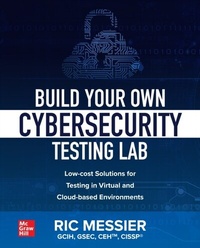
Build Your Own Cybersecurity Testing Lab: Low-cost Solutions for Testing in Virtual and Cloud-based Environments
1st Edition
Published on 28. February 2020
320 pages
978-1-260-45832-9 (ISBN)
Available for download
Description

Publisher's Note: Products purchased from Third Party sellers are not guaranteed by the publisher for quality, authenticity, or access to any online entitlements included with the product.Manage your own robust, inexpensive cybersecurity testing environmentThis hands-on guide shows clearly how to administer an effective cybersecurity testing lab using affordable technologies and cloud resources. Build Your Own Cybersecurity Testing Lab: Low-cost Solutions for Testing in Virtual and Cloud-based Environments fully explains multiple techniques for developing lab systems, including the use of Infrastructure-as-Code, meaning you can write programs to create your labs quickly, without manual steps that could lead to costly and frustrating mistakes. Written by a seasoned IT security professional and academic, this book offers complete coverage of cloud and virtual environments as well as physical networks and automation. Included with the book is access to videos that demystify difficult concepts.Inside, you will discover how to: Gather network requirements and build your cybersecurity testing lab Set up virtual machines and physical systems from inexpensive components Select and configure the necessary operating systems Gain remote access through SSH, RDP, and other remote access protocols Efficiently isolate subnets with physical switches, routers, and VLANs Analyze the vulnerabilities and challenges of cloud-based infrastructures Handle implementation of systems on Amazon Web Services, Microsoft Azure, and Google Cloud Engine Maximize consistency and repeatability using the latest automation tools
More details
Other editions
Additional editions
Ric Messier
Build Your Own Cybersecurity Testing Lab: Low-cost Solutions for Testing in Virtual and Cloud-based Environments
Low-cost Solutions for Testing in Virtual and Cloud-based Environments
Book
03/2020
McGraw-Hill Education
€45.70
Shipment within 10-20 days
Content
- Cover
- About the Author
- Title Page
- Copyright Page
- Contents
- Introduction
- Chapter 1 Why Perform Security Testing?
- Compliance
- Security Testing
- Software Security Testing
- Stress Testing
- Penetration Testing
- Red Teaming
- Blue Team/Operations Testing
- Goals
- Isolation
- You vs. the Enterprise
- Summary
- Chapter 2 Network Design
- Networking Basics
- Network Access Layer
- Switching
- Internetworking Layer
- Network Topologies
- Design Requirements
- The Importance of Isolation
- Air Gaps
- Routing
- Firewalls
- Summary
- Chapter 3 Physical and Virtual Machines
- Physical Systems
- Specifications
- Go New!
- Reduce, Reuse, Recycle
- Low-Cost Devices
- Racking and Stacking
- Virtualization
- Type 1 Hypervisors
- Type 2 Hypervisors
- Containers
- Summary
- Chapter 4 Operating Systems
- Operating Systems to Test From
- Windows
- Linux
- Single-Board Computer (SBC) Operating Systems
- Systems Under Test
- Metasploitable 2
- Metasploitable 3
- Web Applications
- Command Line Considerations
- Summary
- Chapter 5 Remote Access
- Virtual Private Networks
- Windows VPN
- Linux VPN
- Shell Access
- Graphical Interfaces
- Remote Management (No Interface)
- Virtual Machine Access
- Summary
- Chapter 6 Networking
- Switching
- Virtual Local Area Networks (VLANs)
- Private VLANs
- Routing
- Static Routing
- Dynamic Routing
- Virtual Machine Networking
- Software Defined Networking
- Summary
- Chapter 7 Cloud Computing and Private Clouds
- Cloud Services
- Infrastructure as a Service
- Platform as a Service
- Storage as a Service
- Software as a Service
- Elements of Cloud
- OpenStack
- Using DevStack
- Admin
- Instantiation
- Networking
- Security Groups
- Finding Images
- Summary
- Chapter 8 Amazon Web Services
- Traditional Architecture
- Data Storage
- Application Server
- Web Server
- Load Balancer
- The Cloud Way
- Microservices
- Message Queuing Services
- Database
- Summary
- Chapter 9 Microsoft Azure
- Traditional Web Design
- Load Balancers
- Web Servers
- Application Server
- Database
- Cloud Native
- Serverless
- Containers
- Databases
- Summary
- Chapter 10 Google Cloud Engine
- Traditional Architecture
- Database
- Application Server
- Web Server
- Load Balancer
- Cloud-Native
- Containers
- Databases
- Summary
- Chapter 11 Automation
- DevOps and DevSecOps
- Command Line Access
- Infrastructure as Code
- Summary
- Index

