

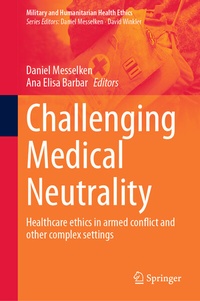
Challenging Medical Neutrality
Description

In this volume, the concept of "medical neutrality," which states that medical services should not be interfered with during armed conflicts and other emergencies, is challenged based on the experience and expertise of the authors, who come from diverse military, humanitarian, and academic backgrounds. The principle of medical neutrality is grounded in International Humanitarian Law as well as in Human Rights Law and it can be justified by ethical rationales such as the principle of Humanity and ordinary medical ethics. Health workers often understand medical neutrality as an obligation not to engage in anything else other than medical outcomes. In this book, a variety of problems and ethical issues in the application of medical neutrality in the professional practice of healthcare personnel are analyzed. The contributors expand the debate around "medical neutrality" and aim at better-informing policy and operational decisions regarding the application of medical ethics, the protection of medical missions in conflict, and the training of healthcare professionals to operate ethically and safely in volatile environments. The volume is of great interest to academics, practitioners, policymakers, and students who are looking for analyses and guidance regarding medical neutrality.
More details
Other editions
Additional editions
Persons
Daniel Messelken is a research associate at the Center for Ethics at Zurich University and leader of the Zurich Center for Military Medical Ethics. He also serves as Head Ethics Teacher for the Center of Reference for Education on IHL and Ethics of the International Committee of Military Medicine and is member of the Board of Directors of the International Society for Military Ethics in Europe (EuroISME).
Ana Elisa Barbar is an expert on protection of healthcare, with focus on safe health responses, civil-military relations and emergency preparedness, and has worked in different roles with the World Health Organization and in the Red Cross and Red Crescent Movement. Her functions have been connected to the delivery of ethical and safe health emergency responses, and the wellbeing of health professionals in contexts of conflict or violence. She has been deployed in Latin America, Middle East and Africa, and has spent four years as a global advisor to policy and operations of the International Committee of the Red Cross on issues of protection of healthcare. Ana Elisa is a clinical psychologist with a license and full residency in Primary Health Care and Health Systems Management, as well as an Executive Master´s in Policy Making and International Negotiations.
Content
1 Preface In Search for the Meaning of Medical Neutrality.- Part One.- 2 Historical Antecedents to Understanding Contemporary Attacks on Healthcare.- 3 Dual Loyalties in Military Medicine Some lessons from the past challenges for the future.- Part Two.- 4 Military Health Care Personnel's moral stance on war: medical neutrality and humanity.- 5 Medical neutrality as impartiality - implications for prioritizing medical care in armed conflict.- 6 On Medical neutrality.- Part Three.- 7 Medical Neutrality or Medical Humanity in War?.- 8 Medical Neutrality and Impartiality in UN Peace Keeping Operations.- 9 Dual Professonal Loyalty and Medical Ethics Outside Armed Conflict: A personal experience.- 10 Providing Medical Care to Further Non-medical Ends.- 11 Medical Neutrality in Times of Military Coup in Myanmar.- 12 Economic Sanctions Policy, Medical Neutrality and the Human Right to Health.- Part Four.- 13 A practical reflection on global health leveraging health as a means to another end.- 14 Risks associated with different understandings of "medical neutrality".- 15 Medical Neutrality and Political Engagement.
