

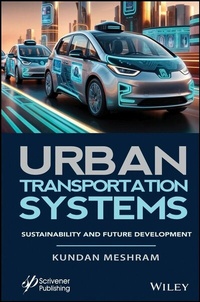
Urban Transportation Systems
Description

This exciting new volume covers the most up-to-date advances, theories, and practical applications for non-motorized transportation (NMT) systems, geographic information system-based transportation systems, and signal processing for urban transportation systems.
This book will allow readers to readers to identify traffic and transport problems in cities and to study mass transportation systems, and modes of transportation and their characteristics, focusing on transportation infrastructure which includes green bays, control stations, mitigation buildings, separator lanes, and safety islands. From this, readers will be able to study urban public transport systems and gain some background into intelligent transportation and telemetric systems, including techniques for designing transport telemetric systems and applying them to urban transportation. Applications include advanced traffic management systems, advanced traveler information systems, advanced vehicle control systems, commercial vehicle operational management, advanced public transportation systems, electronic payment systems, advanced urban transportation, security and safety systems, and urban traffic control.
From this, an artificial Intelligence-based transportation system design using genetic algorithms and neural networks is discussed, to show applications in designs. These models and their studies are further extended in signal processing systems and geographic information systems (GIS) to improve transportation system design, and to apply this to the design of non-motorized transportation models, while ensuring pedestrian safety. All these models are further analyzed for environmental impact assessment, which include structural audits, analysis of site selection procedure, baseline conditions and major concerns, green building and its advantages, the description of potential environmental effects, and many more interesting topics.
More details
Other editions
Additional editions
Person
Kundan Meshram, PhD, is an assistant professor in the Department of Civil Engineering, at Guru Ghasidas Vishwavidyalaya (A Central University) Bilaspur (C.G.), India. He received his PhD in civil engineering from Maulana Azad National Institute of Technology Bhopal, India. He has six patents and two books to his credit, as well as three book chapters and over 40 research papers in scientific journals and conferences. He was awarded the International Innovative Researcher in Civil Engineering award, RULA Peace Award, and the CPWD Medal and Best Paper Award from the Indian Road Congress.
Content
Preface xi
1 Introduction to Sustainable Transportation 1
1.1 Introduction 1
1.2 Traffic and Transport Problems of an Urban City 2
1.3 Mass Transport System 4
1.4 Modes of Transportation and Characteristics 4
1.5 Public Transport System 8
1.6 Advantages and Disadvantages of Public Transport System 10
1.7 Role of Transportation in Mass Transportation Systems 10
1.8 Public-Private Transport System 11
1.9 Transportation Infrastructure 12
1.10 Introduction to Sustainable Transportation, and How It Can Solve Various Issues 13
2 Use of Sustainable Transportation for Urban Scenarios 19
2.1 Introduction to Urban Transportation Scenarios 19
2.2 Advanced Operation Concepts of Public Transportation 22
2.3 BRTS and Bus Lane System 24
2.4 Advantages and Limitations in Worldwide Transport Scenario 27
2.5 Advantages and Limitations in Indian Transport Scenario 29
2.6 Rail System and Its Types (in the Context of Monorail, Metro, etc.) 31
2.7 Advantages and Disadvantages of Rail System 33
2.8 Skywalk and Under Bridge and Its Advantages 35
2.9 Measuring Performance of Transit Systems 36
3 Background on Intelligent Transportation and Telemetric Systems 41
3.1 Introduction 41
3.2 Definitions 42
3.3 Features and Objectives of ITS 44
3.4 History of ITS and Its Development Over the World 45
3.5 Telemetric Concept 47
3.6 Transport Telemetric 49
3.7 Telemetric Structure 51
3.8 ITS Taxonomy 53
3.9 ITS Application Areas and Uses 55
3.10 Application in Urban Transportation 58
4 Use of ITS for Deployment of Sustainable Transportation Models 63
4.1 Introduction 64
4.2 How ITS can be Used to Maintain Sustainability 66
4.3 Advanced Traffic Management Systems 70
4.4 Advanced Traveler Information Systems 73
4.5 Advanced Vehicle Control System 75
4.6 Commercial Vehicle Operational Management 77
4.7 Advanced Public Transportation Systems 80
4.8 Electronic Payment Systems 82
4.9 Advanced Urban Transportation Models 86
4.10 Security and Safety Systems 88
4.11 Urban Traffic Control 90
4.12 Benefits and Limitations of ITS for Sustainable Transportation 94
5 Artificial Intelligence-Based Transportation System 99
5.1 Introduction to Artificial Intelligence 99
5.2 Components of Transportation System that Require Optimization 102
5.3 Role of Artificial Intelligence in Optimization of these Components 108
5.4 Congestion Control with Artificial Intelligence 109
5.5 Accident Avoidance with Artificial Intelligence 112
5.6 Active Alert System Design with Artificial Intelligence 115
6 Introduction of Signal Processing for Sustainable Transport 127
6.1 Introduction 128
6.2 Signal Processing Overview 129
6.3 Fundamentals of Image Processing 131
6.4 Fundamental Signals (1-D, 2-D, and 3-D) 133
6.5 Classification of Systems 135
6.6 Characteristics of LTI/LSI Systems 137
6.7 Application of Image Processing in Urban Transportation Systems 138
7 Geographic Information System-Based Transportation System 143
7.1 Introduction to Geographic Information System 144
7.2 Sources of GIS 147
7.3 Role of GIS in Transportation 150
7.4 Assessment of Roads, and Railways Using GIS 153
7.5 Case Study of Smart City GIS 156
8 Deployment of Sustainability for Non-Motorized Transportation Systems 161
8.1 Introduction 161
8.2 Components of NMT 162
8.3 Categories of NMT 165
8.4 Planning Smart Cities to Facilitate NMT 167
8.5 Effect of NMT Planning on Healthcare 170
8.6 Use of Artificial Intelligence and Machine Learning for Integrating Sustainability in NMTs 174
9 Sustainability for Pedestrian Safety Applications 181
9.1 Introduction 182
9.2 Urban Pedestrian Safety-Skyways, Intersection Subways, Halt Stations 184
9.3 Crossing Measures 188
9.4 Flexibility in Accessibility 192
9.5 Design of Collision Control Systems for Intersections to Improve Pedestrian Safety 196
9.6 Design of Use Case for Pedestrian Safety for Sustainable Operations 200
10 Environmental Impact Assessment 207
10.1 Introduction 208
10.2 Description of Proposed Activity 211
10.3 Structural Audits 212
10.4 Analysis of Site Selection Procedure 214
10.5 Baseline Conditions/Major Concerns 216
10.6 Green Building and Its Advantages 218
10.7 Description of Potential Positive and Negative Environmental, Social, Economic, and Cultural Impacts Including Cumulative, Regional, Temporal, and Spatial Considerations 221
10.8 Significance of Mitigation Plans and Monitoring Plans 225
11 Traffic Flow Analysis 231
11.1 Introduction 231
11.2 Study Area 233
11.3 Data Collection 234
11.4 Development of Relationship Between Speed, Flow, and Density 236
11.5 Recommendations 242
12 Machine Learning-Based Traffic Operation System 245
12.1 Introduction 245
12.2 Literature Review 247
12.3 Proposed Integrated Machine Learning Model for Improving Highway Traffic Maintenance Efficiency with IoT Devices 252
12.4 Performance Analysis 255
12.5 Conclusion and Future Scope 259
13 Traffic Scenario: Efficient Model for Accident Analysis 263
13.1 Introduction 264
13.2 Motivation and Contributions 265
13.3 Review of Existing Models 266
13.4 Comparative Analysis 284
13.5 Design of the Proposed Model 297
13.6 Result Analysis 301
13.7 Conclusions and Future Scope 312
14 Smart Vehicle Scenarios in Urban Transportation Through Blockchain and Advanced Machine Learning Techniques 319
14.1 Introduction 320
14.2 Motivation and Contribution 321
14.3 Literature Review 322
14.4 Comparative Analysis of Reviewed Models 350
14.5 Design of the Proposed Model 363
14.6 Result Analysis 367
14.7 Conclusion and Future Scope 377
Future Scope 378
References 378
Appendix 1 385
Index 399
1
Introduction to Sustainable Transportation
Abstract
This book chapter provides an overview of the traffic and transport problems that arise in urban cities, and the role of mass transportation systems in addressing them in detail for different use cases. The chapter discusses the different modes of transportation and their characteristics, including the public and private transport systems. The advantages and disadvantages of public transport systems are also explored for real-time scenarios. The role of transportation infrastructure in mass transportation systems, including green bays, control stations, mitigation buildings, separator lanes, and safety islands, is also discussed for different use cases. The chapter then introduces sustainable transportation as a solution to various transport issues and explores its benefits. Overall, this chapter provides a comprehensive understanding of the transportation issues faced by urban cities and the potential solutions offered by sustainable transportation characteristics.
Keywords: Sustainable transportation, mass transportation system, public transport system
1.1 Introduction
Transportation has been one of the cornerstones of human development, it includes categories like road transportation, air transportation, water transportation, and deep-sea transportation. While road transportation accumulates to nearly 70% of all transportation media, and thereby is considered as one of the most useful modes of transportation, other modes of transportation are also popular when context-sensitive transport is needed. Each of these modes has their own characteristics, including,
- Movement options, which indicates the number and scale of vehicles which the mode of transport can be used for carrying.
- Speed and accessibility, which represents the delay needed, and the number of people to which the medium is capable of reaching.
Table 1.1 Transportation modes and their characteristics.
Mode Movement options Speed Accessibility Cost Capacity Intermodal capability Roadways Very broad Moderate High Moderate Low Very high Railways Broad Slow Moderate Low Moderate Very high Airlines Narrow Fast Low Very high Very low Moderate Waterways Broad Very slow Moderate Very low Very high Very high Pipeline Very narrow Very slow Low Low Very high Very low- Cost and capacity, which represents the cost of moving single units, and the number of units which can be moved.
- Intermodal capability, which indicates the capability of the system for interacting with other modes of transportation.
A brief survey of these modes is tabulated in Table 1.1, wherein each of the modes and their characteristics are segregated and compared.
Based on this comparison, various transportation modes and their usage can be estimated for smart cities. In this chapter, a wide variety of transportation problems, their characteristics, advantages, drawbacks, and infrastructure details are discussed in detail.
1.2 Traffic and Transport Problems of an Urban City
As the population of any city grows, the number of vehicles also grow exponentially. An example of number of vehicles with regards to number of people in an urban area can be observed from Figure 1.1, which indicates that for each new individual, there is at least one vehicle on the road. In fact, it can be observed that the number of vehicles on road follow Equation 1.1 for any urban area,
(1.1)Where, Vnum and Pnum represent number of vehicles, and number of persons in the area, while k is the area constant, which depends upon geographical size of the area.
Figure 1.1 Population v/s number of vehicles.
Due to increase in population size, the following issues arise during transportation:
- Traffic movement and congestion
- Off-peak inadequacy of public transport
- Public transport crowding
- Parking difficulties
- Difficulties for pedestrians
- Traffic noise
- Environmental impact
- Atmospheric pollution
Each of these issues result in increased congestion, and have a multiplicative effect on others. For instance, due to increased traffic movement and congestion, there is an increase in atmospheric pollution, which causes environmental impacts like global warming. Furthermore, due to larger traffic movements, there are parking issues, which further lead to congestion and overcrowding of public transports, which results into difficulties for pedestrians, and causes deficiencies in public transportation systems. Thus, these issues must be tackled during town planning, and mass transportation systems must be designed as discussed in the next sub-section.
1.3 Mass Transport System
Due to increase in overall traffic, governmental agencies have deployed mass transportation systems. These systems assist in transporting large number of people from one place to another, thereby reducing the need of multiple vehicle types. Examples of mass transportation systems are:
- City buses, which have moderate level of capacity, and move at moderate speed. These are the second most preferred way of transport, and usually follow a schedule.
- Trolley buses, require dedicated power lines, and thus are used in legacy mode.
- Trams (or light rail) are similar to trolley buses, but have larger capacities. Smart cities have replaced trams with underground and overground metro railways.
- Passenger trains are the most preferred way of communication in metropolitan cities, and are responsible for reducing traffic via maintaining fixed departure and arrival schedules.
- Rapid transit (metros, subways, underground railways, etc.) is one of the most upcoming modern day transportation systems, which are used for high efficiency, low cost and largescale transportations.
- Ferries and other water taxis are also used in geographies with water bodies. They are useful for low speed, but high-capacity transportation.
All these modes of transportation are categorized under public transportation system, which can be observed from Figure 1.2, and are discussed in the next sub-section of this text. This will assist in analysis of different transportation models, and thereby improving their feasibility for real time deployment.
1.4 Modes of Transportation and Characteristics
The transportation industry has a significant impact on how our culture and economy are shaped. However, the traditional forms of transportation, which are mostly dependent on fossil fuels, have had detrimental effects on the environment, people's health, and sustainability in general. It is crucial to investigate alternate forms of transportation that lower greenhouse gas emissions, advance energy efficiency, and improve livability as the work toward a more sustainable future. This chapter seeks to provide a general overview of several sustainable transportation options and their features.
Figure 1.2 Mass transportation system for smart city.
1. Cycling and Walking
The most basic and sustainable forms of transportation are cycling and walking. These modes have a number of benefits, including the promotion of physical activity, a decrease in air pollution and traffic, and a need for less infrastructure. They are best suited for quick travels inside cities or getting to transportation hubs. In order to promote these forms of transportation, walkability, and the availability of bicycle infrastructure, such as designated lanes and bike-sharing programs, are essential.
Characteristics: following characteristics of cycling and walking are given below:
- i. High sustainability and zero emissions.
- ii. Improve public health by encouraging physical exercise.
- iii. Suitable for short journeys.
- iv. Demand bicycle facilities and pedestrian-friendly infrastructure.
- v. Encourage engagement with the environment and a feeling of community.
2. Public Transportation
For a huge number of people, shared mobility alternatives are provided via public transportation systems, which include buses, trams, light rail, subways, and trains. By lowering energy use, emissions per passenger kilometer, and traffic congestion, public transportation has a substantial positive impact on sustainability. By influencing the patterns of land use, effective public transportation systems may improve accessibility, promote social fairness, and aid in urban growth.
Characteristics: the characteristics of public transportation are given as follow:
- i. Efficient and cooperative resource usage.
- ii. Reduce emissions and traffic congestion.
- iii. Accessibility to a variety of locations is provided.
- iv. Encourage dense construction and communities that are close to transportation.
- v. Need well thought-out infrastructure and encouraging...
