

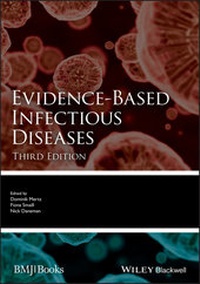
Evidence-Based Infectious Diseases
Description

More details
Other editions
Additional editions
Persons
Edited by
Dr. Dominik Mertz, Associate Professor, Division of Infectious Diseases, McMaster University and Medical Director, Infection Prevention and Control, Hamilton Health Sciences, Hamilton, Ontario, Canada
Dr. Fiona Smaill, Professor, Department of Pathology and Molecular Medicine, McMaster University and Medical Microbiologist, Hamilton Regional Laboratory Medicine Program, Hamilton, Ontario, Canada
Dr. Nick Daneman, Clinician-Scientist, Division of Infectious Diseases, Sunnybrook Health Sciences Centre, University of Toronto, Toronto, Ontario, Canada
Content
List of Contributors vii
Preface xi
1 Introduction to Evidence-based Infectious Diseases 1
Dominik Mertz, Nick Daneman, and Fiona Smaill
Part 1 Specific Diseases 11
2 Skin and Soft-tissue Infections 13
Douglas Austgarden and Guilio DiDiodato
3 Bone and Joint Infections 23
Nora Renz and Andrej Trampuz
4 Infective Endocarditis 37
Bahareh Ghadaki and Deborah Yamamura
5 Meningitis and Encephalitis 53
Christopher E. Kandel and Wayne L. Gold
6 Community-acquired Pneumonia 73
Mark Downing and Jennie Johnstone
7 Healthcare-associated Pneumonia 81
Jennie Johnstone and Mark Downing
8 Tuberculosis 87
Peter Daley and Marek Smieja
9 Clostridium Difficile Infection in Adults 99
Louis Valiquette
10 Urinary Tract Infections 107
Thomas Fekete
11 Sexually Transmitted Infections 127
Courtney A. Thompson, Darrell H. S. Tan, and Kaede Sullivan
12 Human Immunodeficiency Virus (HIV) 149
Ali Amini, Monique Andersson, Ravindra Gupta, and Brian Angus
13 Hepatitis 181
Lise Bondy and Michael S. Silverman
14 Influenza 193
Ashley Roberts and Joanne M. Langley
15 Critical Care 201
Bram Rochwerg and Jocelyn A. Srigley
Part 2 Special Populations 215
16 Infection Prevention and Control 217
Graham M. Snyder and Eli N. Perencevich
17 Antimicrobial Stewardship 235
Alainna J. Jamal and Andrew M. Morris
18 Infections in Neutropenic Hosts 251
Eric J. Bow
19 Infections in General Surgery 269
Paul A. Moroz and Christine H. Lee
20 Infections in Healthcare Workers 279
Gregory W. Rose
Index 287
Chapter 1
Introduction to Evidence-based Infectious Diseases
Dominik Mertz, Nick Daneman, and Fiona Smaill
The purposes of this first chapter are to provide brief overviews of the scope of the third edition of this book as well as evidence-based infectious diseases (EBID) practice, and to introduce the approach we implemented to reflect the level of evidence supporting recommendations made in this book.
1.1 What is Evidence-based Medicine?
Evidence-based medicine was born in the 1980s of the last century [1,2]. David Sackett, the founding chair of the Department of Clinical Epidemiology and Biostatistics at McMaster University, defined evidence-based medicine as "the conscientious, explicit and judicious use of current best evidence in making decisions about the care of patients" [3]. One of the key aspects of evidence-based medicine is a focus on randomized clinical trials (RCTs) for assessing treatment, which now is a standard requirement for the licensing of new therapies.
1.2 Evidence-based Infectious Diseases (EBID)
The field of infectious diseases, or more accurately the importance of illness due to infections, played a major role in the development of epidemiological research in the 19th and early 20th centuries. Classical observational epidemiology was derived from studies of epidemics-infectious diseases such as cholera, smallpox, and tuberculosis. Classical epidemiology was nevertheless action-oriented. For example, John Snow's observations regarding cholera led to his removal of the Broad Street pump handle in an attempt to reduce the incidence of cholera. Pasteur, on developing an animal vaccine for anthrax, vaccinated a number of animals with members of the media in attendance [4]. When unvaccinated animals subsequently died, while vaccinated animals did not, the results were immediately reported throughout European newspapers.
In the era of clinical epidemiology, it is notable that the first true RCT is widely attributed to Sir Austin Bradford Hill's 1947 study of streptomycin for tuberculosis [5]. In subsequent years, and long before the "large simple trial" was rediscovered by the cardiology community, large-scale trials were carried out for polio prevention as well as tuberculosis prevention and treatment.
Infectious diseases were at the frontiers of both classical and clinical epidemiology, but is current infectious diseases practice evidence-based? We believe the answer is "somewhat." We have excellent evidence for the efficacy and side effects of many modern vaccines and antiviral drugs for treatment of HIV and Hepatitis C. Furthermore, non-inferiority trials are mandatory for new antibiotics to receive approval from the FDA and other regulatory authorities for specific indications. This being said, the current use of many anti-infectives are not supported by high-level RCT data, and head-to-head comparisons of different anti-infectives and/or durations of treatment are largely missing. Thus, the acceptance of before-and-after data to prove the efficacy of antibiotics for syndromes such as bacterial meningitis is ethically appropriate and recommended in guidelines despite the fact that no RCT data exists. Therefore, it is not surprising that recommendations in Infectious Diseases Society of America (IDSA) guidelines are primarily based on low-quality evidence derived from non-randomized studies or expert opinion [6].
Furthermore, in treating many common infectious syndromes-from sinusitis and cellulitis to pneumonia-we have many very basic diagnostic and therapeutic questions that have not been optimally answered. How do we reliably diagnose pneumonia? Which antibiotic is most effective and cost-effective? Can we improve on the impaired quality of life that often follows such infections as pneumonia? Furthermore, there may not be a single "best" antibiotic for pneumonia, in contrast to treatment algorithms for myocardial infarction that apply uniformly to the majority of patients. Much of the "evidence" that guides therapy in infectious diseases, particularly for bacterial diseases, may not be clinical, but exists in the form of a sound biologic rationale, the activity of the antimicrobial against the offending pathogen, and the penetration at the site of infection (pharmacodynamics and pharmacokinetics). Still, despite having a sound biologic basis for choice of therapy, there are many situations where better RCTs need to be conducted and where clinically important outcomes, such as symptom improvement and health-related quality, are measured.
How, then, can we define EBID? Paraphrasing David Sackett, EBID may be defined as "the explicit, judicious and conscientious use of current best evidence from infectious diseases research in making decisions about the prevention and treatment of infection of individuals and populations." It is an attempt to bridge the gap between research evidence and the clinical practice of infectious diseases. Such an "evidence-based approach" may include critically appraising evidence for the efficacy and safety of a treatment option. However, it may also involve finding the best evidence to support (or refute) use of a diagnostic test to detect a potential pathogen. Additionally, EBID refers to the use of the best evidence to estimate prognosis of an infection or risk factors for the development of infection. EBID therefore represents the application of research findings to help answer a specific clinical question. In so doing, it is a form of knowledge transfer, from the researcher to the clinician. It is important to remember that use of research evidence is only one component of good clinical decision-making. Experience, clinical skills, and a patient-centered approach are all essential components. EBID serves to inform the decision-making process. For the field of infectious diseases, a sound knowledge of antimicrobials and microbiologic principles are also needed.
1.3 Posing a Clinical Question and Finding an Answer
The first step in practicing EBID is posing a clinically driven and clinically relevant question. To answer a question about diagnosis, therapy, prognosis, or causation, we can begin by framing the question [2]. The question usually includes a brief description of the patients, the intervention or exposure, the comparison, and the outcome (PICO). For example, if asking about the efficacy of antimicrobial-impregnated catheters in intensive care units [7], the question can be framed as follows: "In critically ill patients, does the use of antibiotic-impregnated catheters, compared with regular vascular catheters, reduce central line associated infections?" After framing the question, the second step is to search the literature. The most time-efficient approach is to search for evidence-based synopses and systematic reviews in a first step. Systematic reviews can be considered as concise summaries of the best available evidence that address sharply defined clinical questions. If there are no synopses or systematic reviews that can answer the clinical question, the next step is to search the primary literature itself, which, of course, is much more time-consuming. After finding the evidence the next step is to critically appraise it.
1.4 Evidence-based Diagnosis
Let us consider the use of a rapid antigen detection test for group A streptococcal infection in throat swabs. The first question to ask is whether there was a blinded comparison against an accepted reference standard. By blinded, we mean that the measurements with the new test were done without knowledge of the results of the reference standard.
Next, we would assess the results. Traditionally, we are interested in the sensitivity (proportion of reference-standard positives correctly identified as positive by the new test) and specificity (the proportion of reference-standard negatives correctly identified as negative by the new test).
Ideally, we would also like to have a measure of the precision of this estimate, such as a 95% confidence interval on the sensitivity and specificity, although such measures are unfortunately rarely reported in the infectious diseases literature.
Note, however, that while the sensitivity and specificity may help a laboratory to choose the best test to offer for routine testing, they do not necessarily help the clinician manage the patient. Thus, faced with a positive test with known 95% sensitivity and specificity, we cannot infer that our patient with a positive test for group A streptococcal infection has a 95% likelihood of being infected. For this, we need a positive predictive value, which is calculated as the percentage of true positives among all those who test positive. If the positive predictive value is 90%, then a positive test would suggest a 90% likelihood that the person is truly infected. Similarly, the negative predictive value is the percentage of true negatives among all those who test negative. Both positive and negative predictive value change with the underlying prevalence of the disease, hence such numbers cannot be generalized to other settings.
A more sophisticated way to summarize diagnostic accuracy, which combines the advantages of positive and negative predictive values while...
