

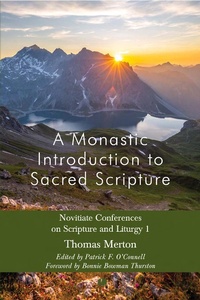
Monastic Introduction to Sacred Scripture
Novitiate Conferences on Scripture and Liturgy 1
Published on 27. October 2022
247 pages
978-0-7188-9639-3 (ISBN)
Description

Thomas Merton led numerous conferences during his decade (1955-1965) as novice master at the Cistercian Abbey of Gethsemani. In A Monastic Introduction to Sacred Scripture, Patrick F. O'Connell presents one of these, a wide-ranging introduction to biblical studies. Drawing on church tradition, teaching of recent papal documents, and scholarly resources of the time, Merton reveals the central importance of the Scriptures for the spiritual growth of his listeners.
For Merton, at the heart of any meaningful reading of the Scriptures, not only for monks but for all Christians, is the invitation to respond not just intellectually but with the whole self, to recognize the gospel as 'good news', as a saving, liberating, consoling, challenging word, reflecting his fundamental belief that 'the Holy Spirit enlightens us, in our reading, to see how our own lives are part of these great mysteries - how we are one with Jesus in them'. O'Connell's extensive introduction situates this reflection in the context of Merton's evolving engagement with the Bible from his own days as a student monk through the mature reflections from his final years on the biblical renewal in the wake of the Second Vatican Council.
For Merton, at the heart of any meaningful reading of the Scriptures, not only for monks but for all Christians, is the invitation to respond not just intellectually but with the whole self, to recognize the gospel as 'good news', as a saving, liberating, consoling, challenging word, reflecting his fundamental belief that 'the Holy Spirit enlightens us, in our reading, to see how our own lives are part of these great mysteries - how we are one with Jesus in them'. O'Connell's extensive introduction situates this reflection in the context of Merton's evolving engagement with the Bible from his own days as a student monk through the mature reflections from his final years on the biblical renewal in the wake of the Second Vatican Council.
Reviews / Votes
As a monk, Thomas Merton was totally immersed in sacred Scripture and, in this book, we encounter some of the earliest fruits of Merton's own prayer, lectio, and study as he began teaching Scripture in the years immediately after his ordination. A Monastic Introduction to Sacred Scripture is a foretaste of the rich banquet that would flow from Merton's pen in the ensuing years.Paul M. Pearson, Thomas Merton Center
This book brilliantly elucidates the centrality of sacred Scripture in Merton's monastic life and reveals his successful efforts to integrate modern exegetical methods with the ancient tradition of monastic biblical hermeneutics. O'Connell's profoundly learned introduction and illuminating editorial notations situate Merton's lectures within the broader frame of theological renewal unfolding before and throughout the Second Vatican Council. This work is an indispensable contribution to the field of Merton studies.
Joseph Q. Raab, Siena Heights University, co-editor of The Merton Annual
The history of monastic biblical interpretation 'must not be studied from the outside,' insists Thomas Merton, but demands 'a deepened and experiential study, from within'. Th-is critical volume demonstrates Merton's encounter with the Bible 'from within' prior to Vatican II, while underscoring just how transformed his reading of the Scriptures would be by his engagement with Jewish and Protestant voices during the 1960s. Editor Patrick O'Connell tracks that dramatic evolution to the great benefit of readers.
Christopher Pramuk, Regis University
More details
Language
English
Place of publication
Cambridge
United Kingdom
Publishing group
James Clarke & Co Ltd
File size
3,39 MB
ISBN-13
978-0-7188-9639-3 (9780718896393)
Copyright in bibliographic data and cover images is held by Nielsen Book Services Limited or by the publishers or by their respective licensors: all rights reserved.
Schweitzer Classification
Other editions
Additional editions
Thomas Merton | Patrick F. O'Connell
Monastic Introduction to Sacred Scripture
Novitiate Conferences on Scripture and Liturgy 1
Book
10/2022
Lutterworth Press
€33.75
Shipment within 10-20 days
Persons
Thomas Merton, Roman Catholic convert, Cistercian monk and hermit, poet, contemplative, social critic, and pioneer in interreligious dialogue, was a seminal figure of twentieth-century American Christianity. Among his many books are his best-selling autobiography The Seven Storey Mountain and the modern spiritual classic New Seeds of Contemplation.
Patrick F. O'Connell, a founding member and former president of the International Thomas Merton Society, edits the ITMS quarterly publication The Merton Seasonal and is co-author of The Thomas Merton Encyclopedia. He has edited thirteen previous volumes of Thomas Merton's writings, including Selected Essays, Early Essays, 1947-52, Cistercian Fathers and Forefathers, and most recently A Monastic Introduction to Sacred Scripture, the first of three books in the series Novitiate Conferences on Scripture and Liturgy.
Patrick F. O'Connell, a founding member and former president of the International Thomas Merton Society, edits the ITMS quarterly publication The Merton Seasonal and is co-author of The Thomas Merton Encyclopedia. He has edited thirteen previous volumes of Thomas Merton's writings, including Selected Essays, Early Essays, 1947-52, Cistercian Fathers and Forefathers, and most recently A Monastic Introduction to Sacred Scripture, the first of three books in the series Novitiate Conferences on Scripture and Liturgy.
Content
Foreword by Bonnie Bowman Thurston
Introduction
Prologue
Part I: Biblical Inspiration
Part II: The Canon of Sacred Scripture
Part III: Texts and Versions of the Scriptures
Part IV: The Interpretation of Sacred Scripture-Hermeneutics
Index
Bibliography
Appendix: For Further Reading
Scriptural Index
General Index
Introduction
Prologue
Part I: Biblical Inspiration
Part II: The Canon of Sacred Scripture
Part III: Texts and Versions of the Scriptures
Part IV: The Interpretation of Sacred Scripture-Hermeneutics
Index
Bibliography
Appendix: For Further Reading
Scriptural Index
General Index
