

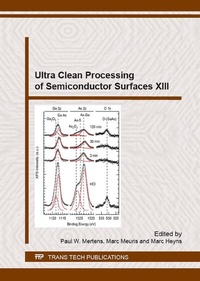
Ultra Clean Processing of Semiconductor Surfaces XIII
Published on 5. September 2016
414 pages
978-3-0357-3084-5 (ISBN)
Description

This volume contains the proceedings of 13th International Symposium on Ultra Clean Processing of Semiconductor Surfaces (UCPSS 2016, Knokke, Belgium, September 12-14, 2016) (www.ucpss.org) and includes studies on cleaning such as particle removal using acoustic enhancement, removal of metallic contamination, pattern collapse of fine flexible and fragile features, wetting and drying issues, control and measuring of contamination . FEOL and BEOL topics cover: chemistry of semiconductor surfaces, cleaning related to new gate stacks, cleaning at the interconnect level, selective wet etching, resist strip and polymer removal, cleaning and contamination control for various new materials and cleaning after Chemical-Mechanical-Polishing (CMP).
More details
Series
Language
English
Place of publication
Zurich-Durnten
Switzerland
Target group
Professional and scholarly
Illustrations
Illustrations
File size
105,80 MB
ISBN-13
978-3-0357-3084-5 (9783035730845)
DOI
10.4028/b-9u0uMX
Copyright in bibliographic data and cover images is held by Nielsen Book Services Limited or by the publishers or by their respective licensors: all rights reserved.
Schweitzer Classification
Other editions
Additional editions
Paul W. Mertens | Marc Meuris | Marc Heyns
Ultra Clean Processing of Semiconductor Surfaces XIII
Book
10/2016
Trans Tech Publications Ltd
€386.89
Shipment within 10-20 days
Paul W. Mertens | Marc Meuris | Marc Heyns
Ultra Clean Processing of Semiconductor Surfaces XIII
Software
10/2016
Trans Tech Publications Ltd
€351.67
Shipment within 10-20 days
Persons
Eds. Paul W. Mertens, Marc Meuris and Marc Heyns
Content
Preface, Committees, Sponsor
Chapter 1: FEOL: Surface Chemistry Group IV Semiconductors
Wet Selective SiGe Etch to Enable Ge Nanowire Formation
Silicon Surface Passivation in HF Solutions for Improved Gate Oxide Reliability
Surface Preparation Quality before Epitaxy our Paper's
Study of Oxygen Concentration in TMAH Solution for Improvement of Sigma-Shaped Wet Etching Process
The Effect of Rinsing a Germanium Surface after Wet Chemical Treatment
Effect of Dilute Hydrogen Peroxide in Ultrapure Water on SiGe Epitaxial Process
Surface Passivation of New Channel Materials Utilizing Hydrogen Peroxide and Hydrazine Gas
Tris(Trimethylsilyl)Germane (Me3Si)3GeH: A Molecular Model for Sulfur Passivation of Ge(111) Surfaces
Applications for Surface Engineering Using Atomic Layer Etching - Invited Paper
Chapter 2: FEOL: Surface Chemistry Groups III-V Compound Semiconductors
Towards Atomic-Layer-Scale Processing of High Mobility Channel Materials in Acidic Solutions for N5 and N7 Technology Nodes
Comparison of the Chemical Passivation of GaAs, In0.53Ga0.47As, and InSb with 1-Eicosanethiol
Digital Etching of GaAs Materials: Comparison of Oxidation Treatments
Chapter 3: FEOL: Etching
Thin Layer Etching of Silicon Nitride: Comparison of Downstream Plasma, Liquid HF and Gaseous HF Processes for Selective Removal after Light Ion Implantation
Selective Etching of Silicon Oxide versus Nitride with Low Oxide Etching Rate
Metrology for High Selective Silicon Nitride Etch
Study on the Etching Selectivity of Oxide Films in Dry Cleaning Process with NF3 and H2O
Titanium Nitride Hard Mask Removal with Selectivity to Tungsten in FEOL
Analysis of Si Wet Etching Effect on Wafer Edge
Chapter 4: FEOL: Photoresist Removal, General Cleaning
Middle of Line (MoL) Cleaning Challenges in Sub-20nm Node Device Manufacturing
Characterization and Development of High Dose Implanted Resist Stripping Processes
Chemical Infiltration through Deep UV Photoresist
Efficient Photoresist Residue Removal with 172nm Excimer Radiation
Chapter 5: Processes of Wetting and Drying
Deep Trench Isolation and through Silicon via Wetting Characterization by High-Frequency Acoustic Reflectometry
Pattern Collapse of High-Aspect-Ratio Silicon Nanostructures - A Parametric Study
Influence of CO2 Gas Atmosphere on the Liquid Filling of Superhydrophobic Nanostructures
Some Critical Issues in Pattern Collapse Prevention and Repair
Watermark-Free and Efficient Spray Clean on Hydrophobic Surface with Single-Wafer Technology
Extended-Nanofluidic Devices and the Unique Liquid Properties - Invited Paper
Chapter 6: Mechanical Fluid Effects, Nanoparticles
Measurement of the Frictional Force between PVA Roller Brushes and Semiconductor Wafers with Various Films Immersed in Chemicals
Removal of Bull's Eye Signature by Optimizing Wet Cleans Recipe
Toward CO2 Beam Cleaning of 20-nm Particles in Atmospheric Pressure
Liquid Cell Platform to Directly Visualize Bottom-Up Assembly and Top-Down Etch Processes inside TEM
A Study on the Electrostatic Discharge (ESD) Defect in SOH Mask Pattern Cleaning
Post-CMP Cleaners for Tungsten at Advanced Nodes
Advanced Cryogenic Aerosol Cleaning: Small Particle Removal and Damage-Free Performance
Developments for Physical Cleaning Sample with High Adhesion Force Particles and Direct Measurement of its Removal Force
Characterization of Cavitation in a Single Wafer or Photomask Cleaning Tool
Chapter 7: Interconnect Cleaning
Molecular Simulation Contribution to Porous Low-k Pore Size Determination after Damage by Etch and Wet Clean Processes - Invited Paper
Rapid Recovery Process of Plasma Damaged Porous Low-k Dielectrics by Wet Surface Modifying Treatment
Characterization of Etch Residues Generated on Damascene Structures
Evaluation of Post Etch Residue Cleaning Solutions for the Removal of TiN Hardmask after Dry Etch of Low-k Dielectric Materials on 45 nm Pitch Interconnects
Optimization of Cu/Low-k Dual Damascene Post-Etch Residue and TiN Hard Mask Removal
TiN Metal Hardmask Etch Residues Removal with AlN Etch
High Throughput Wet Etch Solution for BEOL TiN Removal
Impact of Dissolved Oxygen in Dilute HF Solution on Material Etch
The Effect of Inhibitors on Co Corrosion in Alkaline Post Cu-CMP Cleaning Solutions
Oxygen Control for Wet Clean Process on Single Wafer Platform
Study of TiW Conditioning through Different Wet and Dry Treatments to Promote Ni Electroless Growth
Post CMP Wet Cleaning Influence on Cu Hillocks
Minimizing Wafer Surface Charging for Single-Wafer Wet Cleaning for 10 nm and beyond
Chapter 8: 3D Integrated Structures
Silica Formation during Etching of Silicon Nitride in Phosphoric Acid
Low Undercut Ti Etch Chemistry for Cu Bump Pillar under Bump Metallization Wet Etch Process
Chapter 9: Metrology, Specification and Control of Contamination
Electrical Characterization of As-Processed Semiconductor Surfaces - Invited Paper
Atomic Resolution Quality Control for Fin Oxide Recess by Atomic Resolution Profiler
Specification of Trace Metal Contamination for Image Sensors
Metal Removal Efficiency in High Aspect Ratio Structures
Quantitative Analysis of Trace Metallic Contamination on III-V Compound Semiconductor Surfaces
A Mathematical Model Forecasting HF Adsorption onto Cu-Coated Wafers as a Function of the Airborne Concentration and Moisture
Chapter 10: Photovoltaics
Oxidation of Si Surfaces: Effect of Ambient Air and Water Treatments on Surface Charge and Interface State Density
Surface Optimization of Random Pyramid Textured Silicon Substrates for Improving Heterojunction Solar Cells
'Just-Clean-Enough': Optimization of Wet Chemical Cleaning Processes for Crystalline Silicon Solar Cells
Progress in Cleaning and Wet Processing for Kesterite Thin Film Solar Cells
Chapter 11: Non-Wafer Cleaning, Mask Cleaning
Optimization of EUV Reticle Cleaning by Evaluation of Chemistries on Wafer-Based Mimic Test Structures
Ultra-Trace Sulfate Ion Removal on Photomasks for Haze Reduction
172 nm Excimer Radiation as a Technology Accelerator for Bio-Electronic Applications
Chapter 12: Contamination ?ontrol of Wafer Ambient
Electrolyzed Water for Efficient Metal Removal
Contamination Control for Wafer Container Used within 300 mm Manufacturing for Power Microelectronics
Inline FOUP Cleaner - The New Type FOUP Cleaner for the Next Generation
Chapter 1: FEOL: Surface Chemistry Group IV Semiconductors
Wet Selective SiGe Etch to Enable Ge Nanowire Formation
Silicon Surface Passivation in HF Solutions for Improved Gate Oxide Reliability
Surface Preparation Quality before Epitaxy our Paper's
Study of Oxygen Concentration in TMAH Solution for Improvement of Sigma-Shaped Wet Etching Process
The Effect of Rinsing a Germanium Surface after Wet Chemical Treatment
Effect of Dilute Hydrogen Peroxide in Ultrapure Water on SiGe Epitaxial Process
Surface Passivation of New Channel Materials Utilizing Hydrogen Peroxide and Hydrazine Gas
Tris(Trimethylsilyl)Germane (Me3Si)3GeH: A Molecular Model for Sulfur Passivation of Ge(111) Surfaces
Applications for Surface Engineering Using Atomic Layer Etching - Invited Paper
Chapter 2: FEOL: Surface Chemistry Groups III-V Compound Semiconductors
Towards Atomic-Layer-Scale Processing of High Mobility Channel Materials in Acidic Solutions for N5 and N7 Technology Nodes
Comparison of the Chemical Passivation of GaAs, In0.53Ga0.47As, and InSb with 1-Eicosanethiol
Digital Etching of GaAs Materials: Comparison of Oxidation Treatments
Chapter 3: FEOL: Etching
Thin Layer Etching of Silicon Nitride: Comparison of Downstream Plasma, Liquid HF and Gaseous HF Processes for Selective Removal after Light Ion Implantation
Selective Etching of Silicon Oxide versus Nitride with Low Oxide Etching Rate
Metrology for High Selective Silicon Nitride Etch
Study on the Etching Selectivity of Oxide Films in Dry Cleaning Process with NF3 and H2O
Titanium Nitride Hard Mask Removal with Selectivity to Tungsten in FEOL
Analysis of Si Wet Etching Effect on Wafer Edge
Chapter 4: FEOL: Photoresist Removal, General Cleaning
Middle of Line (MoL) Cleaning Challenges in Sub-20nm Node Device Manufacturing
Characterization and Development of High Dose Implanted Resist Stripping Processes
Chemical Infiltration through Deep UV Photoresist
Efficient Photoresist Residue Removal with 172nm Excimer Radiation
Chapter 5: Processes of Wetting and Drying
Deep Trench Isolation and through Silicon via Wetting Characterization by High-Frequency Acoustic Reflectometry
Pattern Collapse of High-Aspect-Ratio Silicon Nanostructures - A Parametric Study
Influence of CO2 Gas Atmosphere on the Liquid Filling of Superhydrophobic Nanostructures
Some Critical Issues in Pattern Collapse Prevention and Repair
Watermark-Free and Efficient Spray Clean on Hydrophobic Surface with Single-Wafer Technology
Extended-Nanofluidic Devices and the Unique Liquid Properties - Invited Paper
Chapter 6: Mechanical Fluid Effects, Nanoparticles
Measurement of the Frictional Force between PVA Roller Brushes and Semiconductor Wafers with Various Films Immersed in Chemicals
Removal of Bull's Eye Signature by Optimizing Wet Cleans Recipe
Toward CO2 Beam Cleaning of 20-nm Particles in Atmospheric Pressure
Liquid Cell Platform to Directly Visualize Bottom-Up Assembly and Top-Down Etch Processes inside TEM
A Study on the Electrostatic Discharge (ESD) Defect in SOH Mask Pattern Cleaning
Post-CMP Cleaners for Tungsten at Advanced Nodes
Advanced Cryogenic Aerosol Cleaning: Small Particle Removal and Damage-Free Performance
Developments for Physical Cleaning Sample with High Adhesion Force Particles and Direct Measurement of its Removal Force
Characterization of Cavitation in a Single Wafer or Photomask Cleaning Tool
Chapter 7: Interconnect Cleaning
Molecular Simulation Contribution to Porous Low-k Pore Size Determination after Damage by Etch and Wet Clean Processes - Invited Paper
Rapid Recovery Process of Plasma Damaged Porous Low-k Dielectrics by Wet Surface Modifying Treatment
Characterization of Etch Residues Generated on Damascene Structures
Evaluation of Post Etch Residue Cleaning Solutions for the Removal of TiN Hardmask after Dry Etch of Low-k Dielectric Materials on 45 nm Pitch Interconnects
Optimization of Cu/Low-k Dual Damascene Post-Etch Residue and TiN Hard Mask Removal
TiN Metal Hardmask Etch Residues Removal with AlN Etch
High Throughput Wet Etch Solution for BEOL TiN Removal
Impact of Dissolved Oxygen in Dilute HF Solution on Material Etch
The Effect of Inhibitors on Co Corrosion in Alkaline Post Cu-CMP Cleaning Solutions
Oxygen Control for Wet Clean Process on Single Wafer Platform
Study of TiW Conditioning through Different Wet and Dry Treatments to Promote Ni Electroless Growth
Post CMP Wet Cleaning Influence on Cu Hillocks
Minimizing Wafer Surface Charging for Single-Wafer Wet Cleaning for 10 nm and beyond
Chapter 8: 3D Integrated Structures
Silica Formation during Etching of Silicon Nitride in Phosphoric Acid
Low Undercut Ti Etch Chemistry for Cu Bump Pillar under Bump Metallization Wet Etch Process
Chapter 9: Metrology, Specification and Control of Contamination
Electrical Characterization of As-Processed Semiconductor Surfaces - Invited Paper
Atomic Resolution Quality Control for Fin Oxide Recess by Atomic Resolution Profiler
Specification of Trace Metal Contamination for Image Sensors
Metal Removal Efficiency in High Aspect Ratio Structures
Quantitative Analysis of Trace Metallic Contamination on III-V Compound Semiconductor Surfaces
A Mathematical Model Forecasting HF Adsorption onto Cu-Coated Wafers as a Function of the Airborne Concentration and Moisture
Chapter 10: Photovoltaics
Oxidation of Si Surfaces: Effect of Ambient Air and Water Treatments on Surface Charge and Interface State Density
Surface Optimization of Random Pyramid Textured Silicon Substrates for Improving Heterojunction Solar Cells
'Just-Clean-Enough': Optimization of Wet Chemical Cleaning Processes for Crystalline Silicon Solar Cells
Progress in Cleaning and Wet Processing for Kesterite Thin Film Solar Cells
Chapter 11: Non-Wafer Cleaning, Mask Cleaning
Optimization of EUV Reticle Cleaning by Evaluation of Chemistries on Wafer-Based Mimic Test Structures
Ultra-Trace Sulfate Ion Removal on Photomasks for Haze Reduction
172 nm Excimer Radiation as a Technology Accelerator for Bio-Electronic Applications
Chapter 12: Contamination ?ontrol of Wafer Ambient
Electrolyzed Water for Efficient Metal Removal
Contamination Control for Wafer Container Used within 300 mm Manufacturing for Power Microelectronics
Inline FOUP Cleaner - The New Type FOUP Cleaner for the Next Generation
