

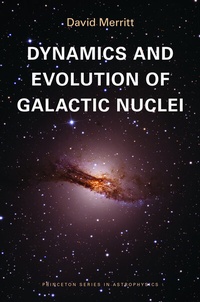
Dynamics and Evolution of Galactic Nuclei
1st Edition
Published on 19. January 2022
544 pages
978-1-4008-4612-2 (ISBN)
Description

Deep within galaxies like the Milky Way, astronomers have found a fascinating legacy of Einstein's general theory of relativity: supermassive black holes. Connected to the evolution of the galaxies that contain these black holes, galactic nuclei are the sites of uniquely energetic events, including quasars, stellar tidal disruptions, and the generation of gravitational waves. This textbook is the first comprehensive introduction to dynamical processes occurring in the vicinity of supermassive black holes in their galactic environment. Filling a critical gap, it is an authoritative resource for astrophysics and physics graduate students, and researchers focusing on galactic nuclei, the astrophysics of massive black holes, galactic dynamics, and gravitational wave detection. It is an ideal text for an advanced graduate-level course on galactic nuclei and as supplementary reading in graduate-level courses on high-energy astrophysics and galactic dynamics.
David Merritt summarizes the theoretical work of the last three decades on the evolution of galactic nuclei, the formation of massive black holes, and the interaction between black holes and stars. He explores in depth such important topics as observations of galactic nuclei, dynamical models, weighing black holes, motion near supermassive black holes, evolution of nuclei due to gravitational encounters, loss cone theory, and binary supermassive black holes. Self-contained and up-to-date, the textbook includes a summary of the current literature and previously unpublished work by the author.
For researchers working on active galactic nuclei, galaxy evolution, and the generation of gravitational waves, this book will be an essential resource.
David Merritt summarizes the theoretical work of the last three decades on the evolution of galactic nuclei, the formation of massive black holes, and the interaction between black holes and stars. He explores in depth such important topics as observations of galactic nuclei, dynamical models, weighing black holes, motion near supermassive black holes, evolution of nuclei due to gravitational encounters, loss cone theory, and binary supermassive black holes. Self-contained and up-to-date, the textbook includes a summary of the current literature and previously unpublished work by the author.
For researchers working on active galactic nuclei, galaxy evolution, and the generation of gravitational waves, this book will be an essential resource.
More details
Language
English
Place of publication
Princeton, NJ
United States
Publishing group
De Gruyter
Target group
Professional and scholarly
Edition type
Digital original
Illustrations
5 halftones. 136 line illus. 6 tables.
File size
25,54 MB
ISBN-13
978-1-4008-4612-2 (9781400846122)
Schweitzer Classification
Other editions
Additional editions
David Merritt
Dynamics and Evolution of Galactic Nuclei
Book
07/2013
Princeton University Press
€102.50
Shipment within 10-20 days
David Merritt
Dynamics and Evolution of Galactic Nuclei
Book
07/2013
Princeton University Press
€164.50
Article not available at the moment
Person
David Merritt is professor of physics at the Rochester Institute of Technology.
Content
Preface ix
Chapter 1 INTRODUCTION AND HISTORICAL OVERVIEW 1
Chapter 2 OBSERVATIONS OF GALACTIC NUCLEI AND SUPERMASSIVE BLACK HOLES 11
2.1 Structure of galaxies and galactic nuclei 11
2.2 Techniques for weighing black holes 18
2.3 Supermassive black holes in the Local Group 29
2.4 Phenomenology 33
2.5 Evidence for intermediate-mass black holes 45
2.6 Evidence for binary and multiple supermassive black holes 47
2.7 Gravitational waves 52
Chapter 3 COLLISIONLESS EQUILIBRIA 57
3.1 Orbits, integrals, and steady states 59
3.2 Spherical nuclei 72
3.3 The adiabatic growth model 90
3.4 Axisymmetric nuclei 93
3.5 Triaxial nuclei 100
Chapter 4 MOTION NEAR SUPERMASSIVE BLACK HOLES 117
4.1 Keplerian orbits 120
4.2 Perturbed orbits 125
4.3 The post-Newtonian approximation 131
4.4 Newtonian perturbations 135
4.5 Relativistic orbits 157
4.6 Capture 176
4.7 Relativistic motion in the presence of a distributed mass 183
4.8 Motion in the presence of a second massive body 192
4.9 Stellar motions at the center of the Milky Way 203
Chapter 5 THEORY OF GRAVITATIONAL ENCOUNTERS 213
5.1 Basic concepts and time of relaxation 213
5.2 Diffusion coefficients 216
5.3 Fokker-Planck equation 236
5.4 Gravitational Brownian motion 246
5.5 Orbit-averaged Fokker-Planck equation 251
5.6 Gravitational encounters near a supermassive black hole 264
5.7 Encounters with a spinning supermassive black hole 277
Chapter 6 LOSS-CONE DYNAMICS 289
6.1 Spherical symmetry 297
6.2 Nonspherical nuclei 326
6.3 Binary and hypervelocity stars 341
6.4 Relativistic loss cones and extreme-mass-ratio inspirals 350
Chapter 7 COLLISIONAL EVOLUTION OF NUCLEI 361
7.1 Evolution of the stellar distribution around a supermassive black hole 366
7.2 Cusp (re)generation 383
7.3 Black-hole-driven expansion 390
7.4 Massive perturbers 391
7.5 Evolution of nuclei lacking massive black holes 395
Chapter 8 BINARY AND MULTIPLE SUPERMASSIVE BLACK HOLES 415
8.1 Interaction of a massive binary with field stars 417
8.2 Massive binary at the center of a galaxy: I. Early evolution 432
8.3 Massive binary at the center of a galaxy: II. Late evolution 446
8.4 Interaction of binary supermassive black holes with gas 462
8.5 Simulations of galaxy mergers 467
8.6 Dynamics of intermediate-mass black holes 468
8.7 Triple supermassive black holes and the final-parsec problem 483
Suggestions for Further Reading 489
References 493
Index 535
Chapter 1 INTRODUCTION AND HISTORICAL OVERVIEW 1
Chapter 2 OBSERVATIONS OF GALACTIC NUCLEI AND SUPERMASSIVE BLACK HOLES 11
2.1 Structure of galaxies and galactic nuclei 11
2.2 Techniques for weighing black holes 18
2.3 Supermassive black holes in the Local Group 29
2.4 Phenomenology 33
2.5 Evidence for intermediate-mass black holes 45
2.6 Evidence for binary and multiple supermassive black holes 47
2.7 Gravitational waves 52
Chapter 3 COLLISIONLESS EQUILIBRIA 57
3.1 Orbits, integrals, and steady states 59
3.2 Spherical nuclei 72
3.3 The adiabatic growth model 90
3.4 Axisymmetric nuclei 93
3.5 Triaxial nuclei 100
Chapter 4 MOTION NEAR SUPERMASSIVE BLACK HOLES 117
4.1 Keplerian orbits 120
4.2 Perturbed orbits 125
4.3 The post-Newtonian approximation 131
4.4 Newtonian perturbations 135
4.5 Relativistic orbits 157
4.6 Capture 176
4.7 Relativistic motion in the presence of a distributed mass 183
4.8 Motion in the presence of a second massive body 192
4.9 Stellar motions at the center of the Milky Way 203
Chapter 5 THEORY OF GRAVITATIONAL ENCOUNTERS 213
5.1 Basic concepts and time of relaxation 213
5.2 Diffusion coefficients 216
5.3 Fokker-Planck equation 236
5.4 Gravitational Brownian motion 246
5.5 Orbit-averaged Fokker-Planck equation 251
5.6 Gravitational encounters near a supermassive black hole 264
5.7 Encounters with a spinning supermassive black hole 277
Chapter 6 LOSS-CONE DYNAMICS 289
6.1 Spherical symmetry 297
6.2 Nonspherical nuclei 326
6.3 Binary and hypervelocity stars 341
6.4 Relativistic loss cones and extreme-mass-ratio inspirals 350
Chapter 7 COLLISIONAL EVOLUTION OF NUCLEI 361
7.1 Evolution of the stellar distribution around a supermassive black hole 366
7.2 Cusp (re)generation 383
7.3 Black-hole-driven expansion 390
7.4 Massive perturbers 391
7.5 Evolution of nuclei lacking massive black holes 395
Chapter 8 BINARY AND MULTIPLE SUPERMASSIVE BLACK HOLES 415
8.1 Interaction of a massive binary with field stars 417
8.2 Massive binary at the center of a galaxy: I. Early evolution 432
8.3 Massive binary at the center of a galaxy: II. Late evolution 446
8.4 Interaction of binary supermassive black holes with gas 462
8.5 Simulations of galaxy mergers 467
8.6 Dynamics of intermediate-mass black holes 468
8.7 Triple supermassive black holes and the final-parsec problem 483
Suggestions for Further Reading 489
References 493
Index 535
