

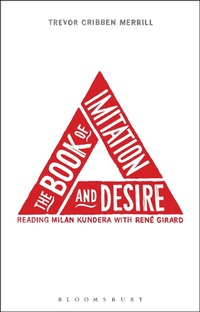
The Book of Imitation and Desire: Reading Milan Kundera with Rene Girard
1st Edition
Published on 14. March 2013
208 pages
978-1-4411-2035-9 (ISBN)
Description

Trevor Cribben Merrill offers a bold reassessment of Milan Kundera's place in the contemporary canon. Harold Bloom and others have dismissed the Franco-Czech author as a maker of "period pieces" that lost currency once the Berlin Wall fell. Merrill refutes this view, revealing a previously unexplored dimension of Kundera's fiction. Building on theorist Rene Girard's notion of "triangular desire," he shows that modern classics such as The Unbearable Lightness of Being and The Book of Laughter and Forgetting display a counterintuitive-and bitterly funny-understanding of human attraction.
Most works of fiction (and most movies, too) depict passionate feelings as deeply authentic and spontaneous. Kundera's novels and short stories overturn this romantic dogma. A pounding heart and sweaty palms could mean that we have found "the One" at last-or they could attest to the influence of a model whose desires we are unconsciously borrowing: our amorous predilections may owe less to personal taste or physical chemistry than they do to imitative desire.
At once a comprehensive survey of Kundera's novels and a witty introduction to Girard's mimetic theory, The Book of Imitation and Desire challenges our assumptions about human motive and renews our understanding of a major contemporary author.
Most works of fiction (and most movies, too) depict passionate feelings as deeply authentic and spontaneous. Kundera's novels and short stories overturn this romantic dogma. A pounding heart and sweaty palms could mean that we have found "the One" at last-or they could attest to the influence of a model whose desires we are unconsciously borrowing: our amorous predilections may owe less to personal taste or physical chemistry than they do to imitative desire.
At once a comprehensive survey of Kundera's novels and a witty introduction to Girard's mimetic theory, The Book of Imitation and Desire challenges our assumptions about human motive and renews our understanding of a major contemporary author.
Reviews / Votes
The contribution that Trevor Merrill's book makes is at least threefold: it sheds new light on the work of one of our era's strongest novelists; it extends and confirms the literary reach of Rene Girard's main hypotheses; and it helps us to better understand our own existence. And it does all of this in a style that's clear, precise, and elegant. What more could be asked of a major work of literary criticism? In the same way that according to Galileo "Nature's great book is written in mathematical language", Trevor Merrill argues brilliantly that Milan Kundera's oeuvre is written in terms of Rene Girard's theory of mimetic, triangular desire. What is remarkable is that Kundera himself was unaware of the existence of the theory when he wrote his first novels. Had he been, he would by his own admission have found himself unable to write them. What is even more remarkable is that this structural kinship once revealed does add to the beauty of Kundera's works in the same way that Newton's or Einstein's equations make Nature even more astounding. This is a great book about a great writer and a great theory, in which the three vertices of the triangle enhance one another. With clear and persuasive style Trevor Cribben Merrill's The Book of Imitation and Desire successfully rescues Milan Kundera from the unjust expulsion he suffered, at the hand of Harold Bloom, from the pantheon of the 20th century canonic authors. By compellingly arguing about the infinite perceptiveness of Kundera's novels in relation to the Quixotesque adventures of our eternally mediated desires, Merrill offers an illuminating and enriching new perspective on the opus of the Czech writer. The Girardian lens, rather than straitjacketing the psychological complexity of Kundera's works, as many have argued, opens up new critical perspectives and a new understanding of the author of The Book of Laughter and Forgetting. Pace Bloom, in the pantheon of the novelistic geniuses set by Girard's seminal Deceit, Desire and the Novel, Merrill's excellent book suggests, a place should now be reserved for Milan Kundera.More details
Edition
1. Auflage
Language
English
Place of publication
New York
United States
Publishing group
Bloomsbury Publishing PLC (Digital)
Target group
Professional and scholarly
ISBN-13
978-1-4411-2035-9 (9781441120359)
Copyright in bibliographic data and cover images is held by Nielsen Book Services Limited or by the publishers or by their respective licensors: all rights reserved.
Schweitzer Classification
Other editions
Additional editions
Trevor Cribben Merrill
The Book of Imitation and Desire: Reading Milan Kundera with Rene Girard
Reading Milan Kundera with Rene Girard
Book
10/2014
Bloomsbury Academic USA
€56.40
Shipment within 3-4 weeks
Person
Trevor Cribben Merrill is Lecturer in French at the California Institute of Technology and sits on the Research Committee of Imitatio: Integrating the Human Sciences. He studied literature at Yale University and the Ecole Normale Superieure and went on to receive his doctorate in French Studies from UCLA, USA, where he was a Chancellor's Fellow. A two-time fellow of the Association Recherches Mimetiques in Paris, he has co-edited a book of essays by Rene Girard and collaborated on Psychopolitics (Michigan State University Press, 2012), a dialogue with psychiatrist Jean-Michel Oughourlian.
Content
Foreword by Andrew McKenna
Author's Preface
I. "WOMEN LOOK FOR MEN WHO HAVE HAD BEAUTIFUL WOMEN"
II. INTO THE LABYRINTH OF VALUES
1. The Transfiguration of the Object
2. Metamorphoses of Kristyna
3. "An Imitation of Feeling"
III. FROM IMITATION TO RIVALRY
1. The Shift from Admiration to Envy
2. Deceit, Desire, and the Plight of the Aging Don Juan
3. Rivalry and the Transfiguration of the Object
4. "The Younger Sister Imitated the Elder"
5. Publish or Perish
IV. THE MODEL AS OBSTACLE
1. Strategies of Revelation
2. The Art of Polyphonic Comparison
3. A Little Theory of Resentment
4. Litost in the Underground
V. JEALOUSY AND ITS METAPHORS
1. The Game Gone Awry
2. The Metaphors of Jealousy
3. "A Test That Gauged Her Susceptibility To Seduction"
VI. THE QUADRILLE OF DESIRE
1. Sex as Theater
2. Acute Rivalry and Homosexual Attraction
3. The Geometry of Sadomasochism
VII. AT THE HEART OF THE LABYRINTH
1. "The Thousand-Headed Dragon"
2. "The Cement of their Brotherhood"
3. The Two Temptations
4. "The Absolute Denial of Shit"
5. First Time As Tragedy, Second Time As Farce
VIII. REPUDIATING THE MODEL
1. Eduard's Smile
2. From Hatred to Compassion
3. Karenin's Smile
4. The Birth of a Novelist
5. Liberating Exiles
IX. TOMAS IN COLONUS, OR THE WISDOM OF THE NOVEL
Postscript: A Response to Elif Batuman
Appendix: A Brief Overview of Kundera's Life and Works
Notes
Bibliography
Index
Author's Preface
I. "WOMEN LOOK FOR MEN WHO HAVE HAD BEAUTIFUL WOMEN"
II. INTO THE LABYRINTH OF VALUES
1. The Transfiguration of the Object
2. Metamorphoses of Kristyna
3. "An Imitation of Feeling"
III. FROM IMITATION TO RIVALRY
1. The Shift from Admiration to Envy
2. Deceit, Desire, and the Plight of the Aging Don Juan
3. Rivalry and the Transfiguration of the Object
4. "The Younger Sister Imitated the Elder"
5. Publish or Perish
IV. THE MODEL AS OBSTACLE
1. Strategies of Revelation
2. The Art of Polyphonic Comparison
3. A Little Theory of Resentment
4. Litost in the Underground
V. JEALOUSY AND ITS METAPHORS
1. The Game Gone Awry
2. The Metaphors of Jealousy
3. "A Test That Gauged Her Susceptibility To Seduction"
VI. THE QUADRILLE OF DESIRE
1. Sex as Theater
2. Acute Rivalry and Homosexual Attraction
3. The Geometry of Sadomasochism
VII. AT THE HEART OF THE LABYRINTH
1. "The Thousand-Headed Dragon"
2. "The Cement of their Brotherhood"
3. The Two Temptations
4. "The Absolute Denial of Shit"
5. First Time As Tragedy, Second Time As Farce
VIII. REPUDIATING THE MODEL
1. Eduard's Smile
2. From Hatred to Compassion
3. Karenin's Smile
4. The Birth of a Novelist
5. Liberating Exiles
IX. TOMAS IN COLONUS, OR THE WISDOM OF THE NOVEL
Postscript: A Response to Elif Batuman
Appendix: A Brief Overview of Kundera's Life and Works
Notes
Bibliography
Index
