

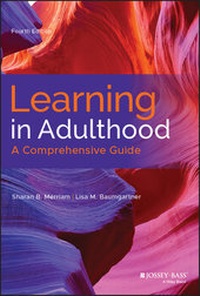
Learning in Adulthood
Description

For nearly three decades, Learning in Adulthood has been the definitive guide in the field of adult education. Now in its fourth edition, this comprehensive volume is fully revised to reflect the latest developments in theory, research, and practice. The authors integrate foundational research and current knowledge to present fresh, original perspectives on teaching and learning in adulthood. Written by internationally-recognized experts, this market-leading guide draws from work in sociology, philosophy, critical social theory, psychology, and education to provide an inclusive overview of adult learning.
Designed primarily for educators of adults, this book is accessible for readers new to adult education, yet suitably rigorous for those more familiar with the subject. Content is organized into four practical parts, covering topics such as the social context of adult learning, self-directed and transformational learning, postmodern and feminist perspectives, cognitive development in adulthood, and more. Offering the most comprehensive single-volume treatment of adult learning available, this landmark text:
* Offers a wide-ranging perspective on adult learning
* Synthesizes the latest thinking and work in the field
* Includes coverage of the sociocultural perspectives of adult learning
* Explores the broader social implications of adult education
Learning in Adulthood: A Comprehensive Guide, 4th Edition is an indispensable resource for educators and administrators involved in teaching adults, as well as faculty and students in graduate programs in adult education.
More details
Other editions
Additional editions
Persons
SHARAN B. MERRIAM is Professor Emerita of Adult Education and Qualitative Research at The University of Georgia in Athens, GA. Merriam's research and writing activities have focused on adult and lifelong learning and qualitative research methods. She has published 33 books and over 100 journal articles and book chapters. She is a four-time winner of the prestigious Cyril O. Houle World Award for Literature in Adult Education.
LISA M. BAUMGARTNER is an Associate Professor at Texas State University, San Marcos, TX. Her research and writing focus on adult learning and development in marginalized populations. She was co-editor of Adult Education Quarterly from 2011-2014. In 2019, she received a Circle of 50 Award from the Learning, Leadership, and Organizational Development Program at the University of Georgia. Awardees are seen as having made an impact on the research and practice of adult education, learning, leadership, and organizational development.
Content
Acknowledgments vii
Preface ix
About the Authors xv
Part I: Adult Learning in Contemporary Society 1
Chapter 1 The Social Context of Adult Learning 5
Chapter 2 Adult Learning and Technology 26
Chapter 3 Learning Environments and Learning Concepts 52
Chapter 4 Adult Learners: Who Participates and Why 82
Part II: Adult Learning Theory 113
Chapter 5 Knowles's Andragogy and McClusky's Theory of Margin 117
Chapter 6 Self-Directed Learning 137
Chapter 7 Transformative Learning 166
Chapter 8 Experience and Learning 196
Part III: Newer Approaches to Adult Learning 229
Chapter 9 Embodied, Spiritual, and Narrative Learning 233
Chapter 10 Learning and Knowing: Eastern and Indigenous Perspectives 268
Chapter 11 Critical Theory, Postmodern, and Feminist Perspectives 290
Part IV: Learning and Development 317
Chapter 12 Adult Development 321
Chapter 13 Cognitive Development in Adulthood 346
Chapter 14 Intelligence and Aging 375
Chapter 15 Brain, Memory, and Cognition 409
Chapter 16 Reflections on Learning in Adulthood 439
References 459
Name Index 541
Subject Index 561
Preface
Learning in adulthood is an intensely personal activity. Yet at the same time, a multibillion-dollar enterprise has arisen in response to adult learning interests-an enterprise that spends more dollars than elementary schools, high schools, and postsecondary schools combined. Indeed, the field of adult and continuing education is characterized by a bewildering array of programs, agencies, and personnel working to assist adults in their learning. It is precisely the focus on adults as learners, however, that unites an otherwise extraordinarily diverse field. It is also the life context of adults and some of the distinguishing characteristics of the adult learning process that differentiate adult education from other kinds of education. To facilitate the process of learning, it is especially important to know who the adult learner is, how the social context shapes the learning that adults are engaged in, why adults are involved in learning activities, how adults learn, and how aging affects learning ability. Learning in Adulthood addresses these topics, among others.
There is a voluminous literature on adult learning, ranging from technical articles on various aspects of adult learning to handbooks, guides, YouTube videos, and other online resources, summarizing material for the new instructor of adult students. If one investigates the Educational Resources Information Center (ERIC) website, which contains journal articles, monographs, conference proceedings, fact sheets, and so on, or does some random exploring on the World Wide Web, one encounters thousands of citations under the topic "adult learning." Further, there are dozens of books with either a central or secondary focus on adult learning.
For this fourth edition of Learning in Adulthood we have paid particular attention to work published since the last edition of the book. This fourth edition of Learning in Adulthood builds on material in the 2007 edition, bringing together the important contributions of the past dozen or so years to our understanding of adult learning. While we have preserved important foundational material (such as a discussion of andragogy), we have also brought to bear the most recent thinking and research. We have endeavored to put together a comprehensive overview and synthesis of what we know about adult learning: the current context in which it takes place, who the participants are, what they learn and why, the nature of the learning process itself, new approaches to adult learning, the development of theory in adult learning, and other issues relevant to understanding adult learning.
The book also takes into account recent work in sociology, philosophy, critical social theory, and psychology. Historically, in much of the writing on adult learning the sociocultural perspective has been neglected in favor of a psychological orientation to the individual learner and how to facilitate her or his learning. In addition to the focus on the learner, we attend to what is today a technology-infused context in which learning takes place and to learners' interactive relationship with that context and with the learning activity itself. We look at how the social structure influences what is offered and who participates, how the sociocultural context creates particular developmental needs and interests, and how social factors such as race, class, and gender shape learning.
This book is intended primarily for educators of adults and scholars of adult learning. We have organized the material so that it will make sense to readers who are new to adult education and at the same time will challenge those who are already familiar with the knowledge base of the field. The organization and presentation of this material reflect our efforts over the years to find the best way to organize courses, workshops, and seminars in adult learning and development for audiences with varying levels of expertise. We have endeavored to put together a book that is at once readable, thorough, and up to date in its coverage. In particular, the book is designed for use in courses in adult learning and as a resource for those interested in conducting research on adult learning. In addition to those associated with the field of adult education itself, however, those in counseling, health, social work, human resource development, administration, and instructional technology and in such institutions as libraries, places of worship, museums, business and industry, and higher education often deal on a daily basis with adult learners. We also intend this book to be a resource for practitioners in these fields who would like to know more about adult learners and the learning process.
Overview of the Contents
This fourth edition of Learning in Adulthood retains the organization of topics found in the previous edition. That is, in the third edition we realized that in most courses using this text, the chapters specific to adult learning theory and models were read before chapters on cognitive development, intelligence and aging, and psychosocial developmental frameworks. We have organized accordingly. This edition is divided into four parts. Part I describes the context of adult learning. Part II focuses on theories and models of adult learning. The chapters in Part III address newer approaches to adult learning, and those in Part IV present material on topics that intersect with adult learning, such as memory and cognition, adult development, and so on.
The chapters in Part I, "Adult Learning in Contemporary Society," center on the context of adult learning. Chapter 1 sets the sociocultural context for adult learning in North America. In it, we discuss three forces-demographics, globalization, and technology-that have shaped adult learning today. It is important to understand how the interaction of those three factors has led to changes in both what adults want to learn and the learning opportunities provided for them. Chapter 2 is a new chapter devoted to the ubiquitous presence of technology in all forms of adult education from formal to nonformal to informal and self-directed learning environments. Directly related to the sociocultural context of adult learning are the environments where learning takes place, the subject of Chapter 3. These range from educational and noneducational institutions, such as hospitals and government agencies, to nonformal and community-based agencies, to incidental and informal learning that is more self-directed than structured by others. Also in this chapter we explore the concepts of organizational learning and the learning organization, lifelong learning and the learning society. The fourth chapter in Part I summarizes the literature on who participates in primarily formal adult learning activities, why people participate, and what they choose to learn. We also take a critical look at key questions of access and opportunity and examine the gaps between the rhetoric and the reality in the provision of formal and nonformal learning activities in our society.
Part II, "Adult Learning Theory," builds on foundational material in adult learning, material that is at the heart of our field of adult education. The topics covered in these chapters represent the field's efforts in distinguishing itself from the education of children. We begin Chapter 5 with a description and critique of the best known of these theories, Knowles's (1980) concept of andragogy. Based on six characteristics of adult learners, andragogy focuses on the adult learner as distinguished from preadult learners. In this chapter we also cover one other model of learning, McClusky's (1970) theory of margin, which has great intuitive appeal to adult learners introduced to it. McClusky considers how everyday life and transitions can be both an opportunity and a barrier to engaging in an adult learning activity. In Chapter 6 we explore the rich array of work that has been completed on self-directed learning. Addressed are the goals and processes of self-directed learning, the concept of self-directedness as a personal attribute of the learner, recent approaches to self-directed learning, and some suggestions for building research and theory in this area. Currently, self-directed learning along with transformative learning has taken center stage in research and writing. Chapter 7 summarizes the development of transformational learning, reviews the burgeoning recent research in this area, and examines unresolved issues inherent in this approach to adult learning. In Chapter 8, the last chapter of Part II, we look closely at the role of experience in learning: both how adult learning builds on prior experience and how experience shapes learning. The concepts of experiential learning, reflective practice, and situated cognition are also examined in this chapter.
Part III, "Newer Approaches to Adult Learning," contains three chapters. There is a burgeoning interest in embodied or somatic learning, spirituality and learning, and narrative approaches to learning, topics addressed in Chapter 9. We uncovered so much recent material in these areas that, had space allowed, we could have easily devoted a full chapter to each of these subjects. Chapter 10 explores Eastern and indigenous approaches to adult learning. Because the majority of the knowledge base represented in Learning in Adulthood is from a Western perspective, characterized by cultural values of privileging the individual learner and cognitive processes over more...
