

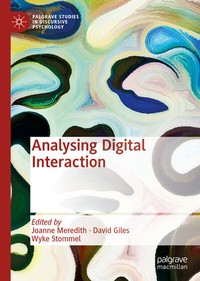
Analysing Digital Interaction
Description

With the explosion of the use of online platforms for everyday and institutional interaction, this book is a timely collection which explores the current state of the field, and considers future directions for microanalysis of online communication.
Reviews / Votes
"Analysing Digital Interaction is an extremely timely contribution representing an important statement on how methods from CA, MCA, and DP can inform our understanding of the rapid social socio-technological that we are currently experiencing. . Flexible and sensitive analytic methods such as those discussed here are capable of rendering distinctive views of these interactional nuances and they are critical to help us understand these rapidly evolving forms of life." (Will Gibson, Symbolic Interaction, March 14, 2023)More details
Other editions
Additional editions
Persons
Joanne Meredith is Senior Lecturer in Psychology at the University of Wolverhampton, UK. Dr Meredith was awarded her PhD in social psychology from Loughborough University, UK focusing on the analysis of instant messaging interaction using conversation analysis. She has a particular interest in the development of conversation analysis and discursive psychology as methods for analysing online interaction.
David Giles
is Reader in Psychology at the University of Winchester, UK. Dr Giles has been writing about media and human behaviour for over two decades, specializing in the relationship between audiences and media figures, particularly celebrities. His books include
Illusions of Immortality
(2000) and
Twenty-First Century Celebrity
(2018). He co-founded, and continues to co-edit, the international peer-reviewed journal Qualitative Research in Psychology.
Wyke Stommel is Assistant Professor in Dutch Language and Culture at Radboud University, The Netherlands. Dr Stommel obtained her PhD from the University of Frankfurt / Main for a study of online support group interaction. Her research focuses on (mediated) interaction in institutional settings using conversation analysis, including chat counselling and video consultations.
Short videos from each chapter author, introducing their research, are available to view here: https://sites.google.com/view/analysingdigitalinteraction/home
Content
1. Introduction: The Microanalysis of Digital Interaction; Joanne Meredith, David Giles and Wyke J. P. Stommel.- 2. Ethical Challenges in Collecting and Analysing Online Interactions; Hannah Ditchfield.- 3. Context, History, and Twitter Data: Some Methodological Reflections; David Giles.- 4. "It's time to shift this blog a bit": Categorial Negotiation as a Local and Cumulative Accomplishment; Linda Walz.- 5. The Radio Host Cried, the Facebook Users Identified: Crying as an Action Linked to 'good people'; Elisabeth Muth Andersen.- 6. "On that note I'm signing out": Endings of Threads in Online Newspaper Comments; Joanne Meredith.- 7. Similarities and Differences Across Settings: The Case of Turn Continuations in Instant Messaging; Anna Spagnolli, Sonia Genovese, Mattia Mori.- 8. The Spectre of 'Ghosting' and the Sequential Organization of Post-match Tinder Chat Conversations; Christian Licoppe.- 9. Participation of Companions in Video-Mediated Medical Consultations: A Microanalysis; Wyke Stommel and Martijn W. J. Stommel.- 10. Conclusion: Future Directions in Analysing Digital Interaction; Janet Smithson.
