

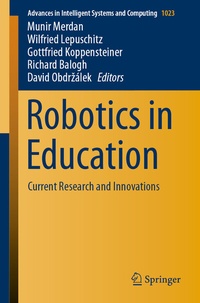
Robotics in Education
Description

This proceedings book gathers the latest achievements and trends in research and development in educational robotics from the 10th International Conference on Robotics in Education (RiE), held in Vienna, Austria, on April 10-12, 2019. It offers valuable methodologies and tools for robotics in education that encourage learning in the fields of science, technology, engineering, arts and mathematics (STEAM) through the design, creation and programming of tangible artifacts for creating personally meaningful objects and addressing real-world societal needs. It also discusses the introduction of technologies ranging from robotics platforms to programming environments and languages and presents extensive evaluations that highlight the impact of robotics on students' interests and competence development. The approaches included cover the entire educative range, from the elementary school to the university level in both formal and informal settings.
More details
Other editions
Additional editions
Content
- Intro
- Preface
- Organization
- Committee
- Co-chairpersons
- International Program Committee
- Local Conference Organization
- Sponsor
- Contents
- Comprehensive View on Educational Robotics
- On Measuring Engagement Level During Child-Robot Interaction in Education
- Abstract
- 1 Introduction
- 2 Measuring Engagement Levels
- 2.1 Typical Education
- 2.2 Special Education
- 3 Discussion
- 4 Conclusions
- Acknowledgment
- References
- The Effect of Commercially Available Educational Robotics: A Systematic Review
- Abstract
- 1 Introduction
- 2 Method
- 2.1 Planning the Review
- 2.2 Conduction of the Review
- 3 Results
- 4 Discussion
- 4.1 The Effect of the Different Educational Robotics Products
- 4.2 How the Studies Were Designed and Conducted
- 4.3 Recommendations
- 4.4 Future Directions and Limitations
- 5 Conclusion
- References
- Workshops, Curricula and Related Aspects
- On the Use of Robotics for the Development of Computational Thinking in Kindergarten: Educational Intervention and Evaluation
- Abstract
- 1 Introduction - Computational Thinking: A 21st Century Skill
- 2 Materials and Methods
- 3 Design and Implementation of the Educational Intervention
- 3.1 Objectives, Background, Outline and Sample
- 3.2 The Pre- and Post-tests to Assess the Level of CT Skills
- 3.3 The Two Central Stages of the Intervention
- 4 Evaluation Results
- 5 Conclusions - Further Research
- References
- "CREA": An Inquiry-Based Methodology to Teach Robotics to Children
- Abstract
- 1 Introduction
- 2 The Framework
- 2.1 Tools
- 2.2 "CREA" - The Methodology to Teach Programming to Children
- 3 Methodology
- 4 Results
- 5 Discussion and Conclusion
- References
- Educational Robotics in Kindergarten, a Case Study
- Abstract
- 1 Introduction
- 1.1 ?ee?ot
- 1.2 School Background
- 1.3 Educational Approaches and Methodology
- 1.4 Teaching Experiment
- 2 Experimental Programming Activities
- 2.1 Meeting ?eeBot
- 2.2 STEM Activities with the Traditional Song Feggaraki
- 2.3 Creation of Floor/Track Inspired by the Krifo Scholio Story
- 2.4 Routes
- 2.5 Playing Music with Boomwhackers
- 2.6 Creation of Coded Track and Routes with BEEBOT Following the Notes of the Song
- 3 Discussion - Conclusions
- References
- Comparison of LEGO WeDo 2.0 Robotic Models in Two Different Grades of Elementary School
- Abstract
- 1 Introduction
- 2 Methodology
- 3 Hello Robot - First Activity with LEGO WeDo 2.0
- 3.1 Activity Goals
- 3.2 The Course of the Activity
- 4 Comparison of First Robotic Models Creation in 3rd and 4th Grade
- 4.1 Construction of a Robotic Model According to the Pupils' Fantasy
- 4.2 Programming of the Robotic Model
- 4.3 Presentation of the Robotic Model
- 5 Discussion
- 6 Conclusion
- Acknowledgement
- References
- STEAM Robotic Puzzles to Teach in Primary School. A Sustainable City Project Case
- Abstract
- 1 Introduction
- 1.1 Educational Robotics and Curricula
- 1.2 Educational Robotics and Low-Cost Platforms
- 1.3 Educational Robotics Board
- 1.4 Goal of the Paper
- 2 Previous Works. Spanish STEAM Curricula
- 3 Design of Intervention Proposal
- 3.1 Contents
- 4 Methodology
- 4.1 Presentation of the Project
- 4.2 Cooperative Puzzle
- 4.3 Final Product Presentation
- 5 Materials and Resources
- 5.1 Virtual Learning Environment
- 5.2 Robotics Kit
- 6 Conclusions and Future Work
- References
- STEAM Approach to Autonomous Robotics Curriculum for High School Using the Robobo Robot
- Abstract
- 1 Introduction
- 2 Robobo: The Next Generation of Educational Robots
- 3 STEAM Curriculum for Autonomous Robotics
- 4 Teaching Unit Examples
- 5 Conclusions
- Acknowledgements
- References
- Design and Analysis of a Robotics Day Event to Encourage the Uptake of a Career in STEM Fields to Pre-GCSE Students
- 1 Introduction
- 1.1 Constructivism and Constructionism
- 1.2 Bloom's Taxonomy
- 1.3 Novelty of Paper
- 2 Method
- 2.1 Part A - Introduction to Robotics
- 2.2 Part B - Group Project
- 2.3 Part C - Keynote Speaker
- 3 Results and Discussion
- 4 Conclusion
- 4.1 Future Work
- References
- Robotics Education To and Through College
- 1 Introduction
- 2 Robotic Platform
- 3 Curriculum
- 3.1 Engineering Design Process
- 3.2 Mechanical/Electrical Engineering
- 3.3 Controls
- 3.4 Programming
- 4 Survey Results
- 4.1 Summer Youth Programs 2017 Results
- 4.2 Spring 2018 Autonomous Systems Results
- 5 Observations and Lessons Learned
- References
- Technological Literacy Through Outreach with Educational Robotics
- Abstract
- 1 Introduction
- 2 Related Work
- 3 Outreach with Educational Robotics
- 3.1 Activity Block: Lecture About Robots
- 3.2 Activity Block: Explore a Robot
- 3.3 Activity Block: Innovation Lab
- 3.4 Activity Block: Interaction with a Humanoid Robot
- 4 Evaluation Design
- 4.1 Quantitative Method
- 4.2 Findings
- 4.3 Qualitative Method
- 4.4 Evaluation Process
- 4.5 Results
- 5 Conclusion and Outlook
- Acknowledgements
- References
- Robotic Theater: An Architecture for Competency Based Learning
- 1 Introduction
- 2 Robotics and Education
- 3 Educational Model
- 4 Educational Model Application
- 4.1 First Educational Stage: Awareness
- 4.2 Second Educational Stage: Appropriation
- 4.3 Third Educational Stage: Impact
- 5 Quemes Robot and VEX Robotic Kit
- 5.1 VEX EDR Robotic Kit
- 6 ARDUBLOCK Programming Environment
- 7 RoboAct Software
- 8 Case of Study: Soacha, Zipaquirá and Girardot
- 9 Conclusion
- References
- First Steps in Teaching Robotics with Drones
- Abstract
- 1 Introduction
- 2 Literature Review
- 3 Educational Specifications
- 4 How to Teach Programming with the Airblock® Drone
- 4.1 Lesson and Method
- 4.2 Differentiation and Grading
- 5 Conclusion
- References
- Project-Based Learning Focused on Cross-Generational Challenges
- Abstract
- 1 Introduction
- 2 Project Activities
- 3 Analyzing Process
- 3.1 ICT Workshop
- 3.2 Innovation-Lab Workshop
- 4 Developing-Process
- 4.1 Cuddly Toy Robot for Seniors
- 4.2 Emergency Bracelet
- 4.3 "Unconscious Recognition" System
- 4.4 Yeet-Bot for Children
- 5 Testing Process
- 6 Impact of the Project
- 7 Conclusion
- Acknowledgements
- References
- Technologies for Educational Robotics
- A Generalized Matlab/ROS/Robotic Platform Framework for Teaching Robotics
- Abstract
- 1 Introduction
- 1.1 Goal of the Paper
- 2 Previous Works. An Educational Platform Based on Matlab/Simulink/Lego EV3
- 3 A Generalized Platform Based on Matlab/ROS/Robotic Platform
- 3.1 Linking Matlab-ROS
- 3.2 Linking Matlab-ROS-Robot
- 4 Testing the Platform with an Educational Application
- 5 Conclusions
- References
- Turtlebot 3 as a Robotics Education Platform
- 1 Introduction
- 2 Hardware Overview
- 3 Software Overview
- 4 Example Use Case: Mobile Robotics Exercise Sessions
- 5 Example Use Case: Embedded Control Systems Experience
- 6 Evaluation of Learning Outcomes
- 6.1 Mobile Robotics
- 6.2 Embedded Control Systems
- 7 Conclusion
- References
- SLIM - A Scalable and Lightweight Indoor-Navigation MAV as Research and Education Platform
- 1 Introduction
- 2 Related Work
- 3 The SLIM
- 3.1 Design-Aspects and Constraints of the Physical MAV-Setup
- 3.2 Modelling and Control of the MAV
- 3.3 Design of the Software Framework
- 3.4 Architectural Overview and Utilized Methods
- 4 Use Cases in Research and Education
- 5 Conclusion and Future Work
- References
- An Open Solution for a Low-Cost Educational Toy
- Abstract
- 1 Introduction and Related Work
- 2 Organization
- 3 2D and 3D Modelling
- 4 Introduction to Arduino Platform
- 5 Building Otto
- 5.1 Powering and Wiring the System
- 6 Open Software Framework
- 6.1 Calibration
- 6.2 Bluetooth Communication
- 6.3 Playing Melodies in the Background
- 6.4 Choreographies
- 6.5 Starting Programs Using Ultrasonic Sensor
- 6.6 Controlling the Robot with Android Devices
- 7 Example Choreographies
- 8 Framework Scalability
- 8.1 Multiple Arduino Units
- 9 Makers Movement in Educational Process
- 10 Future Directions and Conclusions
- References
- Environment Virtualization for Visual Localization and Mapping
- 1 Introduction
- 2 Learning Contents
- 2.1 Visual Mapping and Localization
- 3 Vision System
- 4 Visual Environment Generation
- 4.1 Virtual Objects
- 4.2 Virtual Layout
- 4.3 Virtual Images
- 4.4 Virtual Output
- 4.5 Assessment
- 5 Conclusions
- References
- Programming a Humanoid Robot with the Scratch Language
- 1 Introduction
- 2 Current Architecture
- 2.1 Kaspar
- 2.2 Scratch Programming Language
- 3 The Scratch Front-End Architecture
- 3.1 Scratch Interface
- 3.2 JavaScript
- 3.3 The API (Spring)
- 4 User Evaluation Study
- 4.1 Ethics Statement
- 4.2 Study
- 4.3 Results
- 5 Discussion
- 6 Conclusions
- 7 Future Work
- References
- Integrating Robotics with School Subjects
- Bringing an Educational Robot into a Basic Education Math Lesson
- Abstract
- 1 Introduction
- 2 Study of Robot-Supported Math Lessons
- 2.1 The Design of the Study
- 2.2 Results
- 3 Conclusions and Discussion
- 3.1 Conclusions
- 3.2 Limitations
- 3.3 Further Developments
- Acknowledgments
- References
- Inviting Teachers to Use Educational Robotics to Foster Mathematical Problem-Solving
- 1 Introduction
- 2 Context
- 3 First Challenge
- 4 Second Challenge
- 5 Third Challenge
- 6 Conclusion
- References
- Integrating Mathematics and Educational Robotics: Simple Motion Planning
- 1 Introduction
- 2 Navigation Framework and Primitives
- 3 Horizontal and Vertical Navigation
- 4 Generalized Navigation
- 5 Empirical Results
- 6 Conclusion
- References
- Learning Symmetry with Tangible Robots
- 1 Introduction
- 2 Related Work
- 2.1 Robots in Education
- 2.2 Tangibles and Haptics for Learning
- 3 System Description
- 4 Design of the Activities
- 4.1 Paper Posters
- 4.2 Interaction Design
- 5 Research Hypothesis
- 6 Case Study
- 6.1 Participants and Apparatus
- 6.2 Activities
- 7 Results
- 7.1 Assessment of Collaboration
- 7.2 Bonus Activity
- 8 Discussion
- 9 Conclusions and Future Works
- References
- Lessons from Delivering a STEM Workshop Using Educational Robots Given Language Limitations
- 1 Introduction
- 2 Methods
- 2.1 Thymio Specifications
- 2.2 Description of Workshop
- 2.3 Questionnaire
- 3 Results
- 4 Discussion
- 5 Conclusion and Future Work
- References
- Using Robots as an Educational Tool in Native Language Lesson
- Abstract
- 1 Introduction
- 2 Methodology
- 3 Results
- 4 Conclusion
- Acknowledgment
- References
- Robotics Competitions
- Educational Robotics Competitions and Involved Methodological Aspects
- Abstract
- 1 Introduction
- 2 Robotex Cyprus 2018 Competition
- 3 Common Robotics Competition Challenges
- 3.1 Line Following
- 3.2 Maze Solving
- 3.3 Mini Sumo
- 4 Application of the Engineering Design Approach
- 5 Practical Competition Robot Design Issues
- 6 Algorithmic Control Procedures and Flowchart Representations
- 6.1 Basic Algorithms for Line Following
- 6.2 Basic Algorithms for Standard Maze Solving
- 7 Conclusions
- References
- Participants' Perceptions About Their Learning with FIRST LEGO® League Competition - a Gender Study
- Abstract
- 1 Introduction
- 2 Theoretical Background
- 2.1 Educational Robotics Competitions' Impact on Students' Learning
- 2.2 Gender Differences Observed in Educational Robotics Competitions
- 3 Methodology
- 3.1 Research Questions
- 3.2 Context and Sample
- 3.3 Research Instruments
- 3.4 Results and Discussion
- 4 Conclusions
- Acknowledgements
- References
- Young Roboticists' Challenge - Future with Social Robots - World Robot Summit's Approach: Preliminary Investigation
- Abstract
- 1 Introduction
- 2 Motivation
- 3 Junior School Robot Challenge
- 4 The Study
- 4.1 The Competition
- 4.2 The Workshop
- 4.3 Participants
- 4.4 Programming Experience
- 4.5 Competition Performance
- 5 Conclusion and Next Step
- References
- Evolution of Educational Robotics in Supplementary Education of Children
- 1 Introduction
- 2 Project Activities in Engineering Education of Schoolchildren
- 3 Eurobot Competition Retrospection
- 4 Evolution of Tools for Technical Education
- 5 Conclusion
- References
- Robot League - A Unique On-Line Robotics Competition
- 1 Introduction
- 2 Robot League
- 2.1 Organization
- 2.2 About the Rules
- 2.3 Tasks Classification
- 2.4 Example Tasks
- 2.5 Supporting Software
- 3 Discussion
- 4 Conclusions
- References
- Autonomous Driving Car Competition
- Abstract
- 1 Introduction
- 2 The Autonomous Driving Contest
- 3 Mathematical Model
- 4 The Design Autonomous Robot
- 5 The Adopted Vision System
- 6 Example of Lane Lines Recognition Algorithm
- 7 Conclusions and Future Work
- Acknowledgment
- References
- Cross Topics in Educational Robotics
- Cross-Age Mentoring to Educate High-School Students in Digital Design and Production
- Abstract
- 1 Introduction
- 2 Theoretical Background
- 3 Study Frameworks
- 4 Findings
- 5 Discussion and Conclusions
- References
- Robot Tutors: Welcome or Ethically Questionable?
- Abstract
- 1 Introduction
- 1.1 Moral Conceptions Regarding Robot Tutors
- 2 Methodology
- 2.1 Selection Procedure
- 2.2 Data Analysis
- 3 Results and Discussion
- 3.1 Values Attributed to the Introduction of Robot Tutors
- 4 Future Research
- References
- Teaching Robotics with a Simulator Environment Developed for the Autonomous Driving Competition
- 1 Introduction
- 2 Autonomous Driving Competition
- 3 Autonomous Driving Simulator
- 3.1 Simulator Engine: MORSE
- 3.2 Autonomous Driving Competition Simulation Scenario
- 3.3 Game Engine - Logic Bricks
- 3.4 Physics
- 3.5 Simulation Builder
- 4 Teaching Robotics with the Autonomous Driving Simulator
- 4.1 Image Processing
- 4.2 Motion Control - Lane Following
- 4.3 Deep Learning - Crosswalk Identification with YOLOv2
- 5 Conclusion
- References
- User-Driven Design of Robot Costume for Child-Robot Interactions Among Children with Cognitive Impairment
- 1 Introduction
- 2 Incorporating Arts and Psychology in Social Robots
- 3 Design of Robot's Costume
- 3.1 Costume Design Criteria
- 3.2 Costume Design Process
- 4 Selection of Robot Costume for Child-Robot Interaction
- 5 Conclusion and Future Work
- References
- Setup of a Temporary Makerspace for Children at University: MAKER DAYS for Kids 2018
- Abstract
- 1 Introduction
- 2 Theoretical Foundation
- 3 Austrian Proof-of-Concept: MAKER DAYS for Kids 2018
- 3.1 Room Design and Rules
- 3.2 Workshops and Tools
- 3.3 Evaluation of Activities in an Open Teaching and Learning Setting
- 4 Results
- 5 Conclusion
- Acknowledgement
- References
- The Uncanny Valley of the Virtual (Animal) Robot
- Abstract
- 1 Introduction
- 2 Methods
- 2.1 Survey Procedure
- 2.2 Participants
- 2.3 Stimulus
- 3 Results
- 4 Discussion
- 5 Future Work
- 5.1 Applications for the Human-(Animal) Robot Interaction as Tutorial Agents
- 5.2 Virtual Animal Robots in Serious Games and Virtual Reality
- 5.3 Simulation Robot Labs: Virtual Animals
- 5.4 Interactive Robotic Avatars with Real-Time Facial Animation
- 6 Conclusion
- Acknowledgements
- References
- Cyber-Physical System Security: Position Spoofing in a Class Project on Autonomous Vehicles
- 1 Introduction
- 1.1 Course and Project Objectives
- 2 Local Positioning System
- 2.1 AprilTag
- 2.2 System Description
- 2.3 Vehicle Design
- 3 Spoofing Experiment
- 3.1 Student Reactions
- 4 Lessons Learned
- 4.1 Future Work
- References
- Author Index
