

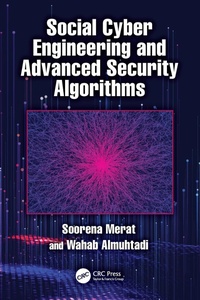
Social Cyber Engineering and Advanced Security Algorithms
1st Edition
Published on 30. May 2025
382 pages
978-1-040-34806-2 (ISBN)
Description

This book takes readers on a captivating journey through the history of social engineering, tracing its evolution from the mechanical marvels of the clockwork era and the rise of automata to the modern age of artificial intelligence and the looming dawn of quantum computing. It explores how social engineering tactics have adapted alongside technological advancements, exploiting human psychology and vulnerabilities across every era.
Social Cyber Engineering and Advanced Security Algorithms delves into the intricate connections between human behavior, evolving technology, and the ever-changing landscape of cybersecurity. It examines how personal and psychological factors can be exploited in cyberattacks, providing real-world examples and case studies to illustrate these vulnerabilities. Beyond highlighting the challenges, the book offers proactive strategies and potential solutions for organizations and policymakers to navigate this complex terrain. It emphasizes the importance of algorithmic resilience in employee categorization and training and explores the transformative potential of quantum computing in bridging mental health and cybersecurity.
This book serves as a guide for computer scientists, engineers, and professionals interested in understanding the intricate relationship between human behavior, technology, and security in the digital age. It offers a unique perspective on the past, present, and future of social engineering, providing valuable insights for anyone seeking to build a more secure and resilient digital world.
Social Cyber Engineering and Advanced Security Algorithms delves into the intricate connections between human behavior, evolving technology, and the ever-changing landscape of cybersecurity. It examines how personal and psychological factors can be exploited in cyberattacks, providing real-world examples and case studies to illustrate these vulnerabilities. Beyond highlighting the challenges, the book offers proactive strategies and potential solutions for organizations and policymakers to navigate this complex terrain. It emphasizes the importance of algorithmic resilience in employee categorization and training and explores the transformative potential of quantum computing in bridging mental health and cybersecurity.
This book serves as a guide for computer scientists, engineers, and professionals interested in understanding the intricate relationship between human behavior, technology, and security in the digital age. It offers a unique perspective on the past, present, and future of social engineering, providing valuable insights for anyone seeking to build a more secure and resilient digital world.
More details
Edition
1. Auflage
Language
English
Place of publication
London
United Kingdom
Publishing group
Taylor & Francis Ltd
Target group
Professional and scholarly
College/higher education
Illustrations
21 Halftones, color; 21 Illustrations, color
File size
17,44 MB
ISBN-13
978-1-040-34806-2 (9781040348062)
Copyright in bibliographic data and cover images is held by Nielsen Book Services Limited or by the publishers or by their respective licensors: all rights reserved.
Schweitzer Classification
Other editions
Additional editions
Soorena Merat | Wahab Almuhtadi
Social Cyber Engineering and Advanced Security Algorithms
Book
05/2025
1st Edition
CRC Press
€206.40
Shipment within 10-20 days
Persons
Soorena Merat is the Chief Cyber Security Officer at Silkatech Consulting Engineers Inc. With over three decades of experience in the technology industry, Dr. Merat brings unwavering commitment and a deep understanding of the ever-shifting cybersecurity landscape. His research focuses on the fascinating intersection of bioneural systems, artificial intelligence, and social cyber engineering. Dr. Merat's work delves into the intricate dynamics of human behavior within technological environments, exploring how vulnerabilities emerge and how they can be proactively addressed. He is particularly interested in developing predictive models that identify potential weaknesses in systems and generating actionable recommendations for enhanced security controls. This research combines insights from neuroscience, cognitive psychology, and computer science to create a more holistic approach to cybersecurity. Driven by a passion for innovation and a commitment to excellence, Dr. Merat's journey in the tech industry is marked by a continuous pursuit of knowledge. He remains at the forefront of advancements in the field, ensuring that his expertise and insights contribute to a safer and more secure digital world.
Dr. Wahab Almuhtadi has over 33 years of industry experience, concurrently over 27 years of university teaching experience. He is Professor/Coordinator of "Optical Systems and Sensors" Program, Algonquin College/Carleton University, Canada. He is Research Council Member, Digital Research Alliance of Canada. Previously, he was Senior System Engineer at Nortel, Optical Solutions R&D. With his professional background, he demonstrated outstanding leadership establishing Applied Research with $10.5M fund that fostered Algonquin College to become Polytechnic Institution. He is the founder of the $6 million cutting-edge Optophotonics Lab (Optical Communications Network) 200Gbps. He is one of the founders of Ontario's Centre of Excellence in Next Generation Networks (CENGN) with $65 million in funding. His expertise is in photonics, optical systems and sensors, optical communications, and wireless. He has published several technical papers and books. He received several awards from IEEE, academia, and industry, e.g., 2010 IEEE Leadership Award, 2015 IEEE Canada W.R. Service Award, 2009 Laurent Isabelle Teaching Excellence, 2006 NISOD Award, and 2015 Canadian Pacific Railway Engineering Medal, Engineering Institute of Canada-EIC. He is P.Eng. and EIC Fellow. Dr. Almuhtadi is actively involved in IEEE for over 29 years serving in many executive level posts across IEEE. He is also currently the President-Elect/Director-Elect (2024-2025) of IEEE Canada/Region 7. IEEE President of IEEE Consumer Technology Society (CTSoc).
Dr. Wahab Almuhtadi has over 33 years of industry experience, concurrently over 27 years of university teaching experience. He is Professor/Coordinator of "Optical Systems and Sensors" Program, Algonquin College/Carleton University, Canada. He is Research Council Member, Digital Research Alliance of Canada. Previously, he was Senior System Engineer at Nortel, Optical Solutions R&D. With his professional background, he demonstrated outstanding leadership establishing Applied Research with $10.5M fund that fostered Algonquin College to become Polytechnic Institution. He is the founder of the $6 million cutting-edge Optophotonics Lab (Optical Communications Network) 200Gbps. He is one of the founders of Ontario's Centre of Excellence in Next Generation Networks (CENGN) with $65 million in funding. His expertise is in photonics, optical systems and sensors, optical communications, and wireless. He has published several technical papers and books. He received several awards from IEEE, academia, and industry, e.g., 2010 IEEE Leadership Award, 2015 IEEE Canada W.R. Service Award, 2009 Laurent Isabelle Teaching Excellence, 2006 NISOD Award, and 2015 Canadian Pacific Railway Engineering Medal, Engineering Institute of Canada-EIC. He is P.Eng. and EIC Fellow. Dr. Almuhtadi is actively involved in IEEE for over 29 years serving in many executive level posts across IEEE. He is also currently the President-Elect/Director-Elect (2024-2025) of IEEE Canada/Region 7. IEEE President of IEEE Consumer Technology Society (CTSoc).
Content
Chapter 1 Personal Security in the Era of Mechanical Marvels: A Historical Perspective
Chapter 2 Individual Cybersecurity in the Era of Digital Computing and the Internet
Chapter 3 Individual Security in the Era of Algorithmic and Artificial Intelligence Advancements
Chapter 4 Algorithmic Insights into the Nexus of Interpersonal Mental Challenges and Social Engineering
Chapter 5 Quantum Breakthrough: Revolutionizing the Historical Challenge of Social Cyber Engineering
Chapter 6 Influence of Multitasking on the Rise of Social Engineering Attacks
Chapter 7 Influence of Surveillance on the Rise of Social Engineering Attacks
Chapter 8 Influence of Cannabis and Drugs on the Rise of Social Engineering Attacks
Chapter 9 Influence of Aging on the Rise of Social Engineering Attacks
Chapter 10 Influence of Depression and Anxiety on the Rise of Social Engineering Attacks
Chapter 11 Influence of Sleep and Sleep Disorder on the Rise of Social Engineering Attacks
Chapter 12 Influence of Bipolar Disorder on the Rise of Social Engineering Attacks
Chapter 13 Influence of Alzheimer's, Dementia, and PTSD on the Rise of Social Engineering Attacks
Chapter 14 Influence of Pandemic on the Rise of Social Engineering Attacks
Chapter 15 Impacts of Discrimination in Cyber Social Engineering Systems
Chapter 16 Mind Games in the Digital Playground: The Rising Threat of Social Engineering in Online Gaming and the Technological Challenges in Detection
Chapter 17 Digital Surveillance and Trust Erosion
Chapter 18 Virtual Reality and Its Impact on Social Trust
Chapter 19 Augmented Reality and Its Impact on Social and Interpersonal Trust
Chapter 20 Navigating the Intersection of Digital Marketing, Intelligent Advertising with Interpersonal Trust
Chapter 21 Cryptocurrency Markets and Interpersonal Trust, Escalating Social Engineering Risks, and the Technological Challenges in Detection
Chapter 22 A Brief Overview of the Benefits of Implementing Quantum Algorithms in Factorizing Cyber Social Engineering Threats
Chapter 23 A Brief Overview of the Benefits of Implementing Quantum Applications in Factorizing Cyber Social Engineering Threats
Chapter 24 Introduction to Hybrid Structures of the Quantum Probability Theory in Social Engineering
Chapter 25 Introduction to the Quantum Structures of the Fuzzy Set in Cyber Social Engineering Systems
Chapter 26 Introduction to Quantum Logic and Automata Theory in Cyber Social Engineering Systems
Chapter 27 Introduction to Quantum Parallelism and Classical Computation in Cyber Social Engineering Systems
Chapter 2 Individual Cybersecurity in the Era of Digital Computing and the Internet
Chapter 3 Individual Security in the Era of Algorithmic and Artificial Intelligence Advancements
Chapter 4 Algorithmic Insights into the Nexus of Interpersonal Mental Challenges and Social Engineering
Chapter 5 Quantum Breakthrough: Revolutionizing the Historical Challenge of Social Cyber Engineering
Chapter 6 Influence of Multitasking on the Rise of Social Engineering Attacks
Chapter 7 Influence of Surveillance on the Rise of Social Engineering Attacks
Chapter 8 Influence of Cannabis and Drugs on the Rise of Social Engineering Attacks
Chapter 9 Influence of Aging on the Rise of Social Engineering Attacks
Chapter 10 Influence of Depression and Anxiety on the Rise of Social Engineering Attacks
Chapter 11 Influence of Sleep and Sleep Disorder on the Rise of Social Engineering Attacks
Chapter 12 Influence of Bipolar Disorder on the Rise of Social Engineering Attacks
Chapter 13 Influence of Alzheimer's, Dementia, and PTSD on the Rise of Social Engineering Attacks
Chapter 14 Influence of Pandemic on the Rise of Social Engineering Attacks
Chapter 15 Impacts of Discrimination in Cyber Social Engineering Systems
Chapter 16 Mind Games in the Digital Playground: The Rising Threat of Social Engineering in Online Gaming and the Technological Challenges in Detection
Chapter 17 Digital Surveillance and Trust Erosion
Chapter 18 Virtual Reality and Its Impact on Social Trust
Chapter 19 Augmented Reality and Its Impact on Social and Interpersonal Trust
Chapter 20 Navigating the Intersection of Digital Marketing, Intelligent Advertising with Interpersonal Trust
Chapter 21 Cryptocurrency Markets and Interpersonal Trust, Escalating Social Engineering Risks, and the Technological Challenges in Detection
Chapter 22 A Brief Overview of the Benefits of Implementing Quantum Algorithms in Factorizing Cyber Social Engineering Threats
Chapter 23 A Brief Overview of the Benefits of Implementing Quantum Applications in Factorizing Cyber Social Engineering Threats
Chapter 24 Introduction to Hybrid Structures of the Quantum Probability Theory in Social Engineering
Chapter 25 Introduction to the Quantum Structures of the Fuzzy Set in Cyber Social Engineering Systems
Chapter 26 Introduction to Quantum Logic and Automata Theory in Cyber Social Engineering Systems
Chapter 27 Introduction to Quantum Parallelism and Classical Computation in Cyber Social Engineering Systems
