

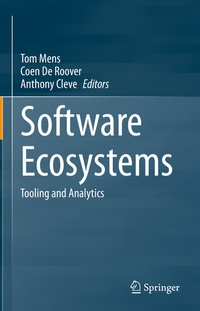
Software Ecosystems
Description

The book starts with an introductory chapter that provides a historical account of the origins of software ecosystems. It provides the necessary context about the domain of software ecosystems by highlighting its different perspectives, definitions, and representations. It also exemplifies the variety of software ecosystems that have emerged during the previous decades. The remaining book is composed of five parts: Part I contains two chapters on software ecosystem representations, Part II two chapters that focus on complementary ways and techniques of analyzing software ecosystems. Next, Part III includes two chapters that focus on aspects related to the evolution within software ecosystems, while Part IV looks at workflow automation and infrastructure-as-code ecosystems. Finally, Part V focuses on ecosystems for software modeling and for data-intensive software.
This book is intended for researchers and practitioners interested in data mining, tooling, and empirical analysis of software ecosystems. The reader will appreciate chapters that cover a wide spectrum of social and technical aspects of software ecosystems, each including an overview of the state of the art.
Chapter 2 The Software Heritage Open Science Ecosystem is available open access under a Creative Commons Attribution 4.0 International License via link.springer.com.
More details
Other editions
Additional editions
Persons
Coen de Roover is a professor at the Software Languages Lab of the Vrije Universiteit Brussel in Belgium. The central theme of his research is the design of program analyses, and their application to problems in software quality.
Anthony Cleve is a full professor and member of the PReCISE research center and of the Namur Digital Institute at University of Namur in Belgium. His main research interests include information system maintenance and evolution, software and data reverse engineering, program analysis and transformation, and self-adaptive and context-aware systems.
