

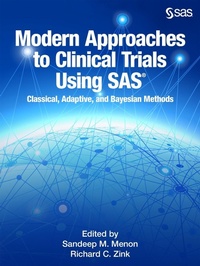
Modern Approaches to Clinical Trials Using SAS: Classical, Adaptive, and Bayesian Methods
Classical, Adaptive, and Bayesian Methods
Published on 9. December 2015
364 pages
978-1-62960-084-0 (ISBN)
Description

Get the tools you need to use SAS® in clinical trial design!
Unique and multifaceted, Modern Approaches to Clinical Trials Using SAS: Classical, Adaptive, and Bayesian Methods, edited by Sandeep M. Menon and Richard C. Zink, thoroughly covers several domains of modern clinical trial design: classical, group sequential, adaptive, and Bayesian methods that are applicable to and widely used in various phases of pharmaceutical development. Written for biostatisticians, pharmacometricians, clinical developers, and statistical programmers involved in the design, analysis, and interpretation of clinical trials, as well as students in graduate and postgraduate programs in statistics or biostatistics, the book touches on a wide variety of topics, including dose-response and dose-escalation designs; sequential methods to stop trials early for overwhelming efficacy, safety, or futility; Bayesian designs that incorporate historical data; adaptive sample size re-estimation; adaptive randomization to allocate subjects to more effective treatments; and population enrichment designs. Methods are illustrated using clinical trials from diverse therapeutic areas, including dermatology, endocrinology, infectious disease, neurology, oncology, and rheumatology. Individual chapters are authored by renowned contributors, experts, and key opinion leaders from the pharmaceutical/medical device industry or academia. Numerous real-world examples and sample SAS code enable users to readily apply novel clinical trial design and analysis methodologies in practice.
More details
Other editions
Additional editions
Sandeep Menon | Richard C. Zink
Modern Approaches to Clinical Trials Using SAS
Classical, Adaptive, and Bayesian Methods
Book
12/2015
SAS Institute
€73.30
Shipment within 3-4 weeks
Content
- Intro
- Contents
- Foreword
- About This Book
- Purpose
- Is This Book for You?
- Prerequisites
- About the Examples
- Software Used to Develop the Book's Content
- Example Code and Data
- Output and Graphics Used in This Book
- Additional Resources
- Keep in Touch
- About the Authors
- Acknowledgments
- Overview of Clinical Trials in Support of Drug Development
- 1.1 Introduction
- 1.2 Evolution of Clinical Trials and the Emergence of Guidance Documents
- 1.3 Emergence of Group Sequential Designs in the 70s and 80s
- 1.4 Emergence of Adaptive Designs in the 90s
- 1.5 Widespread Research on Adaptive Designs Since the Turn of the 21st Century
- 1.5.1 Early Phase Oncology Designs
- 1.5.2 Multiplicity in Adaptive Designs
- 1.5.3 Formation of the Adaptive Design Working Group
- 1.5.4 Opportunities in the Learning Phase
- 1.5.5 Software
- 1.6 Opportunities and Challenges in Designing, Conducting, and Analyzing Adaptive Trials
- 1.6.1 Logistics in Trial Execution
- 1.6.2 Open Research Questions
- 1.7 The Future of Adaptive Trials in Clinical Drug Development
- References
- Authors
- Designing and Monitoring Group Sequential Clinical Trials
- 2.1 Introduction
- 2.2 Examples of Classical Fixed-Sample Designs
- 2.3 Theories of Group Sequential Tests
- 2.3.1 General Framework
- 2.3.2 Normal Endpoint
- 2.3.3 Binomial Endpoint
- 2.3.4 Survival Endpoint
- 2.4 Types of Stopping Boundaries
- 2.4.1 Calculation of Stopping Boundaries
- 2.4.2 P-value or Haybittle-Peto Boundaries
- 2.4.3 Unified Family Boundaries
- 2.4.4 Spending Function Boundaries
- 2.5 Special Issues
- 2.6 Summary
- References
- Authors
- Sample Size Re-estimation
- 3.1 Introduction
- 3.1.1 Motivation. Why Sample Size Re-estimation?
- 3.1.2 Overview of Considerations and Issues
- 3.2 Blinded SSR Methods
- 3.3 Unblinded SSR Methods
- 3.3.1 Overview
- 3.3.2 Classification of Methods Used to Control Type I Error Rate
- 3.3.3 Methods Based on Combination Tests
- 3.3.4 Sample Size Re-estimation Based on Promising Zone
- 3.3.5 Methods Based on the Conditional Type I Error Principle
- 3.4 Information-Based Design
- 3.5 Summary and Conclusions
- References
- Authors
- Bayesian Survival Meta-Experimental Design Using Historical Data
- 4.1 Introduction
- 4.2 Meta Design Setting
- 4.2.1 Notation
- 4.2.2 Input Data for a Meta-Trial Design Variable
- 4.2.3 Input Historical Data
- 4.3 Meta-Regression Survival Models
- 4.3.1 Model for Future Survival Data
- 4.3.2 Model for Historical Survival Data
- 4.4 Bayesian Meta-Experimental Design
- 4.5 Specification of Prior Distributions
- 4.5.1 Fitting Priors
- 4.5.2 Sampling Priors
- 4.6 Computational Algorithms
- 4.6.1 Predictive Data Generation
- 4.6.2 Sampling from the Posterior Distributions
- 4.6.3 Power Calculation
- 4.7 SAS MACRO BSMED
- 4.7.1 Implementation of BSMED
- 4.7.2 Illustrative Examples
- 4.8 Summary
- References
- Authors
- Appendix
- Macro Call
- Inputs
- Output
- Running Time
- Continual Reassessment Methods
- 5.1 Dose Finding in Oncology
- 5.2 Continual Reassessment Method
- 5.3 Bayesian Model Averaging Continual Reassessment Method
- 5.4 Fractional Continual Reassessment Method
- 5.5 Time-to-Event Continual Reassessment Method
- 5.6 Summary
- References
- Authors
- Classical Dose-Response Study
- 6.1 Introduction
- 6.2 Statistical Design Considerations in a Classical Dose-Response Study
- 6.2.1 Dose-Response Relationship
- 6.2.2 Finding the Minimum Effective Dose
- 6.2.3 Determining the Dose Range to Study
- 6.2.4 Was the Concept Proven?
- 6.2.5 How to Space the Test Dosages
- 6.2.6 Number of Doses and Control Groups
- 6.2.7 Sample Size Considerations
- 6.2.8 Example of the Design Stage
- 6.3 Considerations in the Design and Final Analysis Stages
- 6.4 Analysis Examples Using Simulated Data
- 6.4.1 Brief Introduction to the Emax Model
- 6.4.2 Continuous Endpoint
- 6.4.3 Binary Endpoint
- 6.5 Summary
- References
- Authors
- Implementing the MCP-Mod Procedure for Dose-Response Testing and Estimation
- 7.1 Introduction
- 7.2 Methodology
- 7.2.1 Original MCP-Mod Approach
- 7.2.2 MCP-Mod for General Parametric Models
- 7.3 Considerations for MCP-Mod at the Design Stage
- 7.4 Further Considerations on MCP-Mod
- 7.5 Analysis Examples Using SAS
- 7.5.1 The optcont Macro
- 7.5.2 Example 1: biom Data with Normally Distributed Outcome and Model Selection
- 7.5.3 Example 2: neurodeg Data for Generalized MCP-Mod Approach with Model Averaging
- 7.6 Conclusions
- References
- Authors
- Appendix
- Appendix A
- Appendix B
- Appendix C
- Appendix D
- Bayesian Dose Response
- 8.1 Introduction and Background
- 8.2 Statistical Model for Bayesian Dose-Response
- 8.3 Analysis Examples for a Continuous Endpoint
- 8.3.1 Asthma Trial with 75 Patients Per Group
- 8.3.2 Asthma Trial with 100 Patients Per Group
- 8.4 Analysis Example for a Binary Endpoint
- 8.5 Summary
- References
- Authors
- Overview of Adaptive Randomization
- 9.1 Introduction
- 9.2 Simple Randomization
- 9.3 Restricted Randomization
- 9.3.1 Permuted Block Randomization
- 9.3.2 Biased Coin Design
- 9.4 Covariate-Adaptive Randomization
- 9.4.1 Stratified Randomization
- 9.4.2 Covariate-Adaptive Randomization by Minimization
- 9.4.3 Model-Based Optimal Covariate-Adaptive Randomization
- 9.5 Response-Adaptive Randomization
- 9.5.1 Play-the-Winner Rule
- 9.5.2 Randomized Play-the-Winner Rule
- 9.5.3 Optimal Adaptive Randomization
- 9.5.4 Bayesian Response-Adaptive Randomization
- 9.6 Summary
- References
- Authors
- Optimal Response-Adaptive Randomization Designs in Binary Outcome Clinical Trials
- 10.1 Introduction
- 10.1.1 Randomized Clinical Trials
- 10.1.2 Response-Adaptive Randomization
- 10.1.3 A Classification of Response-Adaptive Randomization Designs
- 10.1.4 Organization of This Chapter
- 10.2 Optimal Allocation
- 10.3 Response-Adaptive Randomization for Implementing Optimal Allocation
- 10.3.1 Preliminaries
- 10.3.2 Sequential Maximum Likelihood Estimation Design
- 10.3.3 Doubly Adaptive Biased Coin Design
- 10.3.4 Efficient Randomized-Adaptive Design
- 10.3.5 Theoretical Comparison of Various RAR Designs
- 10.4 Simulation of Optimal Response-Adaptive Randomization Procedures
- 10.4.1 Simulating a Single RAR Sequence
- 10.4.2 Operating Characteristics of RAR designs via Monte Carlo Simulation
- 10.5 Power and Sample Size for Response-Adaptive Randomization
- 10.6 Additional Considerations
- 10.6.1 More Than Two Treatments and Non-Binary Outcomes
- 10.6.2 Delayed Response
- 10.6.3 Misclassified Response
- 10.6.4 Time Trends
- 10.7 Examples
- 10.7.1 Redesigning a Real Clinical Trial
- 10.7.2 Implementing DBCD
- 10.8 Summary
- References
- Authors
- Population Enrichment Designs
- 11.1 Introduction
- 11.1.1 Background
- 11.1.2 Issues to Consider
- 11.2 Classical Designs
- 11.2.1 Retrospective Design
- 11.2.2 Prospective Design
- 11.3 Efficiency of Classical Enrichment Designs
- 11.4 Adaptive Enrichment Designs
- 11.4.1 Introduction
- 11.4.2 Frequentist Methods
- 11.4.3 Bayesian Methods
- 11.5 Summary
- References
- Authors
- Index
