

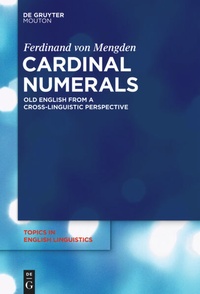
Cardinal Numerals
Description

The book embeds a description and an analysis of the Old English numeral system into a broader, cross-linguistic discussion. It provides a theoretical framework for the study of numerals and numeral systems of natural languages, bridging the gap between recent findings in the cognitive sciences on numeracy and the known typological generalisations on cardinal numerals.
The Old English numeral system shows a number of peculiarities not found in the present-day languages of Europe. Its detailed description is therefore an ideal locus for studying the features of linguistic number expressions in terms of their morpho-syntactic properties and of the structure of numeral systems.
The approach is innovative in that it combines a detailed analysis of the numeral system with the analysis of the grammatical properties of cardinal numerals. For the description of Old English, the study focuses on aspects of information structure and of referent identification in quantificational constructions. This leads to a novel perspective on the language-internal variation in the agreement patterns between numerals and quantified nouns, allowing the author to test and refine some long standing tenets in the study of numerals and to offer alternative explanations.
Rather than seeing numerals as a hybrid word class, the author argues that this variation in the morpho-syntactic behaviour follows identifiable patterns specific to the word class numeral. He accounts for these patterns by positing different, cross-linguistically uniform stages in the emergence of numeral systems, as well as varying degrees of discreteness of the quantified noun. Moreover, the author demonstrates that the constraints determining this variation in Old English have obvious parallels across languages.
Reviews / Votes
"This monograph is a major contribution to the literature on numerals andnumerical cognition. Its value will be in its rekindling of debates long leftdormant, and its integration of Germanic historical linguistics, syntax,semantics, and cognitive linguistics within a fascinating study of thisneglected lexical domain."Stephen Chrisomalis in: Linguist List 21.5213More details
Other editions
Additional editions
Person
Content
2 - Table of contents [Seite 7]
3 - Abbreviations [Seite 12]
4 - Introduction [Seite 15]
5 - Chapter I. Linguistic numeral systems [Seite 26]
6 - Chapter II. The numeral system of Old English [Seite 86]
7 - Chapter III. Complex numerals [Seite 143]
8 - Chapter IV. Numeral constructions in Old English [Seite 192]
9 - Chapter V. The word class 'cardinal numeral' [Seite 262]
10 - Concluding remarks [Seite 300]
11 - References [Seite 308]
12 - Subject index [Seite 334]
13 - Author index [Seite 341]
